VP of sales
Deal desk analyst
Finance business partner
General counsel
Chief revenue officer
Sales operations manager

This process is used when a sales deal involves terms that fall outside approved standard parameters, including non-standard pricing, excessive discounting, extended payment terms, custom contractual provisions, or bundled offerings that deviate from the standard catalog. It applies when deal desk or sales operations flags a deal for additional review before it can be finalized. It is triggered when a deal exceeds discount thresholds, includes non-standard legal terms, or requires executive authorization due to deal size or strategic significance. Ideal for enterprise sales, SaaS, professional services, and any environment where deal structures vary and require governance to protect margins and manage risk.
Sales representatives or account executives submit the deal for non-standard approval with supporting justification. Deal desk analysts review the deal structure against pricing policies and discounting guidelines. Finance business partners evaluate margin impact, revenue recognition, and payment term risk. Legal counsel reviews any non-standard contractual provisions such as liability, SLA commitments, or IP terms. Chief revenue officers or VPs of sales provide final authorization for deals exceeding defined thresholds.
Preserved deal velocity by routing non-standard reviews in parallel across deal desk, finance, and legal rather than sequentially. Clear deal governance with every exception, discount, and non-standard term traceable to who requested, reviewed, and authorized it. Reduced margin erosion by ensuring non-standard pricing and discounting receive finance review before commitment. Better risk management by routing deals with non-standard legal terms through legal counsel before execution.
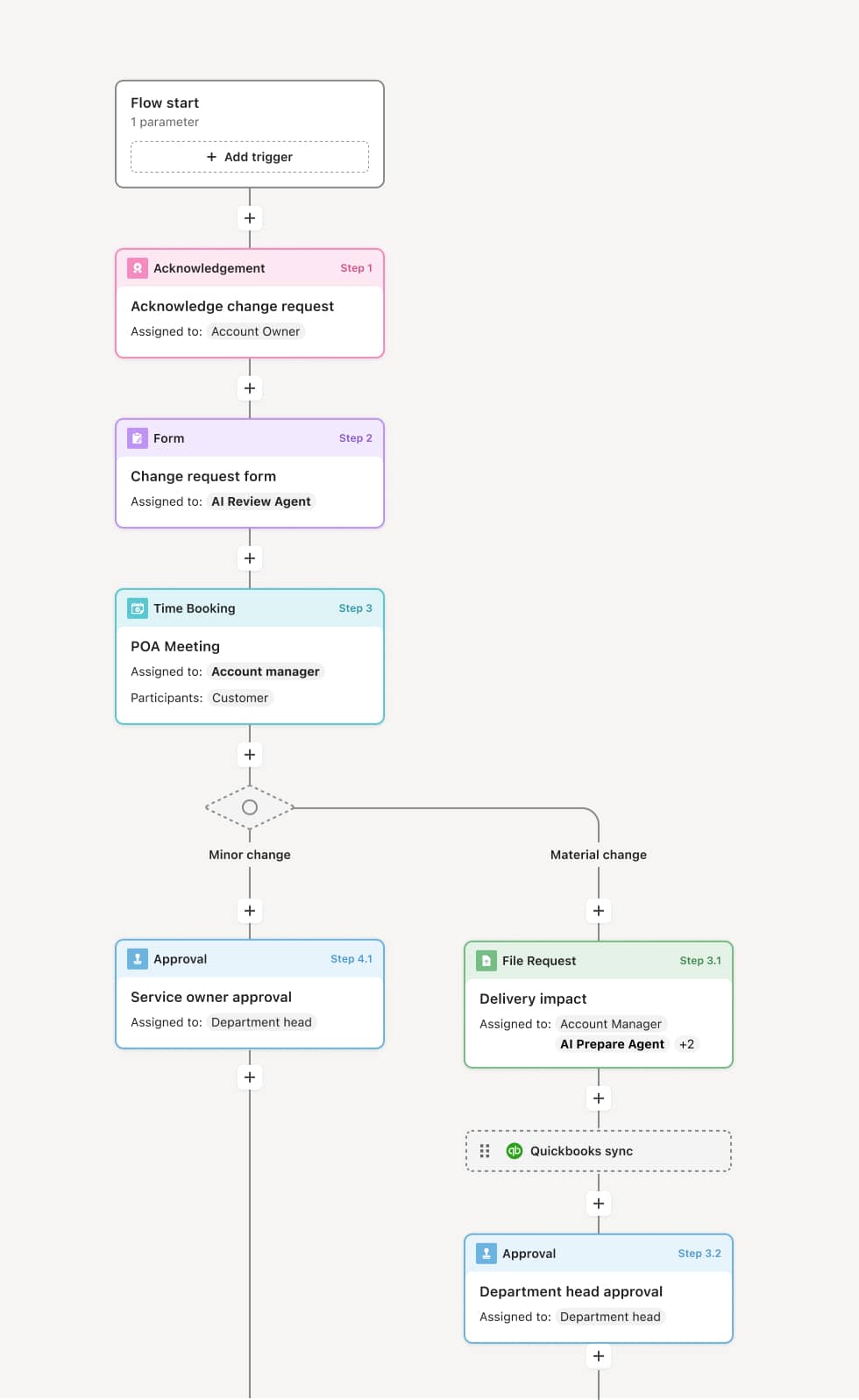
Your version of this process may vary based on roles, systems, data, and approval paths. Moxo’s flow builder can be configured with AI agents, conditional branching, dynamic data references, and sophisticated logic to match how your organization runs this workflow. The steps below illustrate one example.
Deal submission and exception identification
The process begins when a sales representative submits a deal that falls outside standard parameters. The submission includes the deal summary, proposed pricing, discount level, payment terms, contract modifications, and a business justification for the non-standard terms. An AI agent can validate the submission for completeness and identify which specific parameters trigger the non-standard review.
Deal desk evaluation
The deal desk analyst reviews the proposed deal structure against pricing policies, discounting guidelines, and historical precedent. This evaluation determines whether the non-standard terms are within acceptable ranges or require escalation to finance and legal. If the deviation is minor and within deal desk authority, the deal may be approved at this stage.
Finance review
For deals with significant pricing deviations, extended payment terms, or margin impact, the finance business partner evaluates the financial implications. This includes assessing the impact on margin, revenue recognition timing, cash flow, and any precedent the deal may set. If finance identifies unacceptable risk, the deal is returned to sales with specific guidance on acceptable parameters.
Legal review
If the deal includes non-standard contractual provisions such as modified liability caps, custom SLA commitments, or IP terms, legal counsel evaluates the risk. Legal may approve the terms, request modifications, or flag the deal for executive review. An AI agent can summarize the non-standard provisions and highlight deviations from standard contract language to accelerate legal review.
Executive authorization
For deals exceeding defined thresholds of deal value, discount depth, or contractual risk, the CRO or VP of sales provides final authorization. This reviewer evaluates the deal in the context of pipeline, strategic importance, and organizational precedent. The executive may approve, approve with conditions, or require renegotiation.
Approval confirmation and deal advancement
Upon approval, the sales representative and relevant operations teams are notified. The approved deal terms are documented, and the deal advances to contract execution, order processing, or implementation depending on the sales cycle stage.
This process commonly relies on inputs such as deal summaries, pricing proposals, discount requests, contract redlines, business justification memos, and margin analysis. It may be triggered by events like a deal exceeding discount thresholds in the CRM, a sales representative flagging non-standard terms, or deal desk identifying policy exceptions. Systems such as a CRM (Salesforce), a CPQ tool (Salesforce CPQ, DealHub), or an ERP (NetSuite) are commonly connected to provide deal data, pricing history, and financial context.
Key decision points include whether the non-standard terms fall within deal desk authority or require escalation, whether the margin impact and financial risk are acceptable to finance, whether non-standard contractual provisions create unacceptable legal risk, and whether the deal’s strategic value justifies the exceptions at the executive level.
Vague justification where sales submits non-standard deals without clear business rationale, causing reviewers to request additional context and extending the approval cycle. Sequential review delays where deal desk, finance, and legal review one at a time rather than in parallel, slowing down time-sensitive deals. Precedent creep where approved exceptions are not tracked, leading to gradual erosion of pricing discipline as similar exceptions are requested without governance. Disconnected CRM data where deal desk and finance review without current deal data from the CRM, resulting in approvals based on outdated or incomplete information.
Orchestrates non-standard deal review across deal desk, finance, legal, and executive sponsors within a single workflow, replacing the email chains and ad hoc escalations that slow deal approvals.
Routes reviews in parallel so that financial, legal, and commercial evaluation happen concurrently rather than sequentially, preserving deal velocity.
AI agents identify triggering exceptions and summarize non-standard terms for each reviewer, accelerating evaluation by highlighting the specific deviations that require attention.
Supports threshold-based escalation so that deals exceeding defined parameters automatically route to executive sponsors without manual triage.
Connects to CRM and CPQ systems to pull real-time deal data, pricing history, and discount benchmarks into the approval workflow, ensuring reviewers evaluate with current information.
Documents every approved exception within the workflow, building a structured record that supports pricing governance, precedent tracking, and audit readiness.