Hiring manager
HR business partner
Compensation analyst
Talent acquisition lead
VP of human resources
Finance business partner

This process is used when an employment offer needs to be reviewed and authorized before it is extended to a selected candidate. It applies when offers involve base salary, variable compensation, equity, signing bonuses, relocation, title, or other terms that must be validated against compensation bands, budget, and organizational policy. It is triggered after a candidate has been selected through the interview process and the hiring manager is ready to extend an offer. Ideal for organizations with structured compensation frameworks, multiple approval levels for senior hires, or environments where offer consistency and equity are closely managed.
Hiring managers submit the proposed offer including role, level, compensation, and any special terms. Talent acquisition leads coordinate the offer process and ensure all required approvals are obtained before the offer is extended. Compensation analysts validate the offer against compensation bands, internal equity, and market data. HR business partners review for policy compliance, headcount authorization, and organizational fit. Finance business partners confirm budget availability for the position. VPs of HR or executive sponsors authorize offers that exceed standard parameters or involve senior-level hires.
Faster time-to-offer by routing compensation, HR, and budget reviews in parallel rather than sequentially. Consistent offer governance with every compensation decision traceable to who proposed, reviewed, and authorized it. Fewer offer retractions by ensuring budget, equity, and policy compliance are confirmed before the offer is extended. Better candidate experience by reducing the time between candidate selection and formal offer delivery.
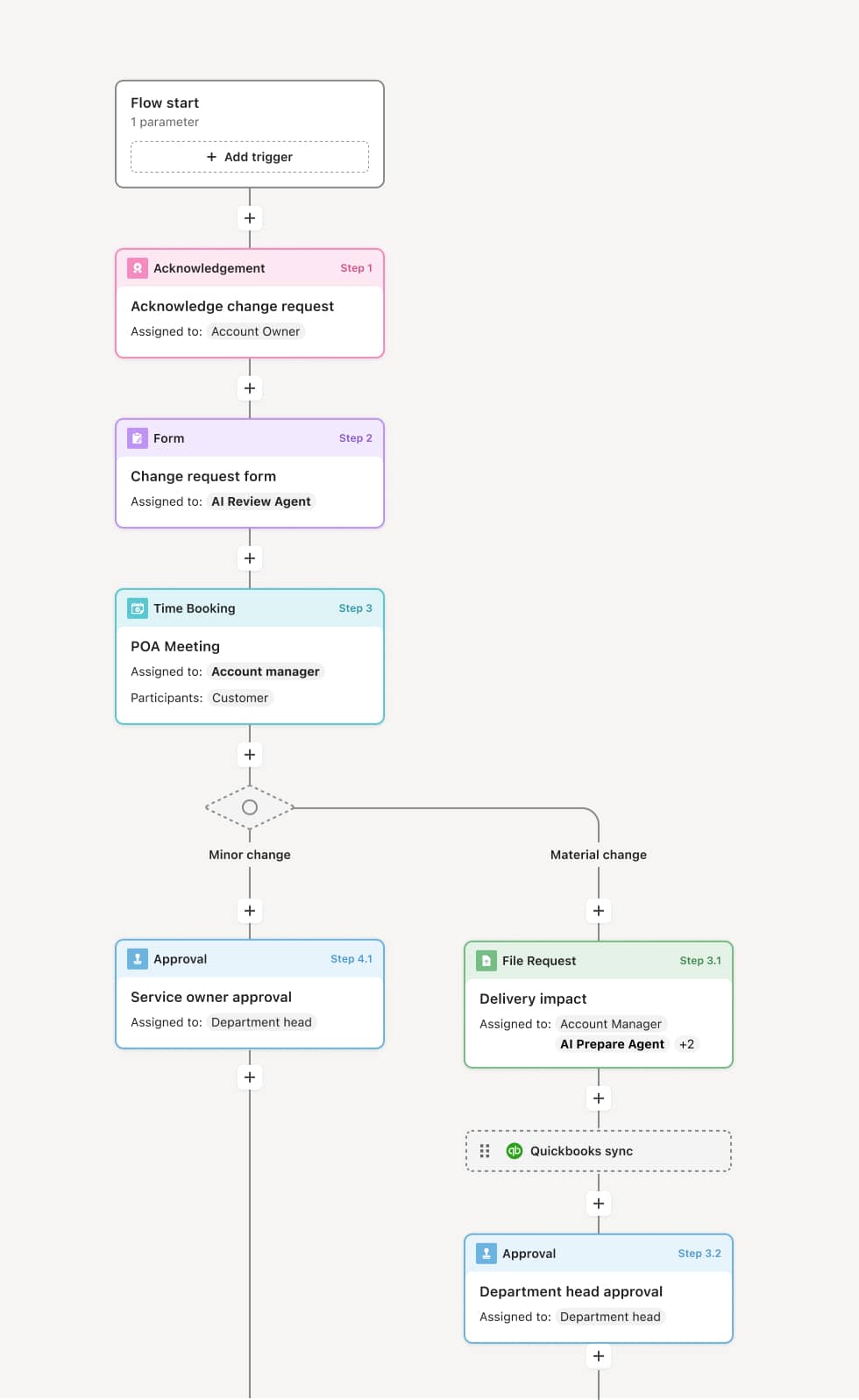
Your version of this process may vary based on roles, systems, data, and approval paths. Moxo’s flow builder can be configured with AI agents, conditional branching, dynamic data references, and sophisticated logic to match how your organization runs this workflow. The steps below illustrate one example.
Offer request submission
The process begins when the hiring manager submits a proposed offer for a selected candidate. The submission includes the role, level, department, proposed base salary, variable compensation, equity or bonus, start date, and any special terms such as signing bonus, relocation, or flexible work arrangements. An AI agent can validate the submission for completeness and flag any proposed terms that fall outside standard compensation bands.
Compensation review
The compensation analyst evaluates the proposed offer against internal equity, compensation bands, market benchmarks, and pay equity guidelines. If the offer falls within approved ranges, the review proceeds. If the proposal exceeds bands or creates equity concerns, the analyst provides guidance on adjustments and routes feedback to the hiring manager.
HR policy review
The HR business partner reviews the offer for compliance with organizational policies, headcount authorization, and any special terms that require additional consideration such as non-standard titles, remote work arrangements, or accelerated vesting schedules. If policy issues are identified, the offer is returned to the hiring manager with specific guidance.
Budget confirmation
The finance business partner confirms that budget is available for the position at the proposed compensation level. This includes verifying headcount allocation and the financial impact on departmental or organizational budgets. If budget constraints exist, finance provides alternatives or escalates for additional authorization.
Executive authorization
For offers above a defined compensation threshold, for senior or executive roles, or for positions requiring non-standard terms, the VP of HR or an executive sponsor provides final authorization. An AI agent can summarize the offer details, reviewer feedback, and any flagged exceptions to support efficient executive decision-making.
Offer finalization and delivery
Once all approvals are obtained, the talent acquisition lead finalizes the offer letter and coordinates delivery to the candidate. The offer terms are locked, and any subsequent modifications require a separate amendment process.
This process commonly relies on inputs such as offer request forms, compensation band data, headcount plans, market benchmarking data, and budget availability reports. It may be triggered by events like a candidate being selected in the ATS, a hiring manager submitting an offer request, or a recruiter initiating the offer stage. Systems such as an HRIS (Workday, BambooHR), an ATS (Greenhouse, Lever), or a compensation management platform are commonly connected to provide candidate data, compensation benchmarks, and headcount authorization.
Key decision points include whether the proposed compensation falls within approved bands or requires exception authorization, whether internal equity or pay equity concerns are raised by the compensation analyst, whether budget is available for the position at the proposed level, and whether the offer involves non-standard terms or senior-level positions that require executive approval.
Compensation data lag where offers are evaluated against outdated market benchmarks or compensation bands, leading to offers that are either uncompetitive or exceed approved ranges. Sequential review delays where HR, compensation, and finance review one at a time, extending the time between candidate selection and offer delivery. Missing budget confirmation where offers are extended before finance confirms headcount budget, creating risk of retraction. Inconsistent exception handling where non-standard terms are approved without documentation, making it difficult to maintain equity across similar offers.
Orchestrates offer review across hiring managers, HR, compensation, finance, and leadership within a single workflow, compressing the approval cycle and reducing time-to-offer.
Routes reviews in parallel so that compensation, HR policy, and budget validation happen concurrently rather than sequentially.
AI agents validate offer completeness and flag out-of-band terms before routing begins, reducing rework caused by incomplete or non-compliant submissions.
Supports threshold-based escalation so that offers above defined levels or with non-standard terms automatically route to executive sponsors.
Connects to HRIS, ATS, and compensation systems to pull candidate data, compensation bands, and headcount authorization into the approval workflow.
Documents every offer decision and exception within the workflow, building a structured record that supports compensation governance and pay equity analysis.