Order management lead
Sales operations manager
Credit analyst
Fulfillment manager
Finance controller
VP of operations

This process is used when a customer order or internal order requires validation and authorization before it enters the fulfillment pipeline. It applies when orders involve custom pricing, non-standard terms, large quantities, credit risk, or capacity constraints that require review beyond the standard order entry process. It is triggered by order submission in the sales or e-commerce system, a customer purchase order, or a manual order request. Ideal for manufacturing, distribution, wholesale, and any environment where orders must be validated against pricing, credit, and capacity before commitment.
Sales representatives or account managers submit orders or customer purchase orders for approval. Order management leads validate order details including pricing, quantities, shipping requirements, and special instructions. Credit analysts evaluate customer creditworthiness and payment terms. Fulfillment managers confirm inventory availability, production capacity, and delivery feasibility. Finance controllers review orders with non-standard pricing or payment terms. VPs of operations authorize high-value or exception orders.
Reduced fulfillment errors by validating order details, pricing, and terms before orders enter the production or shipping pipeline. Faster order-to-fulfillment cycle by routing credit, capacity, and pricing reviews in parallel rather than sequentially. Clear order accountability with every approval decision traceable to who validated pricing, confirmed capacity, and authorized commitment. Improved customer experience by identifying and resolving order issues before they reach the fulfillment stage.
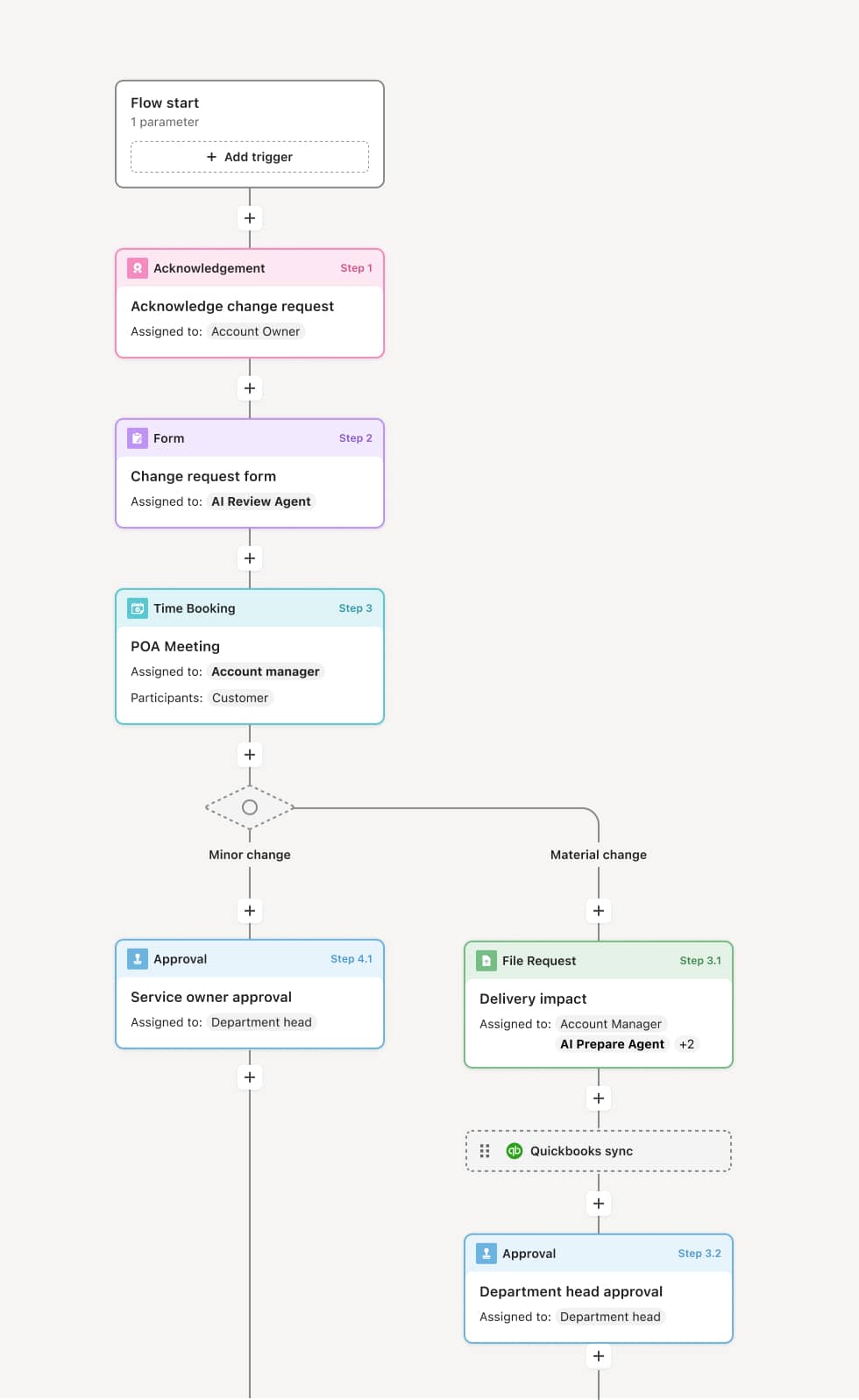
Your version of this process may vary based on roles, systems, data, and approval paths. Moxo’s flow builder can be configured with AI agents, conditional branching, dynamic data references, and sophisticated logic to match how your organization runs this workflow. The steps below illustrate one example.
Order submission and validation
The process begins when a sales representative or account manager submits an order for approval. The submission includes customer details, product or service line items, quantities, pricing, delivery requirements, and any special terms. An AI agent can validate the order against the product catalog, pricing rules, and customer account data, flagging discrepancies or missing information before the order moves to review.
Credit review
The credit analyst evaluates the customer’s credit standing, payment history, and outstanding balances. If the order falls within approved credit limits and the customer is in good standing, the credit review passes. If the customer has overdue balances, is near their credit limit, or is a new account, the credit analyst may require additional review or escalation before the order proceeds.
Capacity and fulfillment review
The fulfillment manager reviews the order against current inventory levels, production schedules, and delivery capacity. If the order can be fulfilled within the requested timeline, the review passes. If inventory shortages, production constraints, or shipping limitations affect the order, the fulfillment manager communicates alternatives or partial fulfillment options.
Pricing and terms review
For orders with non-standard pricing, custom discounts, or modified payment terms, the finance controller or pricing authority reviews the order for margin impact and policy compliance. If adjustments are needed, feedback is provided to the sales team before the order is authorized.
Authorization and commitment
Once all reviews are complete, the order is authorized for fulfillment. For high-value orders or those involving significant exceptions, the VP of operations may provide final authorization. Upon approval, the order is released to the fulfillment pipeline and the customer is notified of confirmation and expected delivery.
Order release and downstream coordination
After authorization, the approved order triggers downstream workflows including production scheduling, inventory allocation, shipping coordination, and invoicing. Stakeholders across fulfillment and finance are notified of the committed order.
This process commonly relies on inputs such as customer purchase orders, sales order forms, product catalog data, pricing rules, credit reports, and inventory availability data. It may be triggered by events like an order submission in the ERP or CRM, a customer purchase order received by email, or a manual order request from sales. Systems such as an ERP (SAP, NetSuite, Oracle), a CRM (Salesforce), or an inventory management system are commonly connected to provide customer data, product information, and fulfillment status.
Key decision points include whether the customer’s credit standing supports the order or requires escalation, whether inventory and production capacity can fulfill the order within the requested timeline, whether non-standard pricing or terms require finance review, and whether the order value or exception level triggers executive authorization.
Incomplete order data where orders are submitted without complete product, pricing, or delivery details, causing delays while information is gathered. Credit review bottlenecks where credit holds stall orders without clear escalation paths or timelines. Capacity surprises where orders are approved without confirming inventory or production availability, leading to fulfillment delays or backorders. Disconnected fulfillment handoff where approved orders are not immediately released to the production or shipping pipeline, creating gaps between authorization and execution.
Orchestrates order review across sales, credit, fulfillment, finance, and operations within a single workflow, replacing the fragmented checks that delay order commitment.
Routes reviews in parallel so that credit, capacity, and pricing validation happen concurrently rather than sequentially, compressing the order approval cycle.
AI agents validate order data against catalog, pricing, and customer records before review begins, catching errors and discrepancies early.
Supports conditional routing so that standard orders proceed quickly while non-standard pricing, credit exceptions, or high-value orders receive additional review.
Connects to ERP, CRM, and inventory systems to pull real-time customer, product, and fulfillment data into the approval workflow.
Releases approved orders to downstream fulfillment workflows upon authorization, eliminating manual handoffs between approval and execution.