Fulfillment manager
Order management lead
Account manager
Supply chain coordinator
Finance analyst
Customer success lead

This process is used when an order cannot be fully fulfilled due to inventory shortages, production delays, supply chain disruptions, or allocation constraints, and a decision must be made on whether to ship available items ahead of the remaining balance. It applies when partial fulfillment requires customer notification, revised invoicing, and tracking of backorder or remaining items. It is triggered when the fulfillment team identifies that a complete order cannot be assembled within the committed delivery window. Ideal for manufacturing, distribution, wholesale, retail, and any environment where order fulfillment may be constrained by inventory or production capacity.
Fulfillment managers identify the shortfall and propose the partial shipment. Order management leads evaluate the impact on the overall order and determine remaining fulfillment options. Account managers or customer success leads communicate with the customer and manage expectations. Supply chain coordinators assess when the remaining items will be available. Finance analysts review invoicing and payment implications of the split shipment.
Faster partial delivery by authorizing shipment of available items without waiting for the entire order to be complete. Clear customer communication with structured notification of what is shipping, what is pending, and when the remainder is expected. Accurate financial tracking by aligning invoicing and payment terms with the actual shipment schedule rather than the original order. Reduced order cancellation risk by proactively delivering available items rather than holding the entire order until full availability.
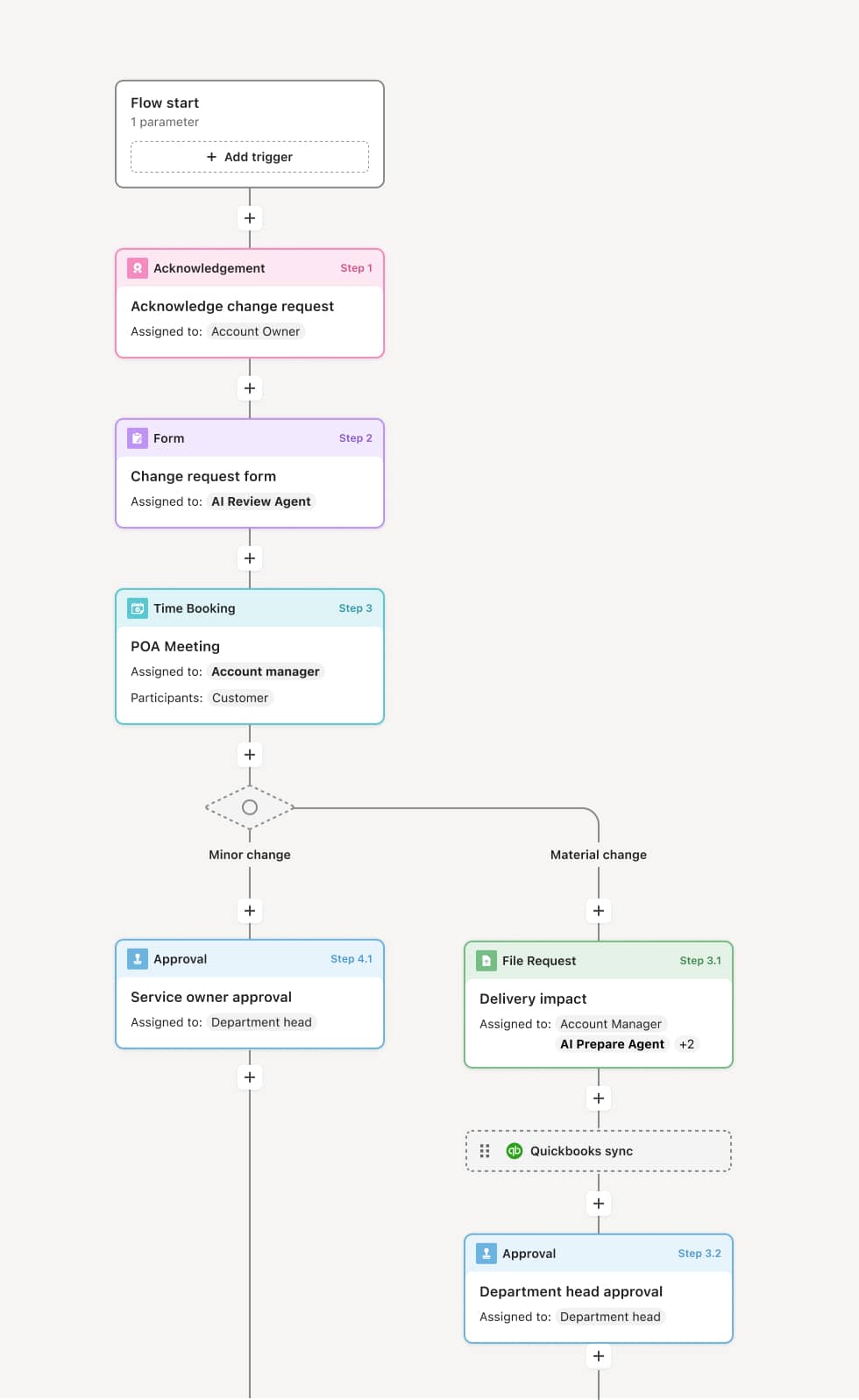
Your version of this process may vary based on roles, systems, data, and approval paths. Moxo’s flow builder can be configured with AI agents, conditional branching, dynamic data references, and sophisticated logic to match how your organization runs this workflow. The steps below illustrate one example.
Shortfall identification
The process begins when the fulfillment team identifies that one or more line items in an order cannot be fulfilled within the committed delivery window. The fulfillment manager documents which items are available, which are short, the reason for the shortfall, and the estimated availability date for remaining items. An AI agent can compile the shortfall details and pull relevant supply chain data to provide context for the decision.
Partial shipment proposal
The fulfillment manager proposes a partial shipment, specifying which items will ship immediately and what will remain on backorder. The proposal includes the revised shipping schedule, any cost implications such as additional shipping charges, and the impact on the customer’s order.
Internal review and authorization
The order management lead and, if applicable, the finance analyst review the proposal. The order management lead evaluates whether the partial shipment meets the customer’s minimum requirements and whether the remaining balance can be fulfilled within an acceptable timeframe. The finance analyst reviews invoicing implications, including whether the partial shipment changes payment terms or triggers a revised invoice. If the partial shipment is straightforward, it may be approved internally without customer consultation.
Customer notification and consent
For orders where the customer’s agreement is required or expected, the account manager or customer success lead communicates the partial shipment proposal. The customer is informed of what will ship, the expected timeline for the remainder, and any changes to cost or terms. If the customer accepts, the partial shipment is authorized. If the customer prefers to wait for the full order or cancel, the order is adjusted accordingly.
Shipment execution and backorder tracking
Upon authorization, the partial shipment is released to the shipping pipeline. The remaining items are placed on backorder with a tracked expected fulfillment date. Stakeholders are notified of the shipment, and the order record is updated to reflect the split.
Remaining balance fulfillment
When the remaining items become available, the backorder is fulfilled and shipped. The customer is notified of the final shipment, and the order is closed upon complete delivery.
This process commonly relies on inputs such as order details, inventory availability reports, production schedules, supply chain status updates, and customer account data. It may be triggered by events like a fulfillment shortfall alert, an inventory allocation conflict, or a production delay notification. Systems such as an ERP (SAP, NetSuite, Oracle), a warehouse management system (WMS), or a CRM (Salesforce) are commonly connected to provide order data, inventory status, and customer communication history.
Key decision points include whether the available items constitute a meaningful partial delivery or should be held for full fulfillment, whether the customer must be consulted before the partial shipment proceeds, whether invoicing and payment terms need adjustment for the split shipment, and whether the remaining items can be fulfilled within an acceptable timeframe or require order modification.
Late shortfall identification where fulfillment gaps are discovered after the committed delivery date, damaging customer trust before the partial shipment can even be proposed. Customer communication gaps where partial shipments are sent without proactive notification, leading to confusion and complaints. Invoicing errors where the split shipment is not reflected in billing, causing payment disputes or revenue recognition issues. Lost backorder tracking where remaining items are not systematically tracked, leading to unfulfilled balances that are forgotten or deprioritized.
Orchestrates partial shipment review across fulfillment, order management, finance, and customer-facing teams within a single workflow, replacing ad hoc email coordination.
Routes shortfall proposals conditionally based on order value, customer tier, or shortfall severity, ensuring the right stakeholders are engaged in the decision.
AI agents compile shortfall details and supply chain context to support faster internal review and customer communication.
Coordinates customer notification and consent within the workflow so that account managers and customer success leads can manage expectations without separate communication channels.
Tracks backorder balances and remaining fulfillment within the workflow, ensuring outstanding items are monitored and fulfilled when available.
Connects to ERP, WMS, and CRM systems to pull real-time inventory, order, and customer data into the partial shipment approval process.