VP of partnerships
Business development manager
Channel manager
Legal counsel
Operations director
Chief revenue officer

This process is used when a proposed partnership must be evaluated and authorized before the organization enters into a formal agreement or commitment. It applies when partnerships involve revenue sharing, co-marketing, technology integration, referral arrangements, or joint go-to-market activities that require cross-functional review. It is triggered when a business development or channel team identifies a partnership opportunity and submits it for evaluation. Ideal for technology, professional services, SaaS, financial services, and any environment where partnerships require strategic, legal, and operational alignment before commitment.
Business development managers or channel managers identify partnership opportunities and submit proposals for evaluation. VPs of partnerships evaluate strategic fit, market alignment, and competitive considerations. Legal counsel reviews contractual terms, liability, IP, and compliance implications. Operations directors assess operational readiness, integration requirements, and resource implications. Chief revenue officers or executive sponsors authorize partnerships above defined thresholds or with strategic significance.
Faster partnership activation by routing strategic, legal, and operational reviews in parallel rather than through sequential meetings and email chains. Clear partnership accountability with every evaluation, approval, and commitment traceable to who reviewed and authorized the engagement. Reduced partnership risk by ensuring legal, competitive, and operational implications are assessed before formal commitments are made. Better strategic alignment by requiring business justification and strategic fit evaluation as part of the approval process.
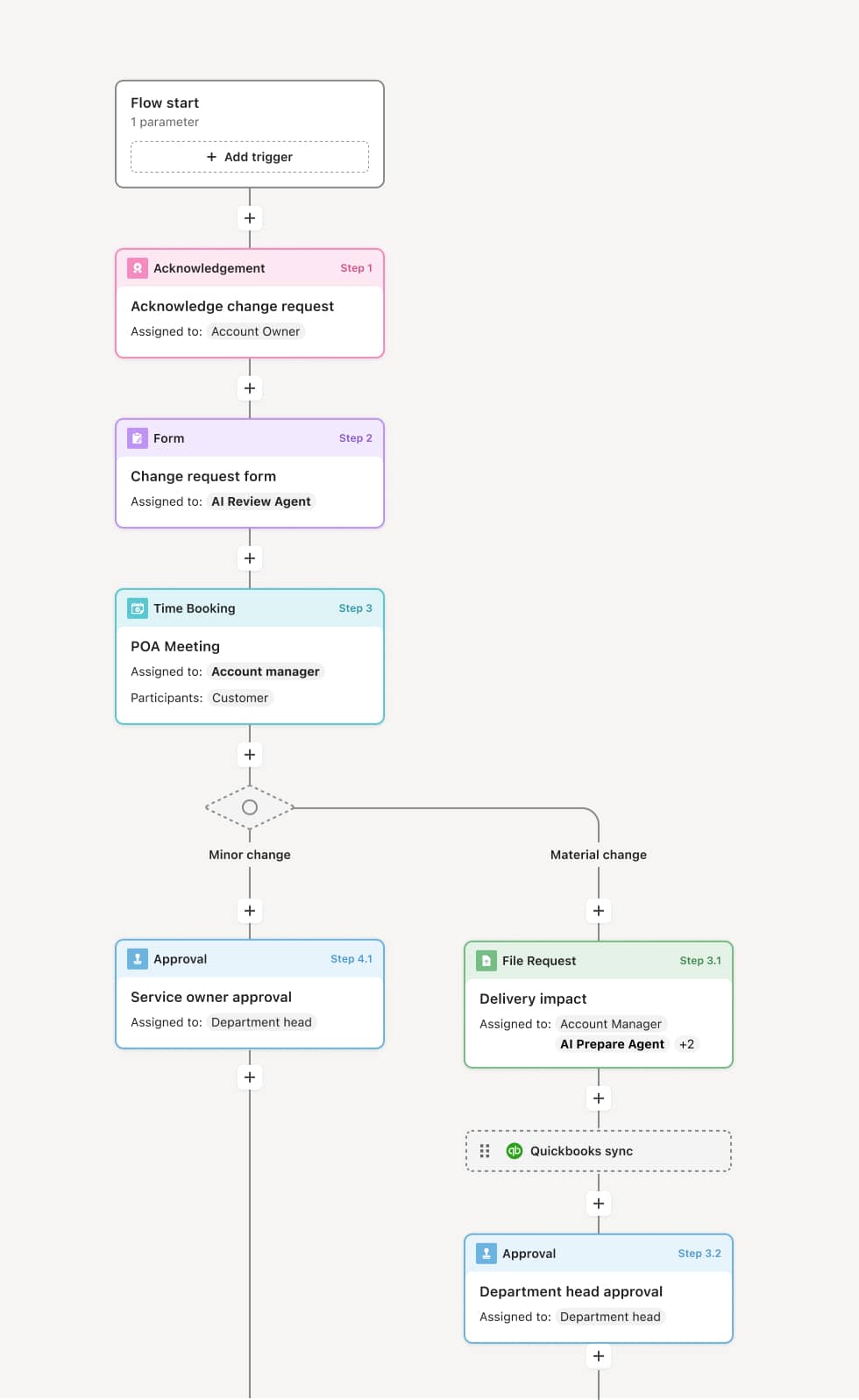
Your version of this process may vary based on roles, systems, data, and approval paths. Moxo’s flow builder can be configured with AI agents, conditional branching, dynamic data references, and sophisticated logic to match how your organization runs this workflow. The steps below illustrate one example.
Partnership proposal submission
The process begins when a business development or channel manager submits a partnership proposal. The submission includes the proposed partner, the type of partnership, the business case, expected outcomes, revenue implications, and any known contractual or operational requirements. An AI agent can validate the submission for completeness and flag any missing context before routing begins.
Strategic review
The VP of partnerships or a strategic review committee evaluates the proposal for alignment with organizational strategy, market positioning, and competitive landscape. This review determines whether the partnership supports growth objectives, whether it conflicts with existing relationships, and whether the expected value justifies the investment. If strategic concerns arise, the proposal is returned with feedback or escalated.
Legal and compliance review
Legal counsel reviews the partnership for contractual implications, liability exposure, intellectual property considerations, data sharing requirements, and regulatory compliance. If the partnership involves a formal agreement, legal evaluates proposed terms and identifies areas requiring negotiation. For referral or co-marketing arrangements, legal assesses disclosure and compliance obligations.
Operational readiness assessment
The operations director evaluates the operational requirements of the partnership, including integration complexity, resource allocation, support obligations, and training needs. If the partnership requires system integration, dedicated staffing, or operational process changes, those requirements are documented and factored into the approval decision.
Executive authorization
For partnerships above a defined threshold of strategic importance, revenue commitment, or operational complexity, the CRO or executive sponsor provides final authorization. An AI agent can prepare a summary of the proposal, reviewer feedback, and any flagged risks to support efficient executive decision-making.
Approval confirmation and onboarding initiation
Upon final approval, the proposing team and all relevant stakeholders are notified. The partnership is authorized for formal engagement, and downstream workflows such as contract execution, partner onboarding, or integration planning are initiated.
This process commonly relies on inputs such as partnership proposals, partner due diligence information, market analysis, competitive assessments, and proposed agreement terms. It may be triggered by events like a partner outreach, a channel development initiative, a technology integration opportunity, or a strategic alliance discussion. Systems such as a CRM (Salesforce, HubSpot), a partner relationship management platform (PRM), or a CLM tool are commonly connected to provide partner data, deal context, and agreement tracking.
Key decision points include whether the proposed partnership aligns with organizational strategy and does not conflict with existing relationships, whether legal and compliance risks are manageable and acceptable, whether operational readiness supports the partnership without overextending resources, and whether the partnership’s strategic importance or revenue commitment requires executive authorization.
Incomplete proposals where partnership submissions lack clear business justification or expected outcomes, causing reviewers to request additional context and delaying evaluation. Strategic misalignment discovered late where competitive or market conflicts are identified after legal and operational review are already underway, wasting review effort. Operational underestimation where the resource and integration requirements of the partnership are not fully assessed, leading to post-approval implementation challenges. Disconnected onboarding where approved partnerships are not transitioned to onboarding workflows, causing delays between authorization and activation.
Orchestrates partner evaluation across business development, legal, operations, and executive teams within a single workflow, replacing the fragmented review that slows partnership activation.
Routes reviews in parallel so that strategic, legal, and operational assessments happen concurrently rather than sequentially.
AI agents validate proposal completeness and summarize reviewer feedback to accelerate evaluation and support executive decision-making.
Supports conditional routing so that high-value or complex partnerships receive additional review while straightforward engagements proceed quickly.
Connects to CRM and PRM systems to pull partner data, competitive context, and relationship history into the approval workflow.
Initiates downstream partner onboarding workflows upon approval, ensuring authorized partnerships transition to activation without manual handoff.