Insurance verification supervisor
Patient financial counselor
Revenue cycle director
Billing manager
Patient access lead
Authorization specialist

This process is used when a patient is scheduled for services that require detailed benefit verification beyond basic eligibility — such as surgical procedures, advanced imaging, specialty treatments, infusion therapy, or services with complex benefit rules. It applies when the verification must determine specific covered amounts, out-of-pocket maximums, deductible accumulation, coinsurance percentages, plan exclusions, and any pre-service requirements. It is common when verification specialists, financial counselors, and billing must coordinate to produce accurate patient cost estimates. Ideal for hospitals, ambulatory surgery centers, specialty practices, infusion centers, and any organization where service costs are significant and benefit details affect patient financial responsibility.
The benefits verification process typically involves insurance verification specialists who research detailed benefit information from payers, patient financial counselors who translate benefit details into patient cost estimates and payment discussions, billing staff who use verified benefits for clean claim submission, and patients who receive financial counseling based on verified benefit information.
Accurate patient cost estimates based on verified benefit details, deductible accumulation, and coinsurance rather than generic assumptions. Fewer claim denials because benefit limitations, exclusions, and pre-service requirements are identified before services are rendered. Better patient financial preparedness through upfront conversations about expected costs, payment options, and financial assistance eligibility. Reduced post-service billing disputes because patients understand their financial responsibility before care is delivered. Improved revenue cycle predictability through accurate expected reimbursement calculations based on verified benefit data.
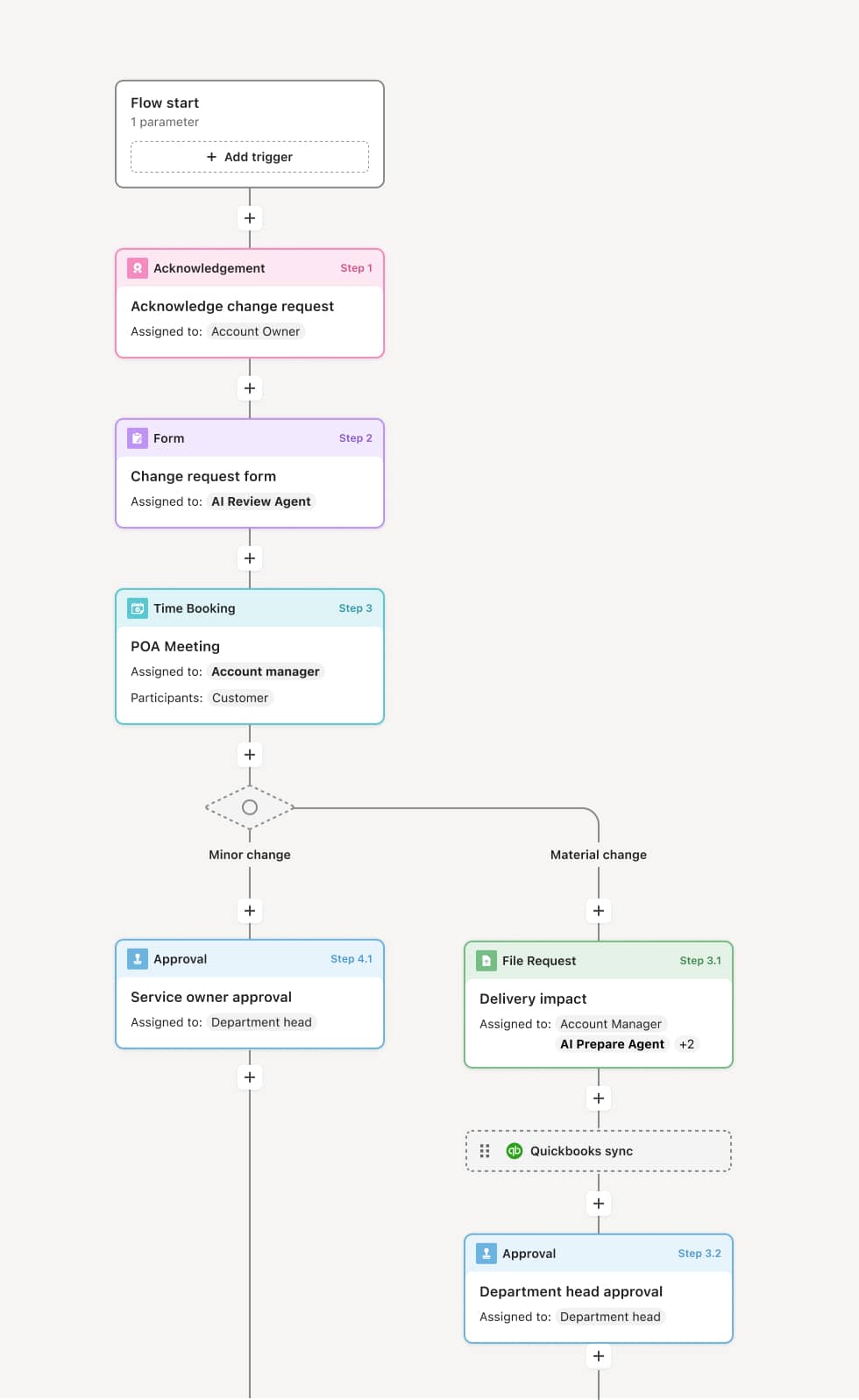
Your version of this process may vary based on roles, systems, data, and approval paths. Moxo’s flow builder can be configured with AI agents, conditional branching, dynamic data references, and sophisticated logic to match how your organization runs this workflow. The steps below illustrate one example.
Verification request and service identification
The process begins when a patient is scheduled for a service requiring detailed benefit verification. The verification specialist identifies the specific procedure codes, service setting, and provider type to verify the correct benefit category. An AI Agent can assist by mapping the scheduled services to the appropriate benefit categories and payer-specific verification requirements.
Detailed benefit research
The specialist contacts the payer through electronic verification, the payer portal, or direct phone inquiry to determine the specific benefit details: covered amounts, deductible status and accumulation, coinsurance or copay amounts, out-of-pocket maximum status, plan exclusions, and any applicable benefit limits such as visit caps or lifetime maximums. An AI Agent may flag discrepancies between the payer’s electronic response and the plan’s published benefit summary.
Pre-service requirement confirmation
The specialist confirms whether prior authorization, pre-certification, or a second opinion is required for the planned services. If requirements exist and are not yet met, the authorization process is initiated.
Cost estimate preparation
Based on the verified benefits, the financial counselor prepares a patient cost estimate that accounts for the expected charges, insurance coverage, deductible application, coinsurance, and the patient’s estimated out-of-pocket responsibility. The estimate is reviewed for accuracy before communicating to the patient.
Patient financial counseling
The financial counselor contacts the patient to discuss the estimated costs, payment options, and any available financial assistance. The patient’s questions are addressed and the financial discussion is documented. If the patient requests a payment plan or financial assistance, the appropriate process is initiated.
Documentation and billing handoff
The verified benefit details, authorization status, and patient financial counseling documentation are recorded in the patient’s account and made available to the billing team for claim submission after services are rendered.
This process commonly relies on inputs such as the patient’s insurance information, scheduled procedure codes, payer benefit plan documents, eligibility verification results, and prior authorization status. It may be triggered by the scheduling of high-cost or complex services. Connected systems often include practice management systems, EHR platforms like Epic or Cerner, eligibility and benefits verification tools like Availity or Waystar, and payer portals.
Key decision points include whether the planned services are covered under the patient’s benefit plan and at what level, whether the patient’s deductible, coinsurance, and out-of-pocket maximum affect their financial responsibility, whether pre-service authorization or certification requirements are met, and whether the patient needs financial counseling, a payment plan, or financial assistance screening.
Benefit details not verified at the service-specific level, resulting in cost estimates based on general plan information rather than the actual benefit category. Deductible accumulation not checked, leading to inaccurate patient cost estimates that do not reflect amounts already applied. Plan exclusions or limitations missed, causing claim denials for services the plan does not cover. Patient cost conversation delayed until after services are rendered, creating billing disputes and collection challenges. Verification data not documented in the billing system, requiring re-verification at the time of claim submission.
Orchestrates detailed benefits verification from service identification through patient financial counseling across verification specialists, financial counselors, and billing in a single workflow.
Maps scheduled services to benefit categories with AI Agents that identify payer-specific verification requirements and flag common coverage issues.
Tracks pre-service authorization requirements within the workflow so missing authorizations are identified and initiated before the service date.
Prepares patient cost estimates within the workflow based on verified benefit data, with AI Agents calculating expected patient responsibility.
Connects to eligibility and benefits verification platforms like Availity, Waystar, and payer portals so benefit details are verified and documented directly in the patient record.
Preserves the complete verification record including benefit details, authorization status, cost estimates, and patient financial counseling documentation for billing accuracy and dispute resolution.