Patient financial services manager
Revenue cycle director
Billing supervisor
Patient advocate
Compliance officer
Customer experience lead

This process is used when a patient formally or informally disputes a charge on their medical bill — claiming the amount is incorrect, the service was not provided, the insurance was not processed properly, or the out-of-pocket cost does not match their expectation based on their coverage. It applies when the dispute requires investigation across billing records, clinical documentation, insurance adjudication, and patient communications to determine the correct resolution. It is common when patient financial services, billing, coding, and insurance teams must coordinate to investigate and respond. Ideal for hospitals, physician practices, ambulatory care centers, and any healthcare organization managing patient billing inquiries at scale.
The patient billing dispute process typically involves patient financial services representatives who receive and log the dispute, billing analysts who investigate charge accuracy and insurance processing, coding staff who verify that billed services match the clinical documentation, insurance follow-up teams who resolve payer-related issues, and patient advocates or supervisors who communicate the resolution.
Faster dispute resolution by routing investigations to the right specialist based on the dispute type rather than handling all disputes generically. Accurate billing corrections when investigation confirms an error, applied promptly to the patient’s account. Clear patient communication that explains the investigation findings and any adjustments in plain language, reducing repeat inquiries. Improved patient satisfaction because disputes are acknowledged promptly and resolved transparently. Root cause data that reveals patterns in billing errors, insurance processing gaps, or communication breakdowns, enabling upstream prevention.
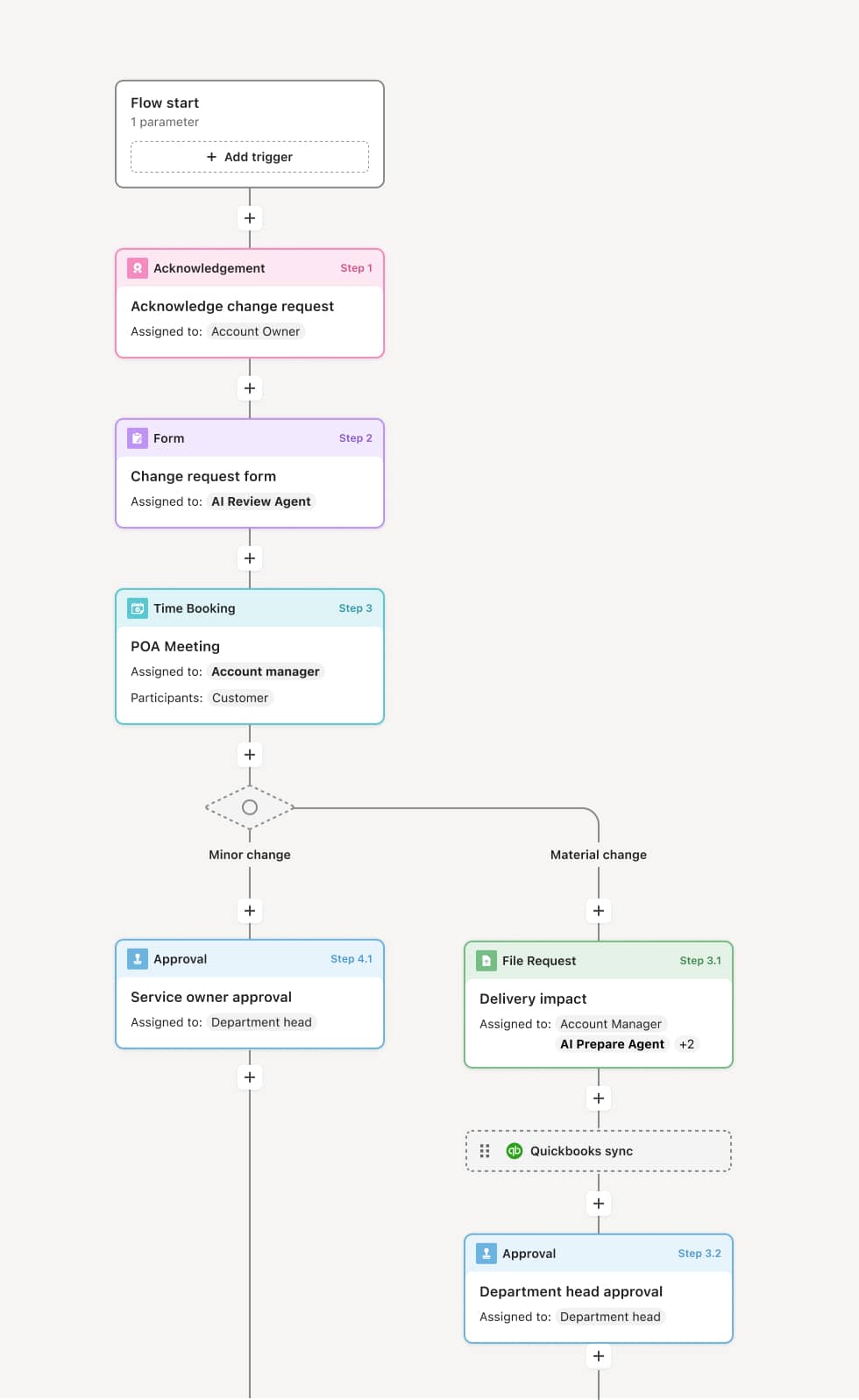
Your version of this process may vary based on roles, systems, data, and approval paths. Moxo’s flow builder can be configured with AI agents, conditional branching, dynamic data references, and sophisticated logic to match how your organization runs this workflow. The steps below illustrate one example.
Dispute receipt and acknowledgment
The process begins when a patient contacts the organization to dispute a charge — by phone, patient portal, mail, or in person. The dispute is logged with the patient’s account information, the specific charges in question, and the patient’s stated reason. The patient receives an acknowledgment that the dispute has been received and is under investigation. An AI Agent can assist by pulling the patient’s billing history and the disputed charges into a single view for the investigator.
Dispute classification and routing
The dispute is classified by type — such as charge accuracy, insurance processing, duplicate billing, service not rendered, or out-of-pocket cost discrepancy. Based on the classification, the dispute is routed to the appropriate investigator: billing analyst for charge issues, insurance follow-up for payer disputes, or coding staff for service verification.
Investigation
The assigned investigator reviews the relevant records — billing detail, clinical documentation, insurance explanation of benefits, remittance advice, and prior patient communications. If the investigation reveals a billing error, the correction is prepared. If the charges are accurate, a detailed explanation is drafted. If the issue is payer-related, the insurance team works with the payer to resolve the discrepancy. An AI Agent may compare the billed charges against the clinical record and insurance adjudication to identify obvious mismatches.
Resolution determination
Based on the investigation, the resolution is determined: full or partial adjustment, rebilling to insurance, patient payment plan, or confirmation that the original charges are correct. If the adjustment requires supervisor or management approval (based on amount or type), it is routed for authorization.
Patient communication
The resolution is communicated to the patient with a clear, plain-language explanation of the investigation findings, any adjustments made, and the resulting balance. If the patient disagrees with the resolution, the dispute may be escalated to a patient advocate or supervisor for further review.
Account update and closure
The patient’s account is updated to reflect any adjustments. The dispute record — including the original complaint, investigation details, resolution, and patient communication — is preserved. Dispute data is available for trend analysis and process improvement.
This process commonly relies on inputs such as the patient’s billing statement, account detail, clinical documentation, insurance remittance advice, and the patient’s stated dispute. It may be triggered by a patient call, a portal message, a written complaint, or an internal billing audit finding. Connected systems often include billing and practice management systems like Epic, Athenahealth, or AdvancedMD, insurance clearinghouses, and patient communication platforms.
Key decision points include how the dispute is classified and which team investigates it, whether the investigation reveals a billing error requiring adjustment or confirms that the charges are correct, whether the adjustment amount requires management authorization, and whether the patient accepts the resolution or requests further escalation.
Disputes not acknowledged promptly, leaving the patient uncertain whether their concern is being addressed. Misclassification at intake that routes the dispute to the wrong investigator, adding delay and rework. Investigation conducted without complete information — such as missing clinical documentation or insurance EOBs — leading to an incorrect or incomplete resolution. Resolution communicated in billing jargon rather than plain language, causing the patient to dispute again. Dispute patterns not tracked, missing opportunities to fix upstream billing, coding, or insurance processing issues.
Orchestrates billing dispute resolution across patient financial services, billing, coding, insurance, and the patient in a single flow that keeps the patient informed throughout.
Routes disputes based on type so charge accuracy issues, insurance discrepancies, and service verification questions reach the right investigator immediately.
AI Agents assemble the investigation package by pulling billing detail, clinical documentation, and insurance adjudication data into a single view for the investigator.
Engages the patient within the workflow for acknowledgment, status updates, and resolution communication so every interaction is tracked and contextual.
Connects to billing, EHR, and clearinghouse systems like Epic, Athenahealth, and insurance platforms so account data and claims information are accessible during investigation.
Preserves the complete dispute record including the complaint, investigation, resolution, patient communication, and any adjustments for compliance, audit, and trend analysis.