Patient access director
Insurance verification specialist
Revenue cycle manager
Scheduling supervisor
Billing manager
Clinic operations lead

This process is used before every scheduled patient encounter to confirm that the patient has active insurance coverage, that the planned services are covered under their plan, and that any referral or prior authorization requirements are met. It applies when verification must account for multiple payers, plan changes, coverage gaps, and service-specific benefit rules. It is common when patient access, insurance verification, and scheduling teams must coordinate to resolve coverage issues before the appointment. Ideal for physician practices, hospitals, ambulatory surgery centers, imaging centers, and any healthcare organization managing insurance verification at scale.
The eligibility verification process typically involves insurance verification specialists who check coverage and benefits, patient access or registration staff who collect and update insurance information, scheduling staff who flag appointments requiring verification, billing staff who rely on accurate eligibility for clean claim submission, and patients who provide insurance details and resolve coverage issues.
Confirmed coverage before care delivery so providers and patients know the insurance status before services are rendered. Reduced claim denials by catching inactive coverage, benefit exclusions, and missing authorizations before the visit. Accurate patient cost estimates because copay, deductible, and coinsurance information is verified in advance. Fewer patient billing surprises through upfront communication about out-of-pocket costs and coverage limitations. Streamlined front desk operations because coverage issues are resolved before the patient arrives rather than at check-in.
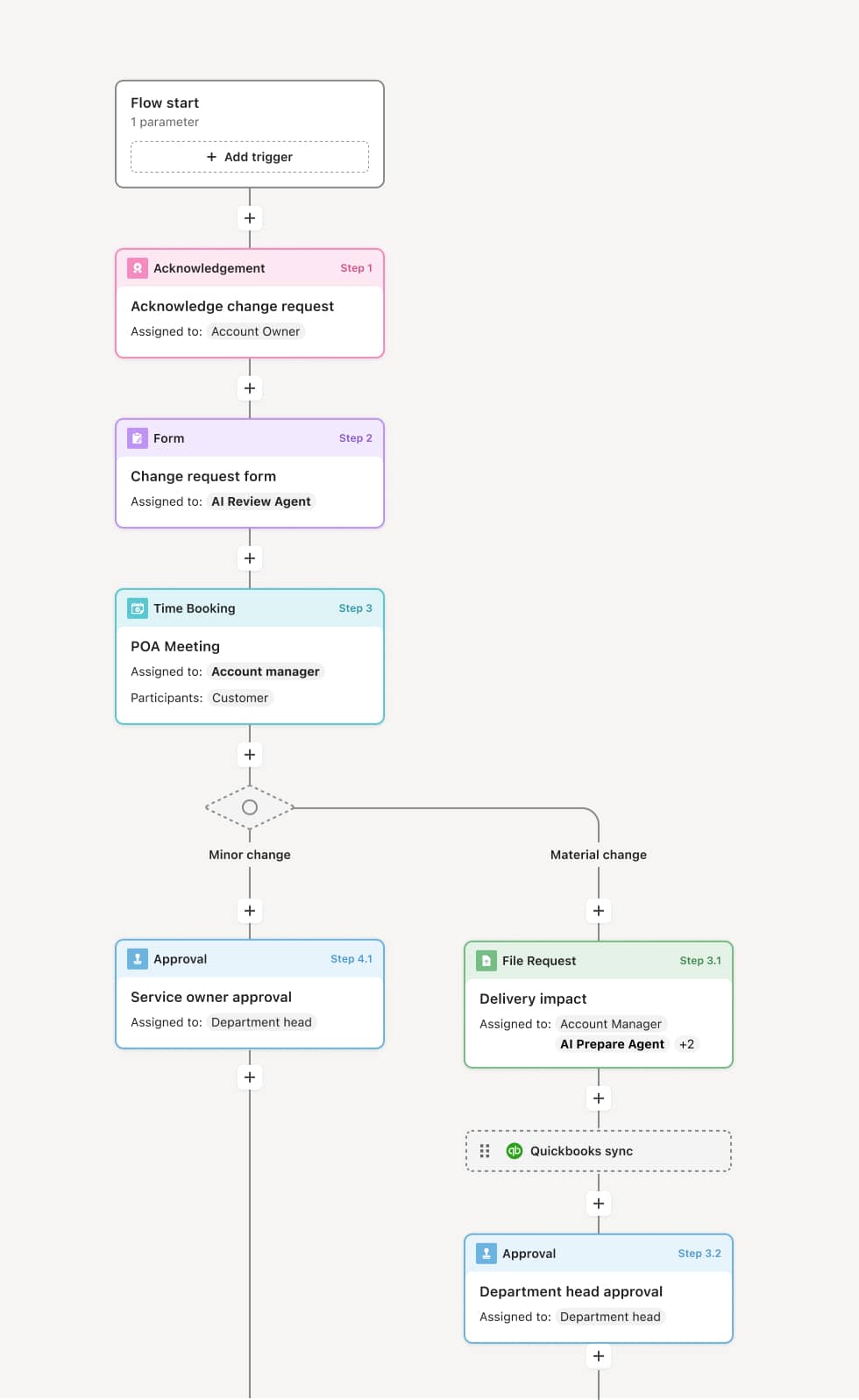
Your version of this process may vary based on roles, systems, data, and approval paths. Moxo’s flow builder can be configured with AI agents, conditional branching, dynamic data references, and sophisticated logic to match how your organization runs this workflow. The steps below illustrate one example.
Verification queue generation
The process begins when upcoming appointments are identified for eligibility verification, typically two to five business days before the scheduled visit. The verification queue is generated from the scheduling system based on appointment type and payer. An AI Agent can assist by prioritizing the queue based on payer complexity, new patients, and appointments with high denial risk.
Insurance eligibility check
The verification specialist checks the patient’s insurance eligibility through electronic eligibility inquiry (270/271 transactions), payer portals, or direct payer contact. The check confirms active coverage, effective dates, plan type, primary and secondary payer information, and the patient’s member and group identifiers.
Benefit and cost-sharing verification
For the specific services scheduled, the specialist verifies covered benefits, copay amounts, deductible status, coinsurance percentages, and any plan exclusions or limitations. If the patient has multiple payers, coordination of benefits is confirmed. An AI Agent may flag common benefit issues based on the payer and service type.
Authorization and referral confirmation
The specialist checks whether the scheduled service requires prior authorization or a referral. If authorization is required and not on file, the authorization process is initiated. If a referral is needed, the referral status is confirmed with the referring provider.
Issue resolution and patient communication
If the verification reveals coverage issues — such as inactive coverage, benefit exclusions, or missing authorization — the patient is contacted to resolve the issue before the visit. The patient is informed of their estimated out-of-pocket costs. If coverage cannot be confirmed, financial counseling or self-pay options are discussed.
Verification documentation and handoff
The verified eligibility information is documented in the patient’s account and made available to registration, clinical, and billing staff. The verification is complete when coverage is confirmed and all issues are resolved before the appointment.
This process commonly relies on inputs such as the patient’s insurance card, demographic data, appointment details, payer eligibility databases, and benefit plan information. It may be triggered by an appointment scheduling event or a batch verification queue. Connected systems often include practice management systems, EHR platforms like Epic or Cerner, real-time eligibility verification tools like Availity or Waystar, and payer portals.
Key decision points include whether the patient has active coverage for the scheduled date of service, whether the planned services are covered under the patient’s benefit plan, whether prior authorization or referral requirements are met, and whether identified coverage issues can be resolved before the appointment or require rescheduling.
Verification not completed before the visit, resulting in coverage issues discovered at check-in or after claim submission. Secondary or tertiary payers not identified, causing coordination of benefits problems and claim denials. Authorization requirements missed during verification, leading to post-service denials for services that needed pre-approval. Patient not notified of coverage issues or cost estimates before the visit, creating billing surprises. Verification data not updated in the billing system, causing claims to be submitted with outdated payer information.
Orchestrates eligibility verification from queue generation through issue resolution across verification specialists, patient access, scheduling, and patients in a single workflow.
Prioritizes the verification queue with AI Agents that flag high-risk appointments, new patients, and payers with complex benefit rules.
Checks eligibility and benefits within the workflow using connected payer systems and flags coverage gaps, missing authorizations, and benefit exclusions.
Engages patients within the workflow when coverage issues require resolution, keeping all communications tracked and contextual.
Connects to practice management, EHR, and eligibility platforms like Epic, Cerner, Availity, and Waystar so verification data flows directly into the patient record and billing system.
Documents verified eligibility for every appointment with coverage details, cost-sharing information, and authorization status for billing accuracy and denial prevention.