Project manager
Construction manager
Accounts payable manager
Finance controller
General contractor
Owner's representative

This process is used when a contractor or subcontractor submits a payment application tied to work completed during a billing period. It is triggered when project milestones are reached, scheduled billing cycles occur, or retainage release thresholds are met. It becomes critical when multiple trades or subcontractors submit overlapping pay applications that require cross-referencing against budgets, contracts, and field-verified progress. Pay application approval is common across construction, real estate development, infrastructure, and capital project management.
Pay application approval typically involves the submitting contractor or subcontractor, a project manager who validates work completion against the schedule of values, a cost engineer or quantity surveyor who reviews financial accuracy, and a finance or accounts payable team responsible for issuing payment. An owner's representative or client stakeholder may also participate, particularly for high-value draws or retainage releases.
Faster draw processing by eliminating manual reconciliation of submitted amounts against contract values and completed work. Reduced payment disputes through structured validation of line items, lien waivers, and supporting documentation before approval. Clear financial accountability with every approval decision tied to a specific reviewer, preventing unauthorized or unverified payments. Improved cash flow visibility by tracking each pay application from submission through approval and disbursement across the project lifecycle.
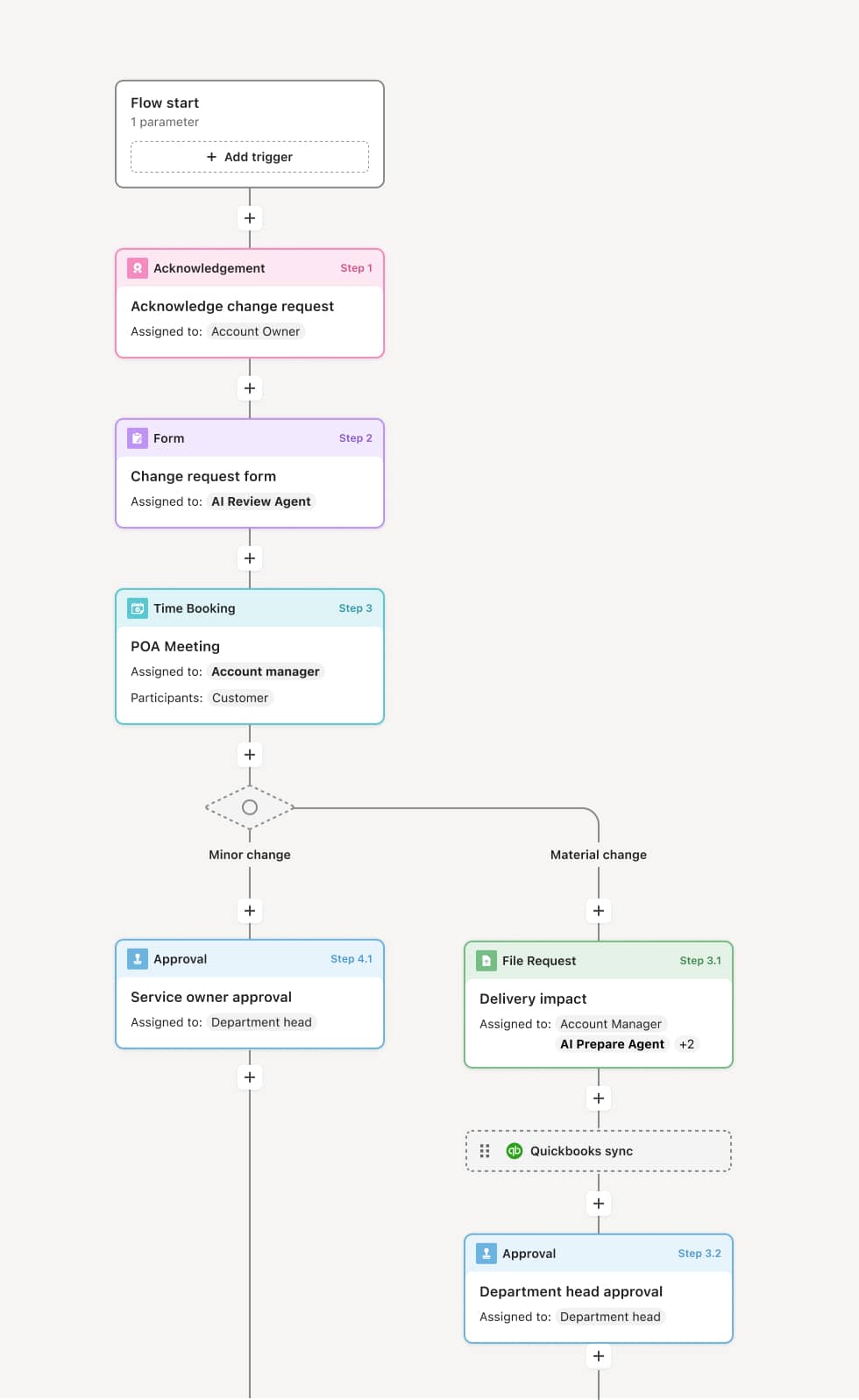
Your version of this process may vary based on roles, systems, data, and approval paths. Moxo’s flow builder can be configured with AI agents, conditional branching, dynamic data references, and sophisticated logic to match how your organization runs this workflow. The steps below illustrate one example.
Submission and intake
The process begins when a contractor or subcontractor submits a pay application, typically including a completed schedule of values, proof of work progress, and any required lien waivers or compliance documents. An AI Agent may assist by validating that the submission is complete, checking for missing attachments, and flagging discrepancies between submitted amounts and the original contract. The submitting party is prompted to provide all required materials in context, reducing the need for follow-up requests.
Field verification and progress review
Once submitted, the pay application is routed to the project manager or field superintendent for verification. This reviewer compares the claimed percentage of completion against actual field conditions, inspections, or photographic evidence. If the claimed progress does not match observed conditions, the reviewer can flag specific line items for adjustment. The process may branch depending on whether the pay application is within tolerance or requires revision before it moves forward.
Financial reconciliation
After field verification, the pay application moves to the cost engineer or finance team for reconciliation. This includes confirming that previously billed amounts are accurate, that retainage calculations are correct, and that the total draw does not exceed contract limits. An AI Agent may prepare a summary comparing the current application against prior submissions and remaining contract balance, helping reviewers focus on areas that need attention rather than recalculating from scratch.
Approval or escalation
With reconciliation complete, the pay application is routed to the designated approver, which may be a project owner, senior finance leader, or owner's representative depending on the draw amount. If the amount exceeds a defined threshold, the approval may escalate to a higher authority or require a secondary sign-off. Approvers review the consolidated package, including verified amounts, supporting documentation, and any notes from prior reviewers, before granting or declining authorization.
Payment processing and closure
Once approved, the pay application moves to accounts payable for disbursement. Payment instructions, remittance details, and any retainage hold information are recorded as part of the process. All stakeholders, including the submitting contractor, are notified of the approval outcome and expected payment timeline. The completed pay application is retained as a structured record, linking the approved draw to the contract, project, and billing period.
This process commonly relies on inputs such as the schedule of values, contractor invoices, lien waivers, proof of work completion, inspection reports, and retainage schedules. It may be triggered by a billing cycle deadline, a milestone completion event, or a direct submission from the contractor. Systems such as Procore, Sage 300, or NetSuite are often connected to provide contract data, project budgets, and payment records.
Key decision points include whether the claimed work completion matches field-verified progress, whether the draw amount falls within contract and budget limits, whether required compliance documents such as lien waivers have been provided, and whether the pay application amount exceeds an approval threshold that requires escalation to a senior authority.
Incomplete submissions, where missing lien waivers or unsigned schedules of values delay the entire review cycle. Misaligned progress claims, when the contractor reports higher completion percentages than what field inspections confirm, causing back-and-forth revisions. Retainage miscalculations, leading to overpayment or disputes at project closeout. Approval bottlenecks, when senior sign-off is required but reviewers lack the consolidated context needed to act quickly.
Orchestrates the full pay application lifecycle across contractors, project managers, finance teams, and owner's representatives in a single coordinated process.
AI Agents validate submission completeness by checking for required documents, flagging missing lien waivers, and comparing submitted line items against contract terms before the review begins.
Routes approvals conditionally based on draw amount thresholds, project type, or retainage status, ensuring the right authority reviews each application.
Extends existing project and finance systems such as Procore, Sage 300, or NetSuite by connecting contract data and payment records directly into the approval workflow.
Maintains a structured record of every submission, review decision, and payment authorization so teams can trace any pay application back to its supporting documentation and approval chain.