Treasury manager
Accounts payable manager
Finance controller
Project manager
Procurement director
Chief financial officer

This process is used when funds have been committed or reserved and a final authorization is required before disbursement occurs. It is triggered when contract milestones are completed, escrow release conditions are satisfied, retainage holdbacks reach their release date, or staged batch payments are ready for execution. Payment release approval is especially critical when large sums are involved, when release depends on third-party confirmation, or when multiple conditions must be verified before funds leave the organization. This process is common in construction, real estate, financial services, procurement, and any context involving milestone-based or conditional payments.
Payment release approval typically involves a finance or treasury team responsible for executing the disbursement, a project manager or operations lead who confirms that release conditions have been met, an accounts payable specialist who verifies documentation and coding, and a senior finance authority such as a controller or CFO who provides final authorization. External stakeholders such as vendors, contractors, or escrow agents may also participate by confirming deliverables or providing release certificates.
Controlled disbursement timing by ensuring funds are released only after all contractual, operational, and financial conditions have been verified. Reduced risk of premature payment through structured condition checks that prevent release before deliverables are confirmed or holdback periods expire. Faster release cycles by automating condition verification and routing approvals directly to the authorized decision-maker without manual handoffs. Complete release traceability with every condition check, authorization, and disbursement recorded in a single process record.
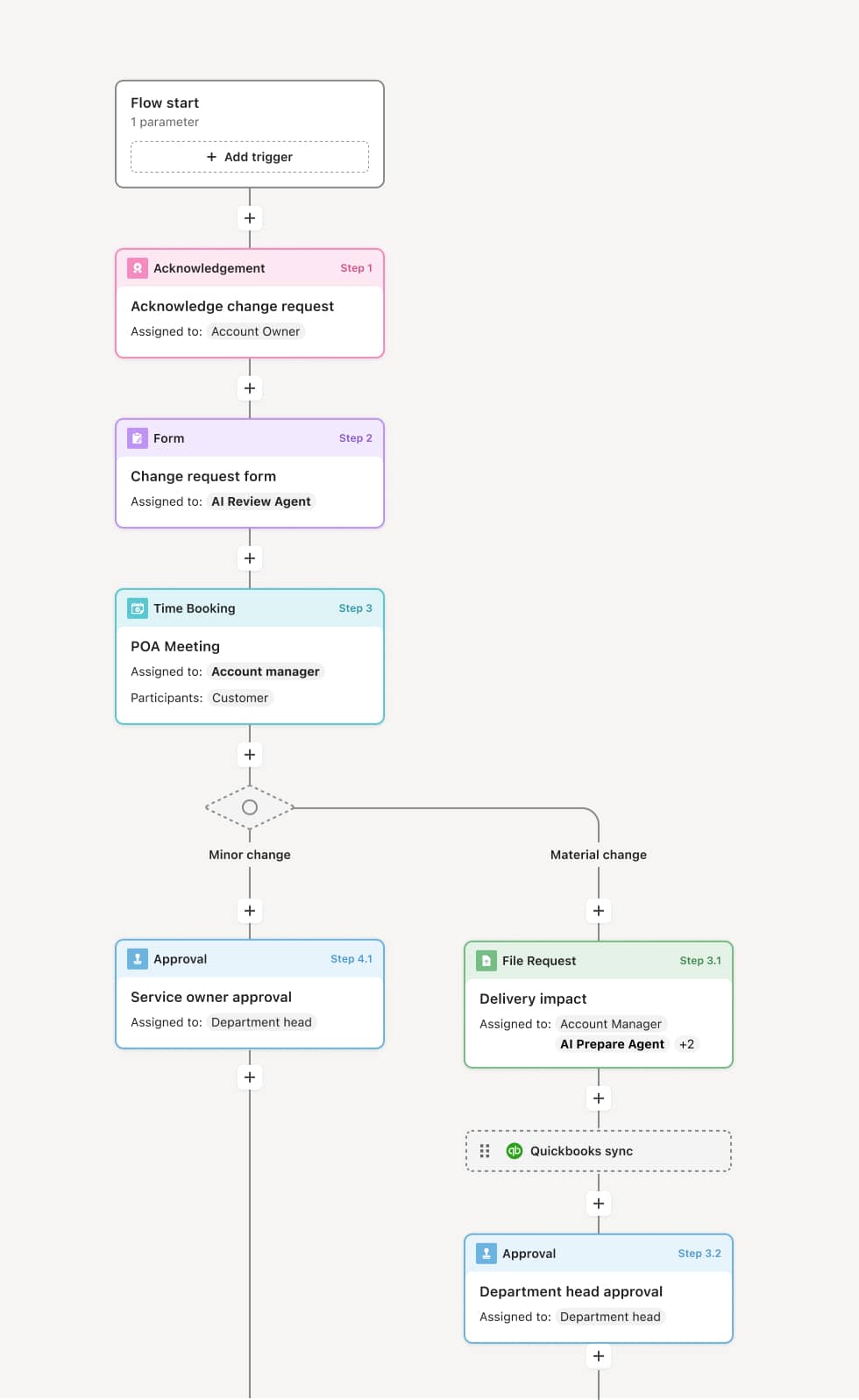
Your version of this process may vary based on roles, systems, data, and approval paths. Moxo’s flow builder can be configured with AI agents, conditional branching, dynamic data references, and sophisticated logic to match how your organization runs this workflow. The steps below illustrate one example.
Release trigger and condition identification
The process begins when a release event occurs, such as a milestone completion, a holdback period expiration, or a third-party confirmation. The relevant conditions for release are identified based on the contract, agreement, or internal policy governing the payment. An AI Agent may assemble the list of required conditions and check which have already been satisfied based on data from connected systems, giving the review team an immediate view of what remains outstanding.
Condition verification
Each release condition is verified by the responsible party. This may include the project manager confirming deliverable acceptance, the operations team verifying inspection results, or an external party providing a certificate of completion. If any condition has not been met, the process pauses at that point and the responsible party is notified with specific guidance on what is required. Conditions may be verified in parallel when they are independent of one another.
Financial reconciliation
Once all conditions are satisfied, the finance or accounts payable team reconciles the release amount against the original commitment, prior partial releases, and any adjustments. This step ensures the release amount is accurate and that cumulative disbursements do not exceed the committed total. An AI Agent may prepare a reconciliation summary comparing the proposed release against the full payment history for the engagement.
Authorization
The verified and reconciled release request is routed to the appropriate approver based on the release amount, payment type, and organizational policy. Standard releases may be authorized by a finance manager, while large or non-standard releases require sign-off from a controller, CFO, or treasury manager. The approver reviews the consolidated package, including verified conditions, reconciliation summary, and any notes from prior reviewers, before granting authorization.
Disbursement and closure
Upon authorization, the payment is executed through the organization's banking or payment platform. The payee and relevant internal stakeholders are notified of the disbursement. All condition verifications, reconciliation details, and authorization records are retained as a structured process record, linking the release to its originating commitment and every decision made along the way.
This process commonly relies on inputs such as contract terms, milestone completion certificates, inspection reports, holdback schedules, prior payment records, and release authorization forms. It may be triggered by a milestone event, a date-based holdback expiration, or a notification from an external party. Systems such as SAP, Oracle, NetSuite, or a construction management platform like Procore may provide commitment data, release conditions, and payment history.
Key decision points include whether all contractual and operational conditions for release have been met, whether the release amount reconciles accurately against prior disbursements and the original commitment, whether the release amount or type triggers escalation to a senior authority, and whether any outstanding disputes or exceptions should delay the release.
Unverified release conditions, when funds are released before all required confirmations are received, exposing the organization to financial risk. Reconciliation errors, when prior partial releases are not accurately accounted for, leading to over- or under-payment. Delayed third-party confirmations, when external stakeholders are slow to provide completion certificates or release approvals, stalling the entire process. Unclear authorization authority, when the required approver for a given release amount or type is not defined, causing requests to sit without action.
Orchestrates the full release lifecycle from trigger identification through condition verification, reconciliation, authorization, and disbursement in a single coordinated process.
AI Agents assemble condition checklists and reconciliation summaries so reviewers and approvers enter each phase with complete context rather than compiling information manually.
Enables parallel condition verification so independent release requirements can be confirmed simultaneously by different parties without creating sequential bottlenecks.
Extends existing ERP and project management systems such as SAP, NetSuite, or Procore by connecting commitment data and payment records directly into the release workflow.
Captures a complete record of every condition check, reconciliation, and authorization so finance teams can trace any release back to its verified conditions and approval chain.