Finance operations manager
Revenue operations lead
Commission administrator
Partner operations manager
Accounts payable manager
Chief financial officer

This process is used when an organization needs to authorize a calculated payout to an employee, partner, vendor, affiliate, or other recipient. It is triggered when commission calculations are finalized, partner revenue shares are computed, insurance claims are settled, rebate thresholds are reached, or contractual distributions are due. Payout approval becomes particularly important when payout volumes are high, when calculations involve complex formulas or tiered structures, or when the organization must verify accuracy before releasing funds. This process is common in financial services, insurance, channel sales, marketplaces, professional services, and any organization managing performance-based or contractual distributions.
Payout approval typically involves an operations or commission administrator who prepares and validates the payout calculations, a finance reviewer who confirms amounts against policy and budget, a senior approver such as a finance controller or CFO who authorizes high-value or exception payouts, and the recipient who may need to confirm details or acknowledge the payout. In partner or affiliate contexts, a partner operations manager may coordinate between internal teams and external payees.
Accurate payout execution by validating calculations, supporting data, and policy compliance before any funds are released. Reduced payout disputes through structured review that catches errors, misapplied tiers, or incorrect data inputs before the recipient is paid. Consistent authorization controls ensuring that every payout, regardless of size or type, follows the same review and approval path appropriate to its risk level. Full traceability from calculation to disbursement with every validation, approval, and exception recorded as part of the payout process record.
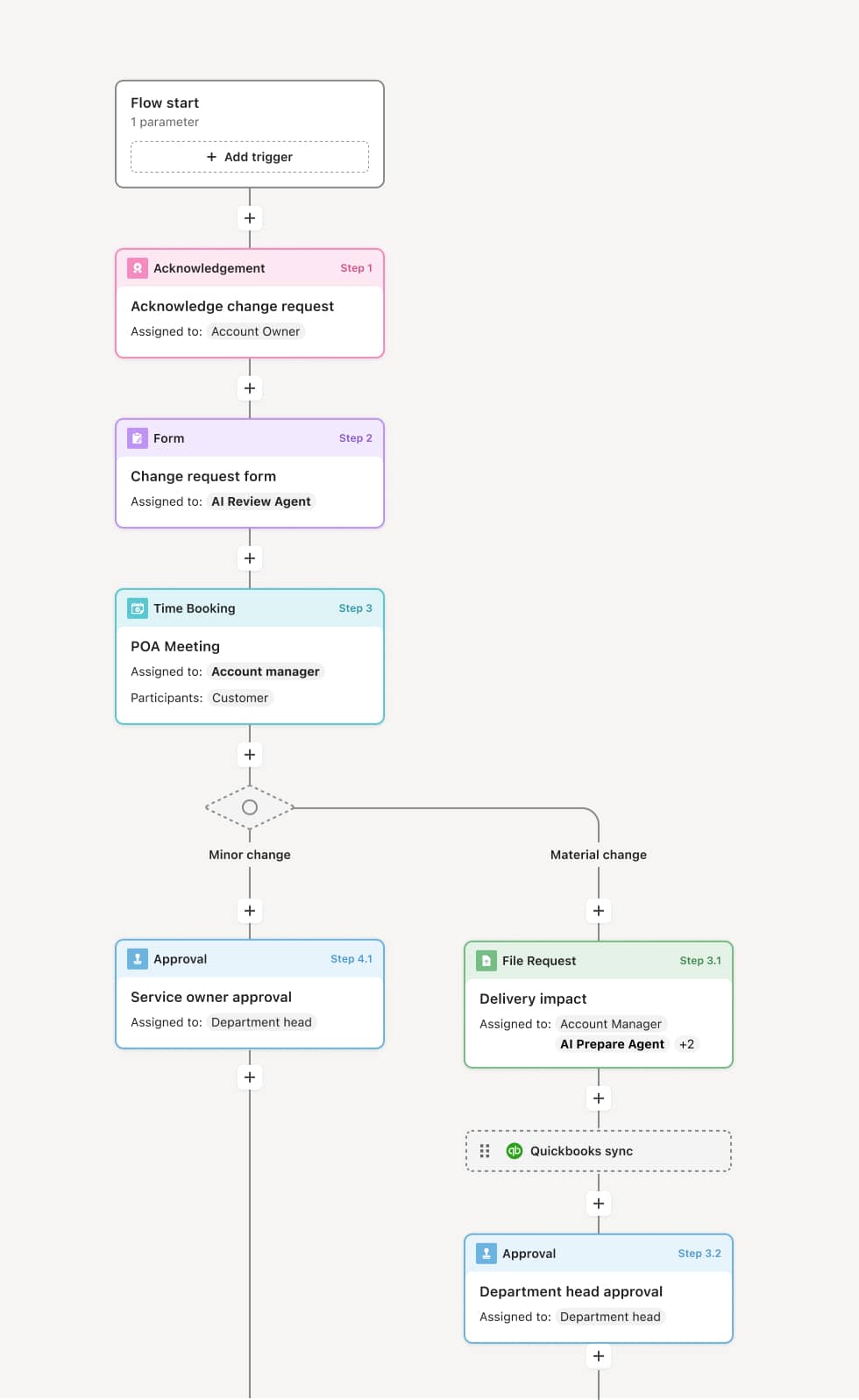
Your version of this process may vary based on roles, systems, data, and approval paths. Moxo’s flow builder can be configured with AI agents, conditional branching, dynamic data references, and sophisticated logic to match how your organization runs this workflow. The steps below illustrate one example.
Payout calculation and preparation
The process begins when payout data is finalized, whether through a commission engine, partner revenue calculation, claims settlement, or contractual formula. The operations or commission administrator compiles the payout batch, including recipient details, calculated amounts, supporting data, and any applicable adjustments. An AI Agent may assist by cross-referencing calculations against source data, flagging outliers or amounts that deviate significantly from historical patterns, and preparing a summary for reviewers.
Validation and accuracy review
The prepared payout batch is routed to a finance reviewer who checks the calculations against policy, contractual terms, and supporting data. This includes verifying that rates, tiers, and thresholds have been applied correctly, that source data matches the calculation inputs, and that any adjustments or clawbacks are accurately reflected. If discrepancies are found, specific line items are flagged and returned to the administrator for correction before the batch proceeds.
Exception and risk review
Payouts that fall outside standard parameters, such as unusually high amounts, first-time recipients, or payees with disputed accounts, are flagged for additional review. A senior reviewer or risk team evaluates these exceptions in the context of the overall batch, deciding whether to approve, adjust, or hold individual payouts. This ensures that standard payouts move quickly while non-standard cases receive the appropriate level of scrutiny.
Authorization
With validation and exception review complete, the payout batch is routed to the appropriate approver based on total batch value, payout type, and organizational policy. The approver reviews the complete package, including the validated calculations, exception notes, and any risk flags, before authorizing the batch for disbursement. High-value batches or individual payouts above a defined threshold may require dual authorization or executive sign-off.
Disbursement and notification
Once authorized, the payout batch is released to the payment system for execution. Recipients are notified of their payout amounts and expected delivery. All calculations, validations, exception reviews, and authorization records are retained as a structured process record, linking each payout to its source data and every decision made during the approval cycle.
This process commonly relies on inputs such as commission calculations, partner revenue reports, claims settlement data, contractual payout formulas, recipient banking details, and adjustment or clawback records. It may be triggered by a periodic payout cycle, a batch calculation completion, or a threshold event. Systems such as Salesforce, Xactly, CaptivateIQ, NetSuite, or a custom commission engine may provide source data, calculation results, and recipient records.
Key decision points include whether payout calculations match source data and contractual terms, whether any individual payouts exceed standard thresholds or trigger exception review, whether the overall batch is within budget and policy limits, and whether dual authorization is required based on batch value or payout type.
Calculation errors propagated to approval, when source data changes after the batch is prepared but before review catches the discrepancy. Delayed exception resolution, when flagged payouts sit without action because the escalation path or responsible reviewer is unclear. Recipient data mismatches, when banking details or payee information is outdated, causing failed disbursements after authorization. Batch approval bottlenecks, when a large batch requires single-approver sign-off and no delegation or parallel review path exists.
Orchestrates the full payout cycle from calculation preparation through validation, exception review, authorization, and disbursement notification in a single coordinated process.
AI Agents flag outliers and validate calculations against source data so reviewers focus on exceptions rather than re-checking every line item manually.
Routes standard and exception payouts through different review paths ensuring routine payouts move quickly while non-standard cases receive appropriate scrutiny.
Extends existing commission and finance systems such as Salesforce, Xactly, or NetSuite by connecting calculation outputs and recipient data directly into the approval workflow.
Captures a complete record of every calculation, validation, exception decision, and authorization so finance and operations teams can trace any payout back to its source data and approval chain.