HR business partner
People operations manager
Department head
Employment counsel
Chief people officer
Team lead

This process is used when a manager determines that an employee's performance has not met expectations despite prior coaching or feedback, and a formal improvement plan is warranted. It is triggered when performance reviews identify sustained underperformance, when documented coaching conversations have not resulted in improvement, or when a specific incident requires a structured remediation path. PIP approval becomes especially important in large organizations where consistency across departments is required, in regulated industries where employment actions must be thoroughly documented, and whenever the outcome of the PIP could lead to termination. This process is relevant across all industries and functions.
PIP approval typically involves the direct manager who drafts the plan and provides performance context, an HR business partner who reviews the plan for fairness, consistency, and policy alignment, employment counsel or a legal advisor who evaluates risk and compliance considerations, and a department head or senior leader who provides final approval before the plan is issued. The employee is typically not involved in the approval phase but is the recipient of the finalized plan.
Consistent treatment across departments by routing every PIP through the same structured review process regardless of the team or manager involved. Reduced legal and compliance risk through documented review by HR and legal advisors before any performance plan is communicated to the employee. Clear documentation of performance context ensuring that the plan references specific, observed performance gaps and prior coaching efforts. Accountability for the approval decision with every review, modification, and sign-off recorded as part of the process, protecting both the organization and the employee.
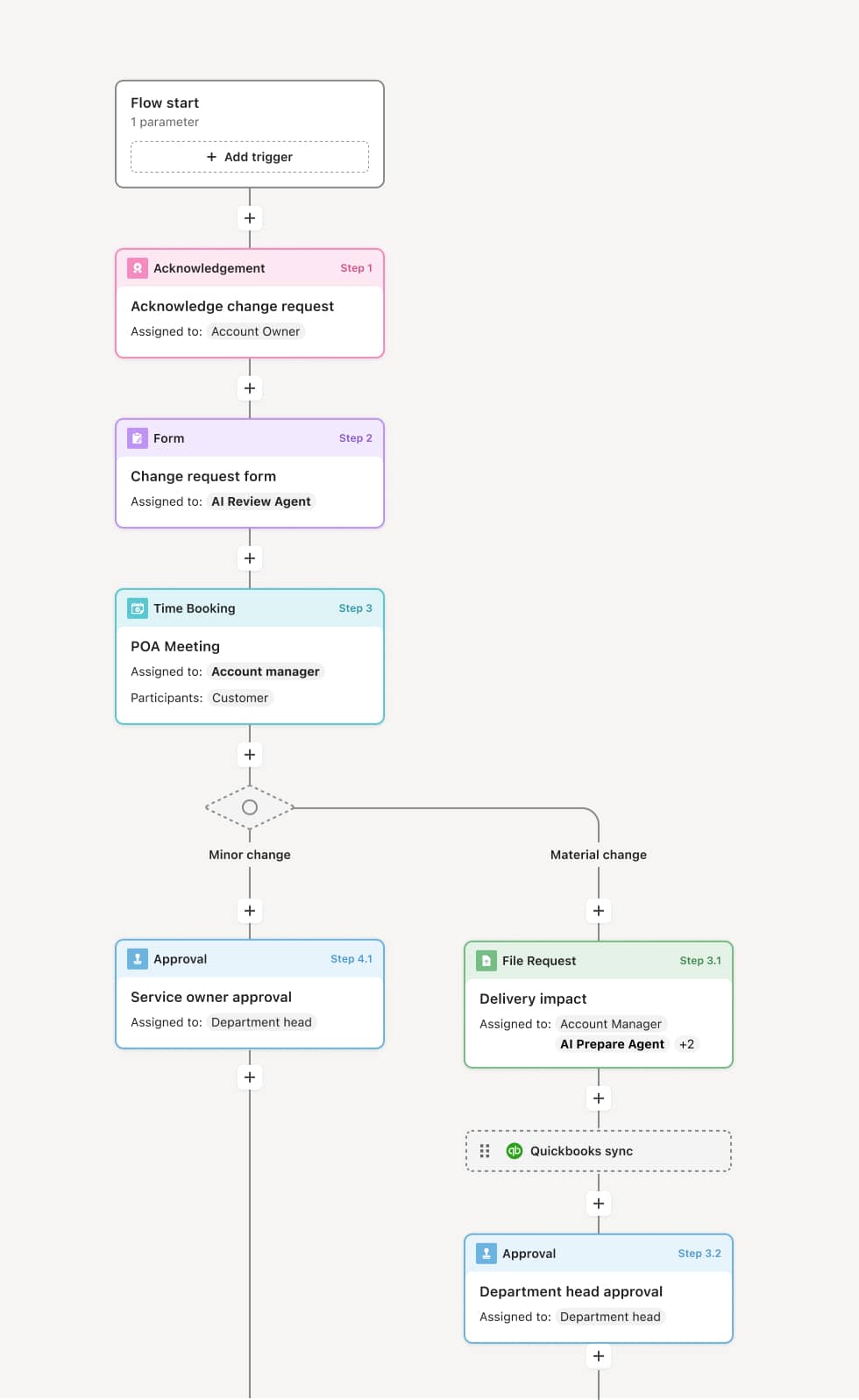
Your version of this process may vary based on roles, systems, data, and approval paths. Moxo’s flow builder can be configured with AI agents, conditional branching, dynamic data references, and sophisticated logic to match how your organization runs this workflow. The steps below illustrate one example.
Plan drafting and context submission
The process begins when a manager prepares a draft performance improvement plan, documenting the specific performance gaps, prior coaching or feedback provided, expected improvements, measurable goals, the timeline for improvement, and the consequences of not meeting the plan's objectives. Supporting documentation such as prior performance reviews, written feedback, or incident records may be attached. An AI Agent may assist by checking that required plan sections are complete and that the stated goals include measurable criteria, prompting the manager to fill in any gaps before the draft moves forward.
HR review and policy alignment
The draft plan is routed to an HR business partner who evaluates whether the PIP is consistent with organizational policy, whether the documented performance gaps are specific and substantiated, and whether the improvement expectations are reasonable and measurable. If the plan needs revision, the HR partner returns it to the manager with specific feedback. The HR partner may also review whether the employee has any accommodations, leave history, or other factors that should be considered before a PIP is issued.
Legal or compliance review
If the PIP involves an employee in a protected category, if the potential outcome includes termination, or if the organization's policy requires legal review for all PIPs, the plan is routed to employment counsel or a compliance advisor. This reviewer evaluates the plan for legal risk, consistency with prior actions taken in similar cases, and adherence to applicable employment regulations. If adjustments are recommended, the plan is returned to HR and the manager for revision before proceeding.
Final approval
With HR and legal reviews complete, the plan is routed to the department head or senior leader for final approval. The approver reviews the complete package, including the draft plan, performance documentation, HR notes, and any legal recommendations, before authorizing the PIP to be issued. If the approver identifies concerns, the plan may be returned for further revision or the approach may be reconsidered entirely.
Communication and issuance
Once approved, the finalized PIP is communicated to the employee, typically in a meeting with the manager and HR present. The employee acknowledges receipt of the plan, and the acknowledgment is captured as part of the process record. The plan's timeline, check-in schedule, and success criteria are formally documented, and the monitoring phase begins. All drafts, reviews, approvals, and the employee acknowledgment are retained as a complete record of the process.
This process commonly relies on inputs such as performance review records, documented coaching conversations, incident reports, the draft PIP document, organizational performance management policy, and any relevant accommodation or leave records. It may be triggered by a performance review cycle, a manager-initiated request, or an HR-identified pattern. Systems such as Workday, BambooHR, or an HRIS may provide performance history, employee records, and policy documentation.
Key decision points include whether the documented performance gaps are specific and substantiated enough to support a formal PIP, whether the improvement plan is reasonable, measurable, and consistent with how similar cases have been handled, whether legal review is required based on the employee's status or the potential outcome, and whether the plan should proceed as drafted, be revised, or be replaced with an alternative approach.
Vague or unmeasurable improvement goals, when the plan lacks specific criteria, making it difficult to assess whether the employee has met expectations. Inconsistent application across departments, when different managers issue PIPs with different standards, exposing the organization to claims of unfair treatment. Insufficient documentation of prior coaching, when the PIP references performance issues that were not previously communicated or documented, weakening the plan's foundation. Delayed legal review, when PIPs that require counsel review sit without action, delaying issuance and potentially allowing performance issues to persist.
Orchestrates the full PIP approval lifecycle from plan drafting through HR review, legal assessment, final approval, and employee communication in a single coordinated process.
AI Agents check plan completeness and consistency by verifying that required sections are present, goals are measurable, and the plan references documented performance context before it reaches HR review.
Routes plans through the appropriate review path based on factors such as the employee's status, the potential outcome, and organizational policy, ensuring legal review is triggered when required.
Extends existing HRIS and performance management systems such as Workday or BambooHR by connecting employee records and performance history directly into the approval workflow.
Captures a complete record of every draft, review, approval, and employee acknowledgment so HR and legal teams can trace any PIP back to its documented basis and authorization chain.