Chief compliance officer
General counsel
HR director
Operations director
Risk manager
Chief operating officer

This process is used when an organization creates a new policy, revises an existing policy, or must formally reaffirm a policy as part of a review cycle. It is triggered by regulatory changes, operational incidents that reveal gaps, strategic shifts, merger or acquisition integration, or scheduled policy review periods. Policy approval becomes especially important when the policy affects multiple departments, when it carries legal or compliance implications, or when it governs how the organization interacts with customers, partners, or regulators. This process is relevant across all industries and is particularly critical in financial services, healthcare, government, and any heavily regulated environment.
Policy approval typically involves a policy owner or author who drafts or revises the policy, subject matter experts from affected departments who provide operational input, legal counsel who reviews for regulatory compliance and risk, a compliance team that ensures alignment with existing frameworks and standards, and an executive sponsor or leadership committee that provides final authorization. In organizations with governance committees, the policy may also require a formal vote or ratification.
Legally and operationally sound policies by ensuring every policy is reviewed by legal, compliance, and operational stakeholders before adoption. Consistent review standards through a structured process that applies the same rigor to every policy regardless of department or author. Reduced risk of policy gaps by requiring cross-functional input before a policy is finalized, catching conflicts or omissions early in the review cycle. Clear authorization and version control with every draft, comment, revision, and approval decision recorded as part of the policy's lifecycle.
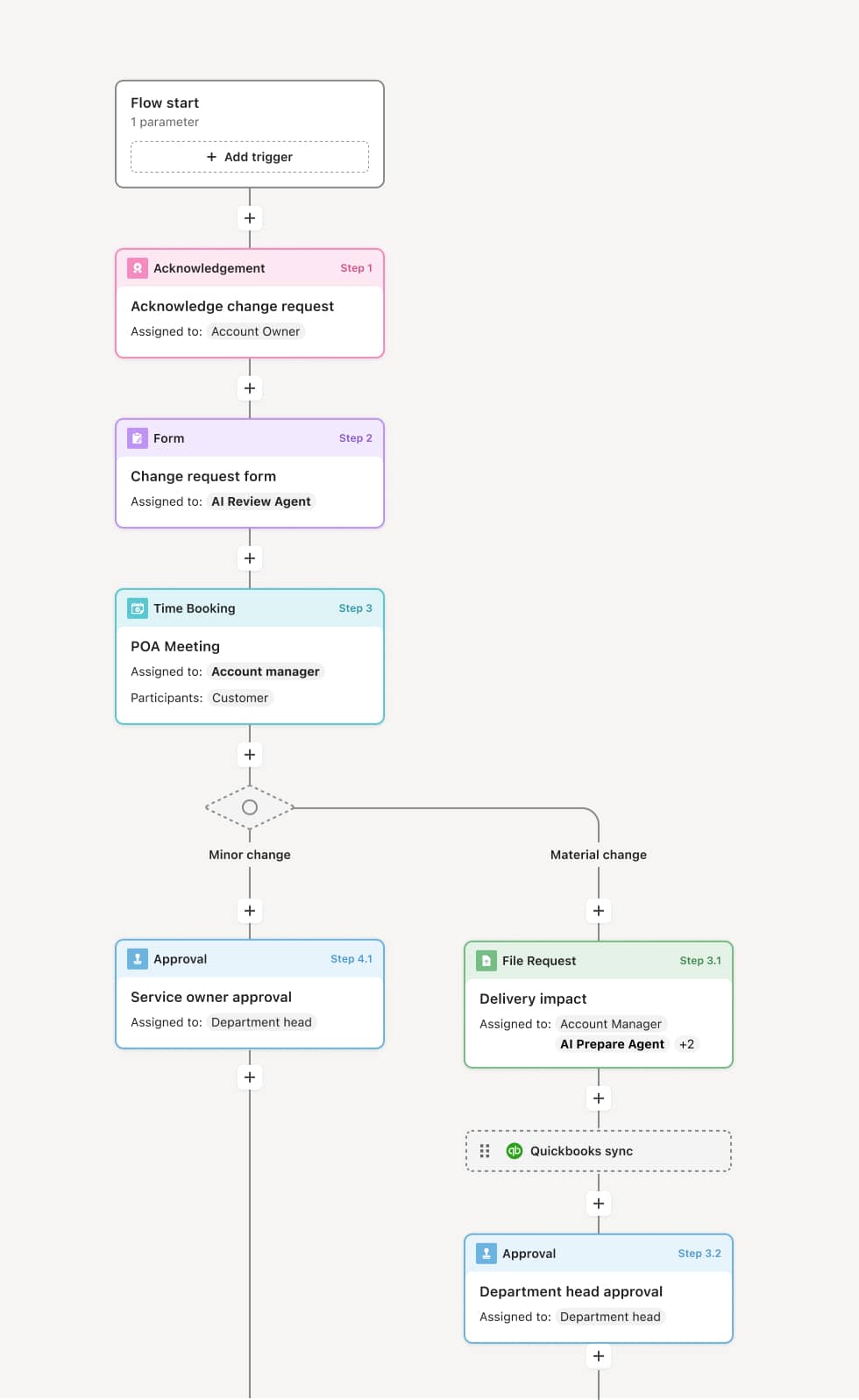
Your version of this process may vary based on roles, systems, data, and approval paths. Moxo’s flow builder can be configured with AI agents, conditional branching, dynamic data references, and sophisticated logic to match how your organization runs this workflow. The steps below illustrate one example.
Drafting and submission
The process begins when a policy owner drafts a new policy or proposes revisions to an existing one. The draft includes the policy's purpose, scope, key provisions, affected roles, effective date, and any supporting rationale such as regulatory references or incident reports that prompted the change. An AI Agent may assist by checking the draft against a standard policy template to identify missing sections or formatting inconsistencies, ensuring the submission is complete before it enters review.
Cross-functional input
The draft policy is circulated to subject matter experts and stakeholders from departments that will be directly affected by the policy. These reviewers provide operational feedback, identify implementation challenges, and suggest modifications based on how the policy would play out in practice. If multiple departments are affected, input may be gathered in parallel so that feedback is collected efficiently without creating sequential delays. Comments and suggestions are captured in context alongside the specific policy provisions they address.
Legal and compliance review
After cross-functional feedback is incorporated, the revised draft moves to legal counsel and the compliance team. Legal reviews the policy for regulatory alignment, risk exposure, and enforceability. Compliance evaluates whether the policy is consistent with existing frameworks, standards, and any applicable certifications. If either reviewer identifies issues, the policy is returned to the author with specific guidance for revision. This cycle may repeat until both legal and compliance are satisfied.
Executive authorization
With legal and compliance approval, the policy is routed to the executive sponsor, leadership committee, or governance body for final authorization. The approver reviews the complete package, including the policy draft, cross-functional feedback summary, legal and compliance sign-offs, and any revision history. If a governance committee is involved, the policy may be added to a meeting agenda for formal vote. Authorization may be granted, deferred for further revision, or declined with documented reasoning.
Publication and communication
Once authorized, the policy is finalized with an effective date and version number, and published to the organization's policy repository. Affected departments and roles are notified, and acknowledgment may be required from key personnel. The complete policy record, including all drafts, feedback, reviews, and authorization decisions, is retained as a structured governance artifact. Scheduled review dates are set to ensure the policy is re-evaluated on the appropriate cycle.
This process commonly relies on inputs such as the draft policy document, regulatory references, incident reports or audit findings that prompted the policy, existing policy frameworks, and feedback from affected departments. It may be triggered by a regulatory change, an operational incident, a scheduled review cycle, or an executive directive. Systems such as a policy management platform, SharePoint, Confluence, or a GRC tool like ServiceNow may provide policy templates, version history, and compliance tracking.
Key decision points include whether the draft policy is complete and formatted consistently, whether cross-functional feedback requires substantive revisions, whether legal and compliance reviewers approve the policy as drafted or require changes, and whether the executive sponsor or governance body authorizes the policy for publication or defers it for further work.
Incomplete stakeholder input, when affected departments are not consulted, leading to policies that are difficult to implement or that conflict with operational realities. Prolonged review cycles, when legal, compliance, and executive reviews are sequential without clear timelines, causing policies to stall between stages. Version confusion, when multiple drafts circulate without clear version control, leading to reviewers commenting on outdated documents. Missing acknowledgment from affected teams, when policies are published without confirmation that the people responsible for implementation have reviewed and understood them.
Orchestrates the full policy approval lifecycle from drafting through cross-functional input, legal and compliance review, executive authorization, and publication in a single coordinated process.
AI Agents check drafts for completeness and formatting consistency before the policy enters review, reducing back-and-forth over structural issues.
Enables parallel cross-functional review so affected departments can provide input simultaneously rather than waiting in sequence, shortening the overall review cycle.
Extends existing policy management and GRC systems such as SharePoint, Confluence, or ServiceNow by connecting policy templates, version history, and compliance records directly into the approval workflow.
Captures a complete record of every draft, comment, review decision, and authorization so governance teams can trace any published policy back to its full review history and approval chain.