Revenue operations lead
Sales director
Pricing analyst
Finance controller
Chief revenue officer
Deal desk manager

This process is used whenever a sales representative or account manager proposes pricing that deviates from standard rate cards, requires a custom discount, or involves non-standard commercial terms. It is triggered when a deal exceeds the rep’s approval authority, when a discount surpasses a defined margin threshold, or when special terms such as extended payment windows, volume commitments, or bundled pricing are included. Pricing approval is especially important when deal values are high, when precedent-setting terms are proposed, or when margin erosion across the pipeline needs to be monitored. This process is relevant in SaaS, manufacturing, distribution, professional services, and any organization with negotiated or variable pricing.
Pricing approval typically involves the sales representative or account manager who submits the pricing request, a deal desk or pricing analyst who evaluates the proposal against standard guidelines and margin targets, a finance reviewer who assesses the financial impact, and a senior leader such as a CRO or VP of Sales who authorizes exceptions. Revenue operations may also participate to ensure consistency across the pipeline.
Protected margins by ensuring every discount or non-standard term is reviewed against profitability thresholds before the deal moves forward. Faster deal velocity by routing standard pricing through streamlined paths and reserving detailed review for exceptions. Consistent pricing discipline through structured evaluation that prevents ad hoc discounting and ensures similar deals receive similar treatment. Auditable pricing decisions with every request, review, and authorization recorded so revenue teams can analyze discounting patterns and margin impact over time.
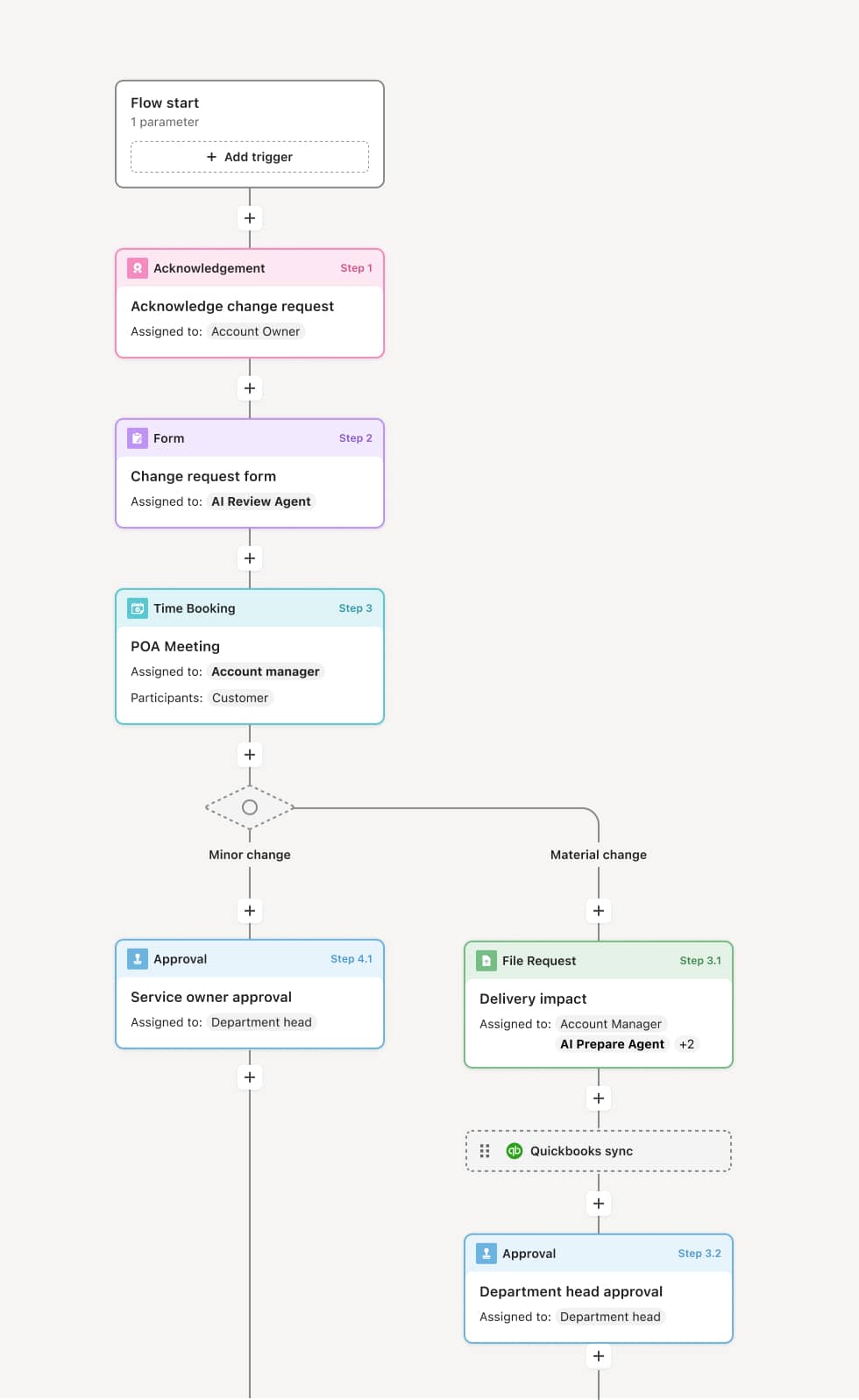
Your version of this process may vary based on roles, systems, data, and approval paths. Moxo’s flow builder can be configured with AI agents, conditional branching, dynamic data references, and sophisticated logic to match how your organization runs this workflow. The steps below illustrate one example.
Pricing request submission
The process begins when a sales representative submits a pricing request that falls outside their standard authority. The request includes the proposed price or discount, deal size, customer context, competitive justification, and any non-standard terms. An AI Agent may assist by comparing the proposed pricing against the rate card, calculating the margin impact, and flagging whether the discount exceeds standard thresholds, giving reviewers immediate context.
Deal desk evaluation
The request is routed to a deal desk analyst or pricing specialist who evaluates the proposal against established guidelines. This includes assessing the discount level relative to deal size, reviewing whether the customer qualifies for the proposed tier, and checking for consistency with similar recent deals. If the proposal falls within standard parameters, the analyst may approve it directly. If it requires further review, the analyst prepares a recommendation and forwards the request to finance or senior leadership.
Financial impact review
For proposals that exceed standard guidelines or involve significant revenue commitment, a finance reviewer assesses the broader financial impact. This includes evaluating the effect on overall margin targets, contract lifetime value, and whether the proposed terms create precedent risk for future deals. If the financial impact is acceptable, the reviewer endorses the request. If adjustments are needed, the request is returned to the sales team with specific guidance on acceptable parameters.
Senior authorization
Pricing requests that exceed defined thresholds or involve strategic accounts are routed to a senior leader for final authorization. The approver reviews the complete package, including the original request, deal desk evaluation, financial impact assessment, and any competitive context. Authorization may be granted as submitted, granted with conditions, or declined with guidance for renegotiation.
Confirmation and deal progression
Once authorized, the approved pricing is confirmed to the sales team, and the deal moves forward with the agreed terms. The pricing decision, including the approved discount, any conditions, and the authorizing party, is recorded as part of the deal record. This enables revenue operations to track discounting trends and margin performance across the pipeline.
This process commonly relies on inputs such as the pricing request form, rate card or standard pricing schedule, customer account data, deal context and competitive justification, and margin or profitability models. It may be triggered by a CRM event such as a deal stage change in Salesforce or HubSpot, a manual request from the sales team, or a CPQ system output. Systems such as Salesforce, DealHub, or NetSuite may provide deal data, pricing history, and margin calculations.
Key decision points include whether the proposed discount falls within the rep’s standard authority or requires escalation, whether the deal desk evaluation endorses the pricing as consistent with guidelines, whether the financial impact is acceptable relative to margin targets and precedent risk, and whether senior authorization is required based on deal size or strategic significance.
Unapproved discounts reaching customers, when sales teams communicate pricing before formal approval, creating commitment risk. Inconsistent treatment of similar deals, when different reps receive different rulings on comparable pricing requests due to lack of visibility into precedent. Slow approval cycles, when multi-level reviews are required but routing is unclear, delaying deal progression and risking competitive loss. Missing margin impact analysis, when pricing is approved based on deal size alone without evaluating the effect on overall profitability targets.
Orchestrates the full pricing approval lifecycle from request submission through deal desk evaluation, financial review, senior authorization, and deal progression in a single coordinated process.
AI Agents calculate margin impact and flag threshold breaches so reviewers enter each evaluation with quantified context rather than manually computing discount effects.
Routes requests conditionally based on discount level, deal size, and account type ensuring standard deals move quickly while exceptions receive appropriate scrutiny.
Extends existing CRM and CPQ systems such as Salesforce, HubSpot, or DealHub by connecting deal data and pricing history directly into the approval workflow.
Captures a complete record of every request, evaluation, and authorization so revenue operations can analyze pricing decisions, discounting trends, and margin performance across the pipeline.