VP of sales
Revenue operations director
Deal desk lead
Finance director
Chief revenue officer
Pricing strategist

This process is used when an organization needs to formalize how pricing decisions are made across its commercial operations, rather than handling approvals on a case-by-case basis. It is triggered when sales teams begin closing deals that require non-standard pricing, when revenue leakage from inconsistent discounting becomes a concern, or when the organization scales to a point where ad hoc approvals create risk and bottlenecks. The pricing approval process is especially important during periods of rapid growth, new product launches, or market expansion when pricing discipline directly affects revenue quality. It is relevant across SaaS, manufacturing, distribution, professional services, and any organization managing negotiated commercial terms at scale.
The pricing approval process involves sales representatives who initiate pricing requests, a deal desk or pricing team that sets and maintains pricing guidelines, revenue operations leaders who define approval thresholds and routing logic, finance reviewers who assess margin impact, and senior commercial leaders who authorize strategic exceptions. The process may also involve product teams when pricing changes affect product packaging or positioning.
Scalable pricing governance by establishing a repeatable process that handles increasing deal volume without adding manual overhead. Improved revenue quality by ensuring every pricing decision is evaluated against margin targets, policy guidelines, and strategic objectives. Reduced cycle time for standard deals by clearly defining which requests can be approved at lower authority levels and which require escalation. Cross-functional alignment on commercial terms by bringing sales, finance, and product stakeholders into a shared pricing decision framework.
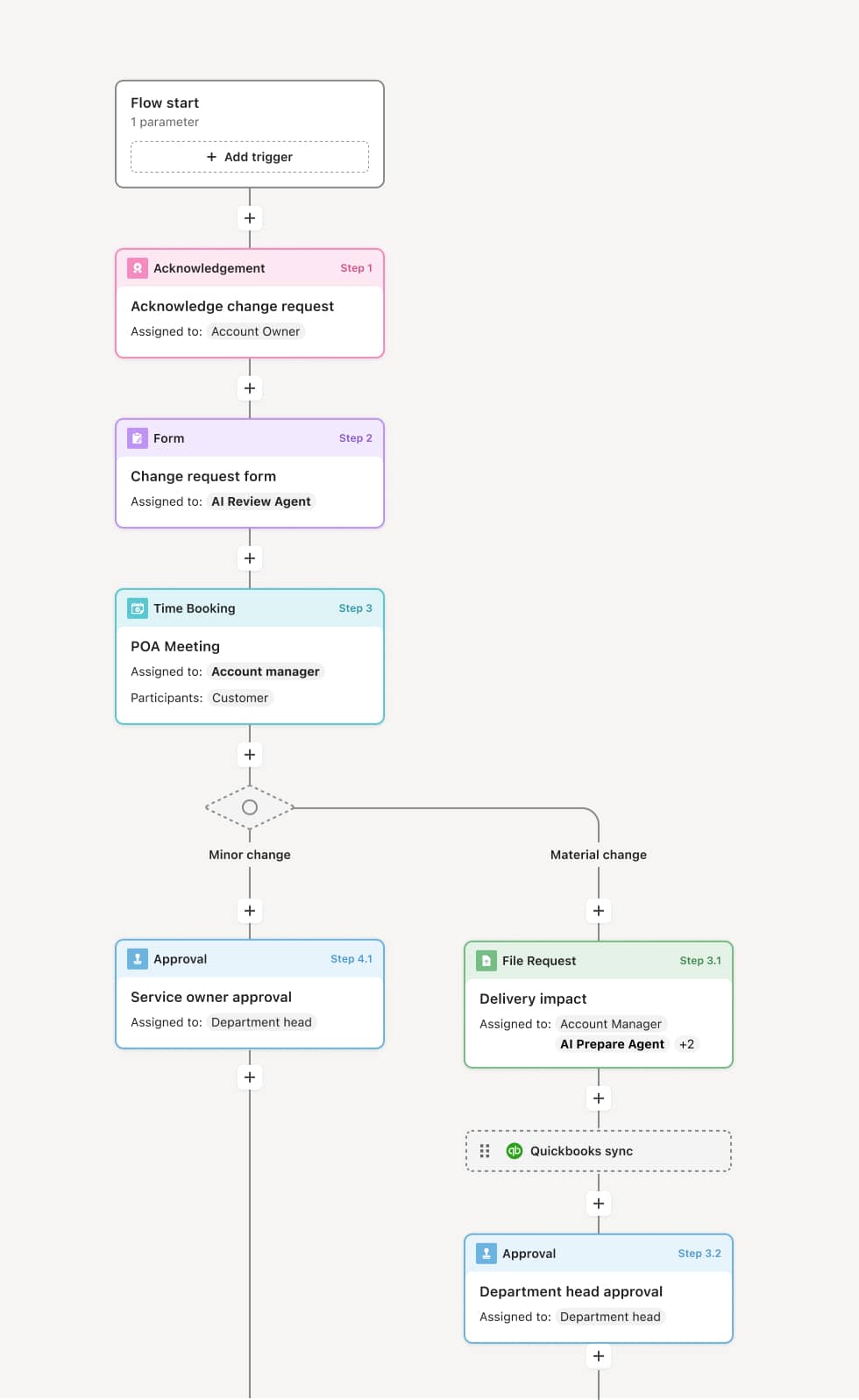
Your version of this process may vary based on roles, systems, data, and approval paths. Moxo’s flow builder can be configured with AI agents, conditional branching, dynamic data references, and sophisticated logic to match how your organization runs this workflow. The steps below illustrate one example.
Process design and threshold definition
The process begins with revenue operations and finance establishing the approval framework, including standard pricing guidelines, discount authority levels, escalation thresholds, and the criteria that determine which deals require additional review. These parameters are configured into the workflow so that routing happens based on defined rules rather than manual judgment at the point of request. An AI Agent may assist by analyzing historical deal data to recommend threshold levels based on actual discounting patterns and margin outcomes.
Request intake and classification
When a pricing request is submitted, the process classifies it based on the discount level, deal size, customer segment, product line, and any non-standard terms. Standard requests that fall within the rep’s authority may be approved immediately. Requests that exceed defined thresholds are automatically routed to the appropriate review tier. The classification ensures that every request enters the correct path without requiring manual triage.
Tiered review and evaluation
Requests requiring review move through the appropriate tier of evaluation. A deal desk analyst reviews against pricing policy and recent precedent. If the request exceeds deal desk authority, it escalates to a finance reviewer who evaluates margin impact and contract lifetime value. Strategic or executive-level deals may escalate further to a CRO or pricing committee. At each tier, reviewers see the full context of the request, prior evaluations, and any AI-prepared analysis.
Authorization and conditions
The authorized reviewer at the appropriate tier grants approval, applies conditions, or declines the request with documented reasoning. Conditions may include volume commitments, term length requirements, or sunset clauses on promotional pricing. The authorization, including any conditions, is recorded and communicated back to the requesting sales team.
Execution and performance tracking
Approved pricing flows into the deal record and the contract or order process. Over time, the pricing approval process generates structured data on discounting frequency, margin outcomes, approval cycle times, and exception rates. This data feeds back into the process design, enabling revenue operations to refine thresholds, adjust authority levels, and identify areas where pricing policy may need to evolve.
This process commonly relies on inputs such as pricing guidelines, rate cards, discount authority matrices, deal data from CRM systems, margin models, and historical approval records. It may be triggered by individual deal submissions or by periodic reviews of pricing policy. Systems such as Salesforce, HubSpot, CPQ tools like DealHub or Apttus, and financial planning platforms may provide deal context, pricing history, and margin analytics.
Key decision points include how requests are classified and routed based on discount level and deal characteristics, whether the deal desk can approve within its authority or must escalate, whether the financial impact assessment supports the proposed pricing, and whether conditions should be attached to the approval to protect margin or enforce commitments.
Undefined authority levels, when it is unclear which role can approve which discount range, leading to inconsistent routing and delays. Threshold bypass, when sales teams negotiate pricing verbally with customers before submitting for approval, creating pressure to rubber-stamp requests. Stale pricing guidelines, when rate cards and margin targets are not updated to reflect current market conditions, causing excessive exception volume. Limited feedback loops, when the process does not generate data on discounting trends and margin outcomes, preventing continuous improvement.
Orchestrates the complete pricing approval framework from threshold definition through intake classification, tiered review, authorization, and performance tracking in a single operational process.
AI Agents classify requests and prepare margin analysis automatically so each request enters the correct review path with quantified context.
Enables configurable authority tiers and conditional routing so standard deals move quickly while exceptions receive the appropriate level of review.
Extends existing CRM and CPQ platforms such as Salesforce, HubSpot, or DealHub by connecting deal data and pricing policy directly into the approval workflow.
Generates structured data on every pricing decision enabling revenue operations to continuously refine thresholds, authority levels, and pricing policy based on actual outcomes.