Deal desk manager
Revenue operations lead
VP of sales
Finance controller
Chief revenue officer
Pricing analyst

This process is used when a deal requires pricing that falls outside the bounds of standard approval authority, whether due to an unusually deep discount, non-standard payment terms, a custom bundling arrangement, or a strategic concession to win or retain an account. It is triggered when a pricing request exceeds the maximum threshold handled by the standard pricing approval process, when a customer demands terms that conflict with pricing policy, or when a competitive situation requires a one-time deviation. Pricing exception approval is especially important for high-value deals, accounts with long-term strategic significance, and situations where the exception could create precedent for future negotiations. This process is common in SaaS, enterprise sales, manufacturing, and any organization with complex or negotiated pricing structures.
Pricing exception approval typically involves the sales representative who submits the exception request with deal context, a deal desk analyst who quantifies the deviation from standard pricing, a finance reviewer who evaluates the margin and revenue impact, and a senior commercial leader such as a CRO, VP of Sales, or pricing committee that makes the final authorization. Revenue operations may also participate to assess precedent risk across the pipeline.
Protected pricing integrity by requiring explicit justification and senior authorization for every deviation beyond standard guidelines. Informed exception decisions with margin impact, competitive context, and precedent risk evaluated before authorization. Reduced precedent risk by documenting every exception and its conditions, preventing informal discounting from becoming the default. Faster resolution on strategic deals by routing exceptions directly to the appropriate authority with pre-assembled context rather than through ad hoc escalation.
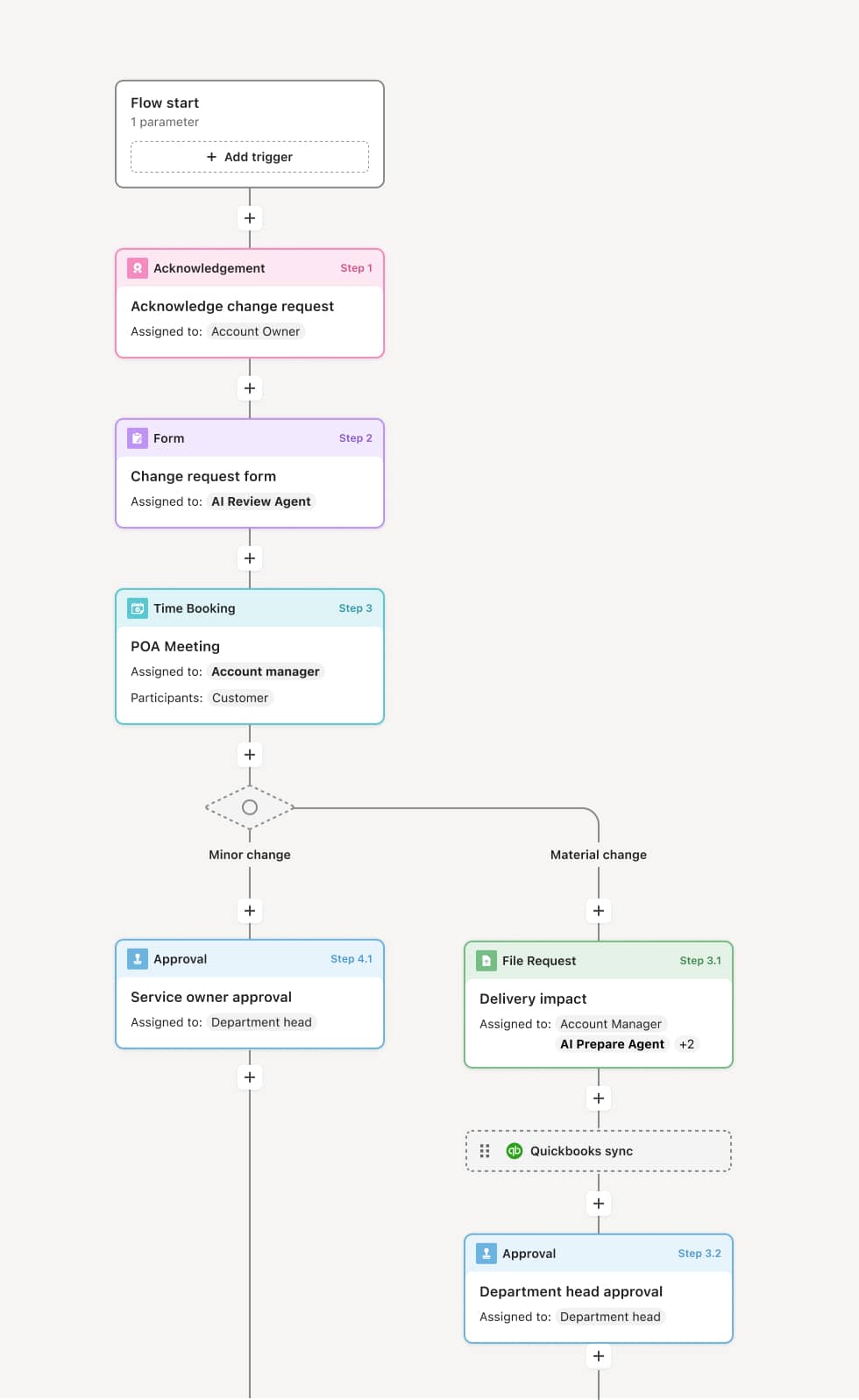
Your version of this process may vary based on roles, systems, data, and approval paths. Moxo’s flow builder can be configured with AI agents, conditional branching, dynamic data references, and sophisticated logic to match how your organization runs this workflow. The steps below illustrate one example.
Exception request and strategic justification
The process begins when a sales representative submits a pricing exception request, including the proposed pricing, the standard rate for comparison, the customer and deal context, competitive pressures, and the strategic rationale for the deviation. An AI Agent may assist by calculating the margin variance, comparing the request against recent exceptions for similar deal profiles, and flagging whether the customer has received prior exceptions, giving reviewers a quantified starting point.
Deal desk quantification
The deal desk analyst reviews the exception against current pricing guidelines and quantifies the deviation. This includes the discount depth relative to the rate card, the impact on deal margin and contract lifetime value, and whether the proposed terms create structural risk such as unsustainable pricing floors or unfavorable renewal dynamics. The analyst prepares a recommendation, endorsing the exception, proposing a counteroffer, or recommending denial, before the request escalates further.
Financial and precedent review
For exceptions with significant margin impact or precedent risk, a finance reviewer evaluates the broader implications. This includes assessing the effect on quarterly revenue quality, whether approving the exception could trigger similar requests from other accounts or reps, and whether the deal contributes enough strategic value to justify the concession. If the exception involves non-standard payment terms, finance also evaluates the cash flow impact.
Executive authorization
The exception is routed to the designated authority, typically a CRO, VP of Sales, or pricing committee, for final authorization. The approver reviews the complete package, including the original request, deal desk quantification, financial assessment, and any competitive intelligence. Authorization may be granted as requested, granted with conditions such as volume commitments or term requirements, or declined with a recommended counteroffer for the customer.
Documentation and deal execution
Once authorized, the approved exception terms are documented and communicated to the sales team. The exception record, including the justification, all reviews, conditions, and the authorizing decision, is linked to the deal in the CRM. This structured record supports future pricing analysis and ensures the exception is traceable if questions arise during renewals, audits, or pipeline reviews.
This process commonly relies on inputs such as the exception request, standard rate card, deal and customer data from the CRM, margin and lifetime value models, competitive intelligence, and records of prior exceptions. It may be triggered by a deal stage change, a manual escalation from the deal desk, or a pricing request that exceeds automated threshold checks. Systems such as Salesforce, HubSpot, CPQ tools, and financial planning platforms may provide deal context, pricing history, and margin analytics.
Key decision points include whether the strategic justification supports the requested deviation, whether the margin impact is acceptable relative to the deal’s overall value and the organization’s profitability targets, whether the exception creates unacceptable precedent risk for future deals, and whether conditions should be attached to the approval to limit exposure.
Weak strategic justification, when the exception request relies on vague competitive pressure rather than documented deal context, making it difficult for approvers to evaluate. Unquantified margin impact, when the financial implications of the exception are not calculated before the request reaches senior leadership. Precedent creep, when approved exceptions are not tracked or communicated, leading other reps to request similar or deeper concessions on subsequent deals. Post-approval term drift, when the final contract includes terms that differ from what was authorized in the exception process.
Orchestrates the full pricing exception lifecycle from request submission through deal desk quantification, financial review, executive authorization, and deal execution in a single coordinated process.
AI Agents calculate margin variance and surface prior exception patterns so reviewers evaluate each request with quantified context and historical comparison.
Routes exceptions based on deviation severity, deal size, and strategic significance ensuring each request reaches the appropriate authority without unnecessary escalation layers.
Extends existing CRM and CPQ systems such as Salesforce or HubSpot by linking exception records directly to deal data and pricing history.
Captures a complete record of every justification, review, authorization, and condition so revenue operations can track exception frequency, margin impact, and precedent patterns across the pipeline.