Prior authorization manager
Clinical operations director
Revenue cycle lead
Medical office manager
Nurse coordinator
Payer relations specialist

This process is used when a healthcare provider plans to deliver a service, procedure, diagnostic test, medication, or referral that the patient’s insurance plan requires prior authorization before coverage is confirmed. It applies when the payer’s coverage policy demands clinical justification demonstrating medical necessity, and when the request must be submitted, tracked, and resolved before the service can be rendered or the claim submitted. It is common when clinical staff, authorization specialists, and the payer must coordinate within defined turnaround times while the patient awaits access to care. Ideal for physician practices, hospitals, ambulatory surgery centers, imaging centers, specialty pharmacies, and any healthcare organization managing payer authorization requirements.
The prior authorization process typically involves the ordering provider who determines the clinical need, clinical staff or nurses who gather supporting documentation, prior authorization specialists who prepare and submit the request, payer utilization review teams who evaluate the request, and the patient who is informed of the status and any implications for their care timeline.
Faster authorization turnaround because requests are submitted with complete clinical documentation the first time, reducing payer requests for additional information. Fewer authorization denials through structured submission that addresses the payer’s specific clinical criteria for the requested service. Reduced care delays by tracking every authorization from submission through determination and alerting the team to pending or overdue requests. Clear patient communication about the authorization status and expected timeline for their scheduled service. Complete authorization records that support claim submission, appeal preparation, and compliance with payer requirements.
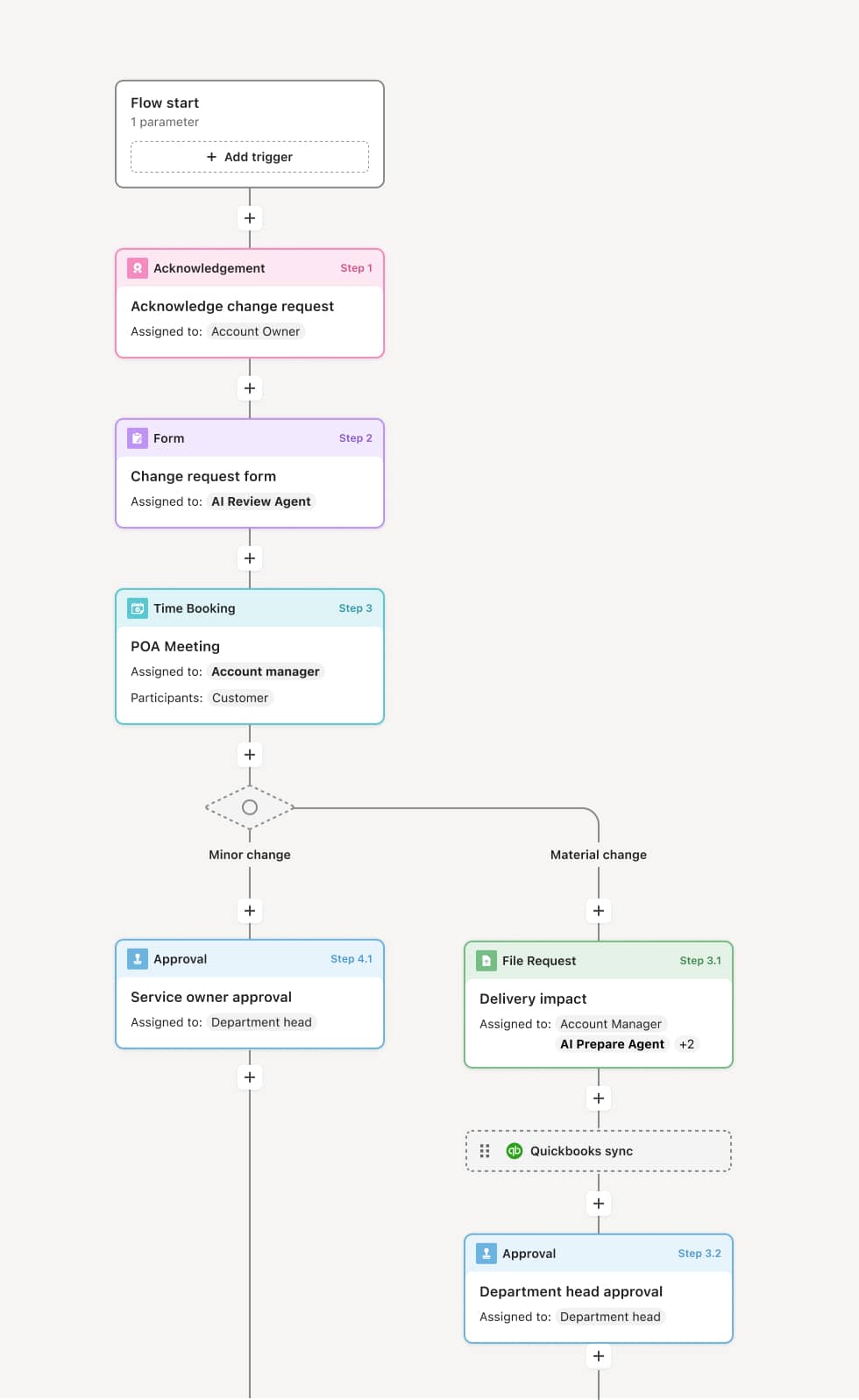
Your version of this process may vary based on roles, systems, data, and approval paths. Moxo’s flow builder can be configured with AI agents, conditional branching, dynamic data references, and sophisticated logic to match how your organization runs this workflow. The steps below illustrate one example.
Authorization requirement identification
The process begins when a provider orders a service that triggers a prior authorization requirement based on the patient’s insurance plan. The authorization requirement may be identified through the practice management system, during scheduling, or at the point of order entry. An AI Agent can assist by checking the patient’s plan against the service or procedure to confirm whether authorization is required and pulling the payer’s specific clinical criteria.
Clinical documentation gathering
The authorization specialist works with clinical staff to assemble the required documentation including the provider’s order, clinical notes supporting medical necessity, relevant diagnostic results, prior treatment history, and any payer-specific forms. An AI Agent may pre-populate the authorization request with available clinical data and flag missing elements before submission.
Request submission
The authorization request is submitted to the payer through the designated channel — electronic portal, fax, phone, or electronic prior authorization system. The submission includes the clinical justification, supporting documentation, and service details. The submission date and method are logged.
Payer review and response tracking
The payer’s utilization review team evaluates the request against their coverage criteria. The authorization specialist tracks the request status and follows up if the payer’s response exceeds expected turnaround times. If the payer requests additional information, the team gathers and submits it promptly.
Determination and next steps
The payer issues a determination — approved, partially approved, denied, or pended for peer review. If approved, the authorization number and validity dates are recorded and the service proceeds. If denied, the team evaluates whether to appeal, request peer-to-peer review, or pursue an alternative service. The patient is informed of the determination and any impact on their care timeline.
Authorization documentation and expiration tracking
The authorization record, including the approval or denial, authorization number, validity period, and any conditions, is preserved. For approved authorizations, the system tracks the expiration date to ensure the service is rendered within the authorized window.
This process commonly relies on inputs such as the provider’s order, clinical notes, diagnostic results, payer coverage criteria, and patient insurance information. It may be triggered by a service order, a scheduling event, or a pharmacy claim rejection requiring authorization. Connected systems often include practice management systems, EHR platforms like Epic or Cerner, electronic prior authorization platforms like CoverMyMeds or Availity, and payer portals.
Key decision points include whether the planned service requires prior authorization based on the patient’s specific insurance plan, whether the clinical documentation meets the payer’s medical necessity criteria, whether a denial warrants appeal, peer-to-peer review, or an alternative service plan, and whether the authorized service is rendered within the authorization’s validity period.
Authorization requirement not identified before the service is rendered, resulting in a claim denial after delivery. Incomplete clinical documentation submitted with the initial request, triggering payer requests for additional information and delaying the determination. Payer response not tracked, allowing pending authorizations to go unresolved while the patient waits. Authorization expiration missed, requiring re-authorization when the service is not rendered within the validity window. Patient not informed of the authorization process, creating frustration and uncertainty about their care timeline.
Orchestrates prior authorization from identification through determination across clinical staff, authorization specialists, payers, and patients in a single coordinated flow.
Identifies authorization requirements at the point of order or scheduling with AI Agents that check the patient’s plan against the planned service.
Assembles complete authorization requests by pulling clinical data from connected systems and flagging documentation gaps before submission.
Tracks every authorization to determination with alerts for pending, overdue, or expiring authorizations so no request falls through gaps.
Connects to EHR, practice management, and ePA platforms like Epic, CoverMyMeds, and Availity so clinical data and authorization status flow seamlessly.
Preserves the complete authorization record including submissions, determinations, authorization numbers, and validity periods for claim support and compliance.