Procurement manager
Operations director
Finance controller
Department head
Chief financial officer
Supply chain manager

This process is used whenever an organization needs to authorize the purchase of goods, services, equipment, or materials, whether through a new vendor engagement, a contract renewal, or a one-time purchase. It is triggered when a purchase requisition is submitted, when a budget threshold is reached, or when a new vendor must be evaluated before engagement. Procurement approval becomes especially important for high-value purchases, sole-source justifications, capital expenditures, or when purchases span multiple departments. This process is relevant across all industries and functions, and is particularly critical in manufacturing, healthcare, government, and organizations with formal procurement policies.
Procurement approval typically involves the requestor who identifies the need and submits the requisition, a procurement specialist who evaluates vendor options and compliance, a budget owner who confirms financial availability, and a senior approver who authorizes purchases above defined thresholds. Legal may review contracts for non-standard terms, and a receiving or operations team may confirm delivery requirements.
Controlled spending by ensuring every purchase is reviewed against budget, policy, and business need before commitment. Vendor compliance through structured evaluation that confirms vendor qualifications, insurance, and contractual terms before engagement. Faster procurement cycles by routing standard requisitions through streamlined paths and reserving detailed review for high-value or non-standard purchases. Complete purchase traceability with every requisition, evaluation, and approval decision linked to the originating business need.
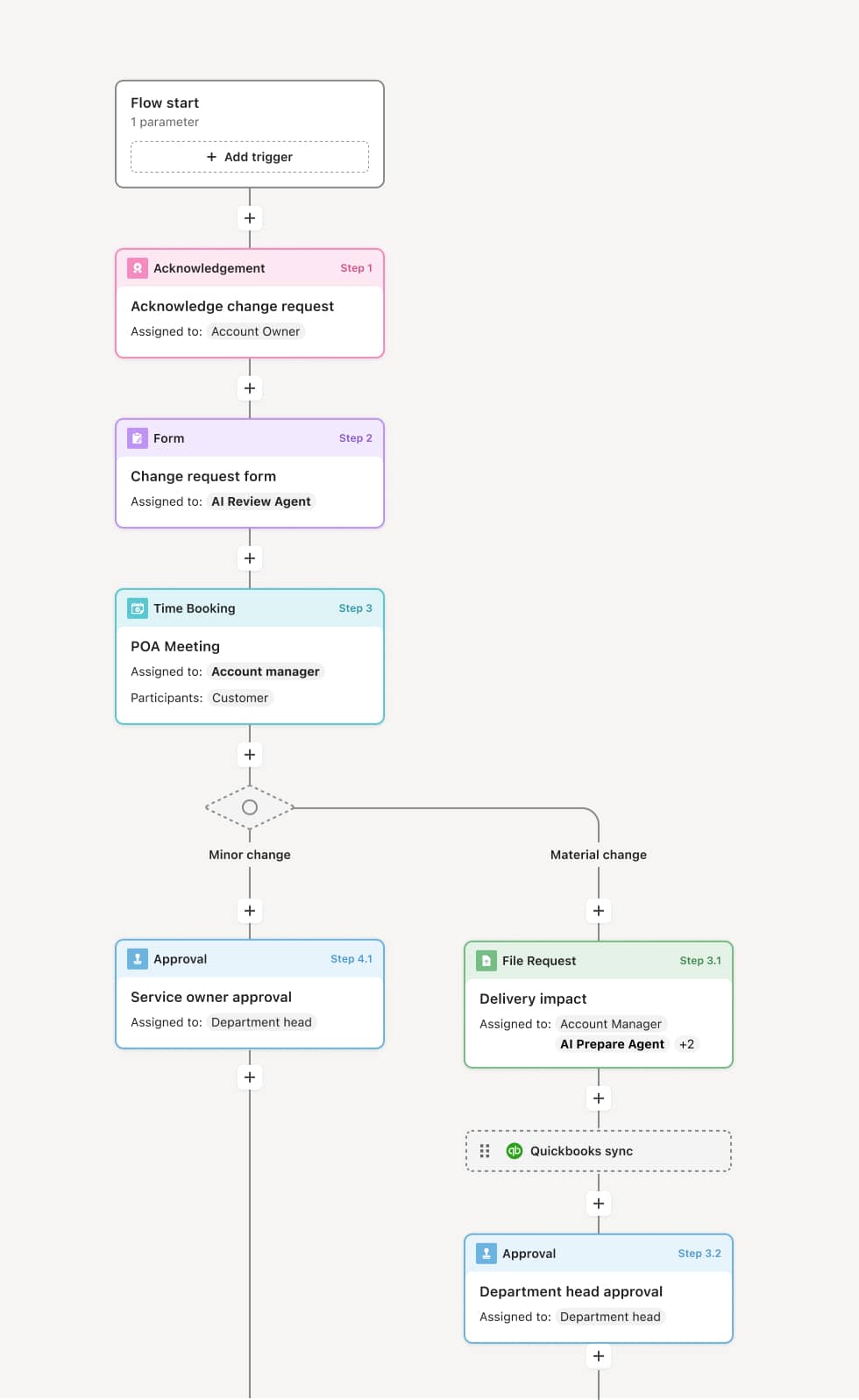
Your version of this process may vary based on roles, systems, data, and approval paths. Moxo’s flow builder can be configured with AI agents, conditional branching, dynamic data references, and sophisticated logic to match how your organization runs this workflow. The steps below illustrate one example.
Requisition submission
The process begins when a requestor submits a purchase requisition, including the goods or services needed, estimated cost, preferred vendor if applicable, required delivery timeline, and business justification. An AI Agent may assist by checking the request against existing contracts and preferred vendor lists, flagging whether a similar purchase was recently made, and identifying whether the estimated cost exceeds the requestor’s spending authority.
Procurement evaluation
The requisition is routed to the procurement team for evaluation. This includes reviewing vendor options, comparing quotes if required, verifying vendor compliance and qualifications, and ensuring the purchase aligns with organizational procurement policy. If the requisition involves a new vendor, the evaluation may include a vendor onboarding assessment. If the purchase is covered by an existing contract, the procurement specialist confirms that the terms apply.
Budget validation
After procurement evaluation, the request moves to the relevant budget owner who confirms that the purchase fits within their approved allocation. If the purchase spans multiple departments, parallel budget confirmations may be required. If the budget is insufficient, the request may be deferred, reduced in scope, or escalated for additional funding approval.
Approval routing
With procurement and budget validation complete, the requisition is routed to the appropriate approver based on the purchase amount, category, and organizational policy. Standard purchases within defined thresholds may be approved by a department head, while capital expenditures or high-value purchases require sign-off from a finance controller, CFO, or executive committee. The approver reviews the complete package, including the requisition, vendor evaluation, budget confirmation, and any procurement notes.
Purchase execution and closure
Once approved, the purchase order is issued to the vendor, and the procurement team coordinates delivery and receipt. Upon delivery, the receiving team confirms that the goods or services match the purchase order specifications. All requisition, evaluation, approval, and receipt records are retained as a complete procurement record.
This process commonly relies on inputs such as purchase requisitions, vendor quotes, existing contracts, budget allocation data, vendor compliance records, and delivery specifications. It may be triggered by a department request, a system event from an ERP, or a contract renewal notification. Systems such as SAP Ariba, Coupa, NetSuite, or Oracle may provide procurement data, vendor records, and budget information.
Key decision points include whether the purchase aligns with an existing contract or preferred vendor relationship, whether the budget has sufficient allocation, whether the vendor meets compliance and qualification requirements, and whether the purchase amount triggers escalation to a higher approval authority.
Maverick spending, when purchases are made outside the formal procurement process, bypassing vendor evaluation and budget controls. Incomplete vendor evaluation, when new vendors are engaged without verifying qualifications, insurance, or compliance, creating risk. Budget overruns from parallel requests, when multiple requisitions against the same budget are approved without visibility into cumulative commitment. Slow approval cycles for standard purchases, when routine, low-risk requisitions are subjected to the same review depth as high-value or non-standard purchases.
Orchestrates the full procurement lifecycle from requisition through vendor evaluation, budget validation, approval, and purchase execution in a single coordinated process.
AI Agents check requisitions against contracts and spending history flagging duplicates, preferred vendor matches, and threshold breaches before the request reaches a human reviewer.
Routes approvals conditionally based on purchase amount, category, and vendor status so standard purchases move quickly while non-standard or high-value requests receive appropriate scrutiny.
Extends existing procurement and ERP systems such as SAP Ariba, Coupa, or NetSuite by connecting vendor data, budget records, and purchase orders directly into the approval workflow.
Captures a complete record of every requisition, evaluation, and authorization so procurement and finance teams can trace any purchase back to its originating need and approval chain.