Product manager
VP of product
Marketing director
General counsel
Operations director
Chief product officer

This process is used when an organization is preparing to release a new product, feature, service tier, or major update to market. It is triggered when the product reaches a defined readiness milestone, when a launch date is approaching, or when cross-functional coordination is required to align messaging, legal compliance, operational readiness, and customer support. Product launch approval becomes especially important when the launch involves regulatory filings, contractual commitments, significant marketing spend, or changes that affect existing customers. This process is relevant in technology, healthcare, financial services, consumer goods, manufacturing, and any organization managing coordinated market releases.
Product launch approval typically involves the product manager who leads the launch effort and coordinates readiness, engineering or development leads who confirm technical readiness, marketing teams who prepare go-to-market materials, legal counsel who reviews compliance and risk, operations and support teams who confirm readiness to serve customers, and an executive sponsor who provides the final go/no-go decision.
Coordinated cross-functional readiness by ensuring every contributing team confirms their readiness before launch rather than discovering gaps on launch day. Reduced launch risk through structured legal, compliance, and operational reviews that surface issues while they can still be addressed. Clear go/no-go accountability with a single, documented decision point where the launch is formally authorized or deferred. Faster time to market by running readiness reviews in parallel across functions rather than sequentially.
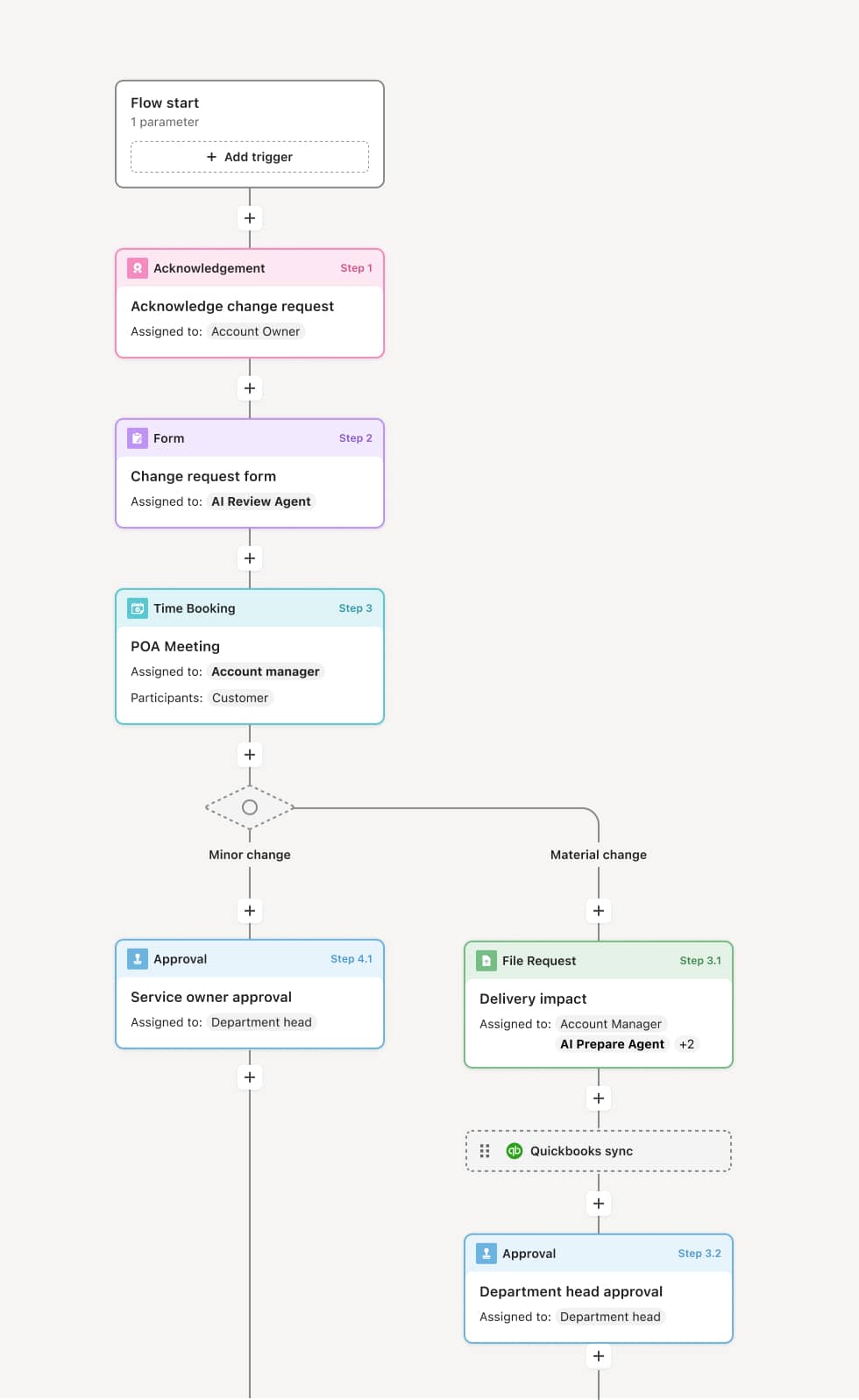
Your version of this process may vary based on roles, systems, data, and approval paths. Moxo’s flow builder can be configured with AI agents, conditional branching, dynamic data references, and sophisticated logic to match how your organization runs this workflow. The steps below illustrate one example.
Launch planning and readiness criteria definition
The process begins when the product manager defines the launch scope, target date, and readiness criteria for each contributing function. This includes what engineering must deliver, what marketing must prepare, what legal must clear, and what operations must have in place. An AI Agent may assist by compiling the readiness checklist based on previous launches and organizational templates, ensuring no critical area is omitted.
Cross-functional readiness assessments
Each contributing function conducts its readiness assessment against the defined criteria. Engineering confirms that the product meets quality and stability standards. Marketing confirms that go-to-market materials, messaging, and campaign assets are complete. Legal confirms that regulatory filings, terms of service updates, and any required disclosures are in order. Operations confirms that support teams are trained, documentation is published, and infrastructure is scaled. These assessments may run in parallel to reduce the overall timeline.
Issue identification and resolution
If any function identifies a blocker or risk during their assessment, it is surfaced immediately to the product manager and the launch team. The team evaluates whether the issue can be resolved before the launch date, whether a workaround exists, or whether the launch must be delayed. This phase may involve iterative cycles of issue resolution and re-assessment until all functions report readiness or a decision is made to proceed with known risks.
Go/no-go decision
With all readiness assessments complete and any outstanding issues documented, the executive sponsor or launch committee convenes for the formal go/no-go decision. The decision-maker reviews the consolidated readiness report, any unresolved risks and their mitigation plans, and the overall impact of launching versus delaying. The decision is recorded with its rationale, and all stakeholders are notified of the outcome.
Launch execution and post-launch review
Once the go decision is confirmed, each function executes their launch responsibilities according to the coordinated plan. After launch, a post-launch review captures lessons learned, customer feedback, and operational performance. The complete launch record, including all readiness assessments, issue resolutions, and the go/no-go authorization, is retained for future reference.
This process commonly relies on inputs such as product specifications, QA and testing reports, go-to-market plans, legal compliance checklists, support readiness assessments, and infrastructure scaling confirmations. It may be triggered by a product milestone, a release candidate completion, or a calendar-driven launch date. Systems such as Jira, Asana, Confluence, or a product management platform may provide development status, testing results, and documentation readiness.
Key decision points include whether each function has met its defined readiness criteria, whether any identified blockers can be resolved before the target launch date, whether the organization is willing to launch with documented known risks, and whether the executive sponsor authorizes the go or directs a delay.
Undiscovered readiness gaps, when functions report readiness without thorough assessment, leading to post-launch issues that could have been caught. Late-stage legal or compliance blockers, when regulatory or legal requirements are surfaced too late to resolve without delaying the launch. Misaligned launch timing, when marketing, sales, and operations are not synchronized, resulting in a fragmented market introduction. Missing post-launch review, when the organization moves on without capturing lessons learned, repeating the same gaps in future launches.
Orchestrates the full product launch lifecycle from readiness planning through cross-functional assessment, issue resolution, go/no-go authorization, and post-launch review in a single coordinated process.
AI Agents compile readiness checklists and flag incomplete assessments ensuring every function is prompted to report against defined criteria before the go/no-go decision.
Enables parallel readiness reviews across all contributing functions so engineering, marketing, legal, and operations can work simultaneously rather than sequentially.
Extends existing product management and project tools such as Jira, Asana, or Confluence by connecting development status and documentation readiness directly into the launch approval workflow.
Captures a complete record of every readiness assessment, issue resolution, and authorization so product teams can trace any launch decision back to its supporting evidence and approval chain.