Project manager
Construction manager
Contract administrator
Project owner
Finance director
Facilities director

This process is used when project conditions require modifications to the original contract, scope, budget, or schedule. It is triggered when unforeseen site conditions are discovered, when design changes are requested by the owner, when errors or omissions in original specifications require correction, when regulatory requirements change during execution, or when value engineering opportunities are identified. The process becomes essential when changes have cost implications requiring budget adjustment, when schedule impacts affect project milestones, when multiple parties must agree to modified terms, or when audit requirements demand documented authorization for contract modifications. Ideal for construction and engineering firms, facilities management organizations, professional services with fixed-scope engagements, manufacturing with custom orders, and any project-based business where scope changes require formal management.
This process typically involves contractors or vendors who identify change conditions and propose change orders, project managers who evaluate technical merit and coordinate stakeholder review, contract administrators who assess contractual implications and maintain change documentation, estimators or cost engineers who validate pricing and schedule impacts, finance personnel who confirm budget availability for cost increases, and project owners or sponsors who authorize changes above defined thresholds. For construction projects, architects or engineers may review design-related changes.
Controlled scope management with all project changes formally evaluated and authorized before work proceeds. Accurate project budgeting when change order costs are captured and approved before they impact financials. Protected contractual rights through proper documentation of change conditions and authorization. Reduced disputes when all parties agree to changes before work is performed, avoiding after-the-fact disagreements. Maintained project schedule by managing schedule impacts through formal change authorization rather than informal scope creep.
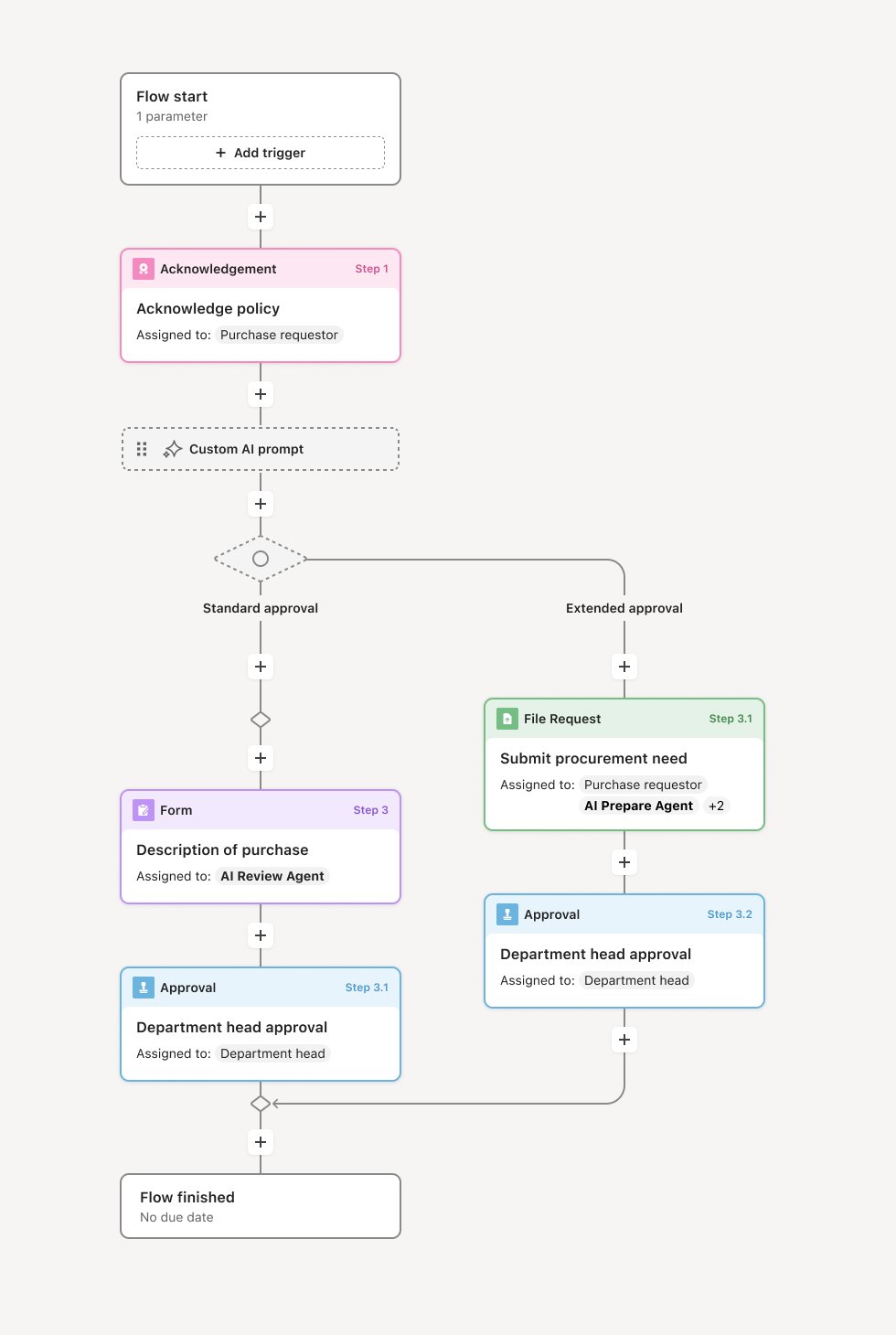
Your version of this process may vary based on roles, systems, data, and approval paths. Moxo's flow builder can be configured with AI agents, conditional branching, dynamic data references, and sophisticated logic to match how your organization runs this workflow. The steps below illustrate one example.
Change identification and request submission
The process begins when a change condition is identified that requires modification to the original agreement. The contractor, project team, or owner submits a change order request documenting the change scope, reason or justification, proposed cost adjustment with supporting detail, schedule impact if any, and reference to relevant contract provisions. Supporting documentation may include photographs, field reports, design modifications, or regulatory correspondence. An AI agent can assist by validating that required information is complete, checking the request against contract terms, and flagging if similar changes have been submitted previously.
Technical and scope review
The project manager and relevant technical personnel review the change request for validity and scope accuracy. This includes verifying that the change is genuinely outside original scope, that the proposed work description is accurate and complete, that the change is necessary for project success, and that alternatives have been considered. For design-related changes, architects or engineers may validate technical approach. If the change request is incomplete or technically flawed, it is returned to the submitter for revision before proceeding.
Cost and schedule validation
Cost engineers or estimators review the proposed pricing for reasonableness. This includes comparing labor, material, and equipment costs against market rates, evaluating overhead and markup percentages against contract terms, and assessing whether the proposed schedule impact is justified. Negotiation may occur between the owner and contractor to reach agreed pricing. For significant changes, independent cost estimates may be obtained. Cost validation confirms that the proposed price represents fair value for the changed work.
Budget and funding confirmation
Finance reviews the change order against project budget and contingency. This includes confirming that funds are available to cover the change, determining whether contingency should be used or additional funding is required, and updating project financial projections to reflect the proposed change. If the change exceeds available budget, escalation may be required to secure additional funding before the change can be approved. Budget confirmation ensures the organization can fund the changed work.
Authorization and execution
Based on change order value and project authority levels, the appropriate approvers authorize the change. Smaller changes may be approved by project managers within their delegated authority. Larger changes require director, owner representative, or executive approval. Once all required approvals are obtained, the change order is executed with signatures from authorized representatives of all parties. The approved change order modifies the contract and authorizes the contractor to proceed with changed work. The workflow records the complete approval chain, negotiation history, and executed documentation.
This process commonly relies on inputs such as change order request forms, original contract documents, scope documentation, cost breakdowns with supporting quotes, schedule analysis, project budget data, and authorization matrices defining approval thresholds. It may be triggered by events like unforeseen field conditions, owner-requested modifications, design changes, regulatory requirements, or value engineering proposals. Common systems that integrate with this workflow include project management platforms like Procore or Oracle Primavera, contract management systems, cost estimation tools, financial systems where project budgets are maintained, and document management systems for contract files.
Key decision points include determining whether the change is genuinely outside original scope, whether the proposed cost is fair and reasonable, whether schedule impact is justified and acceptable, whether budget is available to fund the change, and which approval authority level is required based on change value. Each decision point may trigger negotiation on pricing, requests for additional documentation, budget reallocation discussions, escalation to senior approvers, or rejection with documented rationale.
Work before authorization where changed work proceeds without approved change orders, creating dispute risk. Inadequate cost justification when pricing is accepted without proper validation, leading to overpayment. Scope creep accumulation where many small changes bypass formal process and cumulatively impact budget significantly. Documentation gaps when change conditions are not properly recorded, undermining dispute resolution. Delayed processing where approval delays cause project slowdowns or force work to proceed without authorization.
Orchestrates the complete change order lifecycle from request submission through technical review, cost negotiation, budget confirmation, and authorization in a single coordinated flow.
Engages contractors and owners together providing secure collaboration space for external parties to submit requests and participate in review.
AI agents validate completeness and flag patterns checking that required documentation is included and identifying cumulative change impacts.
Connects to project management systems so contract data flows in automatically and approved changes update project budgets and schedules.
Routes by change value so minor changes are approved quickly by project managers while significant changes receive appropriate owner and executive review.
Maintains complete change records with timestamps, negotiation history, approver identities, and executed documentation for contract administration and dispute prevention.