Product manager
VP of engineering
UX design lead
Chief product officer
Technical architect
Program manager

This process is used when a product manager submits a requirements document, user story set, or feature specification for review and approval before development begins. It is triggered when a new feature or capability is proposed, when a significant change to existing functionality is required, or when a customer-driven request needs formal evaluation against the product strategy. Product requirements approval is especially important when engineering resources are constrained, when the requirement affects multiple product areas, or when the proposed work involves significant technical risk. This process is relevant in software, technology, manufacturing, and any organization managing a structured product development lifecycle.
Product requirements approval typically involves the product manager who authors and justifies the requirements, engineering leads who assess technical feasibility and effort, design leads who evaluate user experience implications, a technical architect who identifies dependencies and integration risks, and a product leadership team that makes prioritization and authorization decisions.
Strategic alignment of development investment by ensuring every approved requirement supports the product vision and organizational priorities. Realistic scope and feasibility through engineering and design review that identifies technical risk, effort, and dependencies before commitment. Reduced rework by catching ambiguities, missing acceptance criteria, and conflicting requirements during review rather than during development. Clear prioritization rationale with every approval or deferral decision documented so stakeholders understand why specific requirements were chosen.
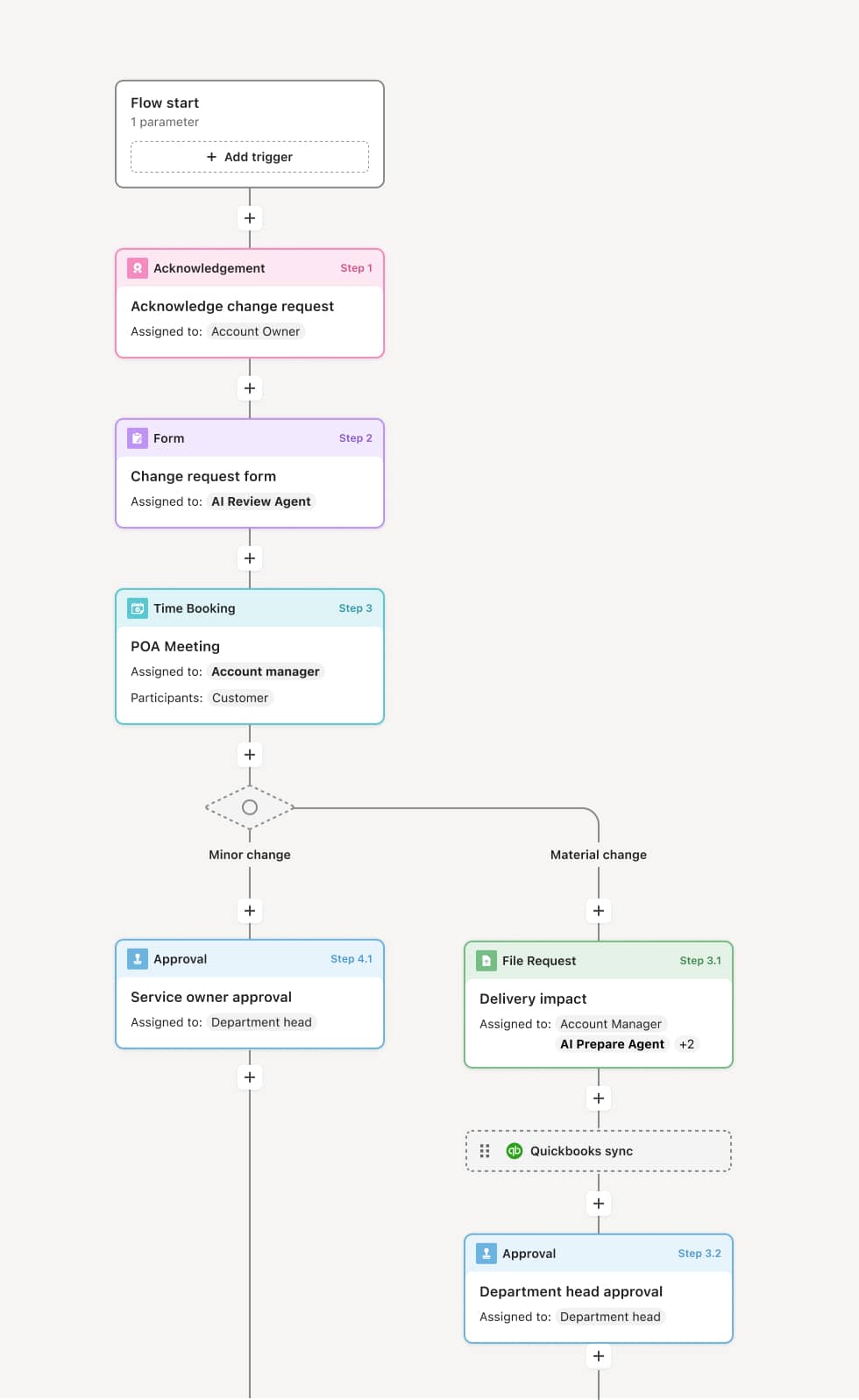
Your version of this process may vary based on roles, systems, data, and approval paths. Moxo’s flow builder can be configured with AI agents, conditional branching, dynamic data references, and sophisticated logic to match how your organization runs this workflow. The steps below illustrate one example.
Requirements drafting and submission
The process begins when a product manager submits a requirements document that includes the problem statement, proposed solution, user stories or acceptance criteria, success metrics, and strategic rationale. An AI Agent may assist by checking the submission for completeness, flagging missing acceptance criteria, and identifying whether similar requirements have been proposed or delivered previously.
Technical feasibility and effort assessment
The requirements are routed to engineering leads and a technical architect for feasibility review. This includes evaluating the technical approach, estimating effort and timeline, identifying dependencies on other systems or teams, and flagging any technical risks or constraints. If the requirements are not technically feasible as written, engineering provides feedback and alternative approaches for the product manager to consider.
Design and user experience review
In parallel with technical review, design leads evaluate the requirements for user experience implications. This includes assessing whether the proposed solution aligns with design patterns, whether user research supports the approach, and whether the requirements create inconsistencies in the product experience. Design feedback is captured alongside the requirements and technical assessment.
Prioritization and authorization
With feasibility and design review complete, the requirements package is presented to the product leadership team or executive sponsor for prioritization. The decision-maker reviews the complete package, including the requirements, feasibility assessment, effort estimate, design feedback, and strategic rationale. Requirements may be approved for the current roadmap, deferred to a future cycle, or returned for rescoping. The prioritization decision and its rationale are documented.
Handoff to development
Once approved, the requirements are formalized and handed off to the development team with the full context of the review, including any conditions or scope adjustments agreed during approval. The approved requirements, review history, and authorization decision are retained as a structured product record that development can reference throughout implementation.
This process commonly relies on inputs such as the requirements document or feature specification, user research, competitive analysis, technical architecture diagrams, and roadmap priorities. It may be triggered by a product planning cycle, a customer escalation, or a strategic initiative. Systems such as Jira, Productboard, Confluence, or Aha! may provide requirements data, backlog context, and roadmap alignment.
Key decision points include whether the requirements are complete and clearly defined with measurable acceptance criteria, whether the proposed solution is technically feasible within the available timeline and resources, whether the requirement aligns with the current product strategy and roadmap priorities, and whether the scope should be adjusted based on feasibility or design feedback.
Ambiguous acceptance criteria, when requirements lack measurable success conditions, leading to disagreements during development about what constitutes completion. Underestimated dependencies, when cross-system or cross-team dependencies are not identified during feasibility review, causing delays during implementation. Scope creep during development, when approved requirements are informally expanded after authorization without returning through the approval process. Disconnected prioritization, when requirements are approved individually without evaluating their relative priority against competing development needs.
Orchestrates the full requirements approval lifecycle from submission through technical feasibility, design review, prioritization, and development handoff in a single coordinated process.
AI Agents check requirements for completeness and surface related prior work so reviewers evaluate each submission with full context rather than starting from scratch.
Enables parallel engineering and design reviews so technical feasibility and user experience feedback are gathered simultaneously rather than sequentially.
Extends existing product management and development tools such as Jira, Productboard, or Confluence by connecting backlog data and roadmap priorities directly into the approval workflow.
Captures a complete record of every submission, review, and prioritization decision so product teams can trace any approved requirement back to its strategic rationale and authorization chain.