Project sponsor
PMO director
Finance controller
Resource manager
Chief operating officer
VP of operations

This process is used when an organization must decide whether to authorize a new project, whether it is an internal initiative, a client engagement, a capital investment, or a strategic program. It is triggered when a project proposal is submitted, when budget allocation decisions are being made, or when a new opportunity requires resource commitment. Project approval becomes especially important when resources are constrained, when the project involves significant financial commitment, when cross-departmental coordination is required, or when the project carries strategic or regulatory risk. This process is relevant across all industries and functions.
Project approval typically involves the project sponsor who champions the initiative and provides strategic justification, a project manager or PMO lead who prepares the proposal and feasibility assessment, a finance reviewer who evaluates the business case and budget, a resource manager who confirms team availability, and an executive leader or steering committee that makes the final authorization decision.
Strategic resource allocation by ensuring projects are evaluated against organizational priorities before resources are committed. Sound financial justification through structured business case review that validates cost projections, ROI estimates, and budget availability. Reduced project failure risk by identifying feasibility concerns, resource constraints, and dependencies during the approval phase rather than after work has begun. Clear authorization accountability with every evaluation, recommendation, and approval decision documented so stakeholders can trace the basis for any authorized project.
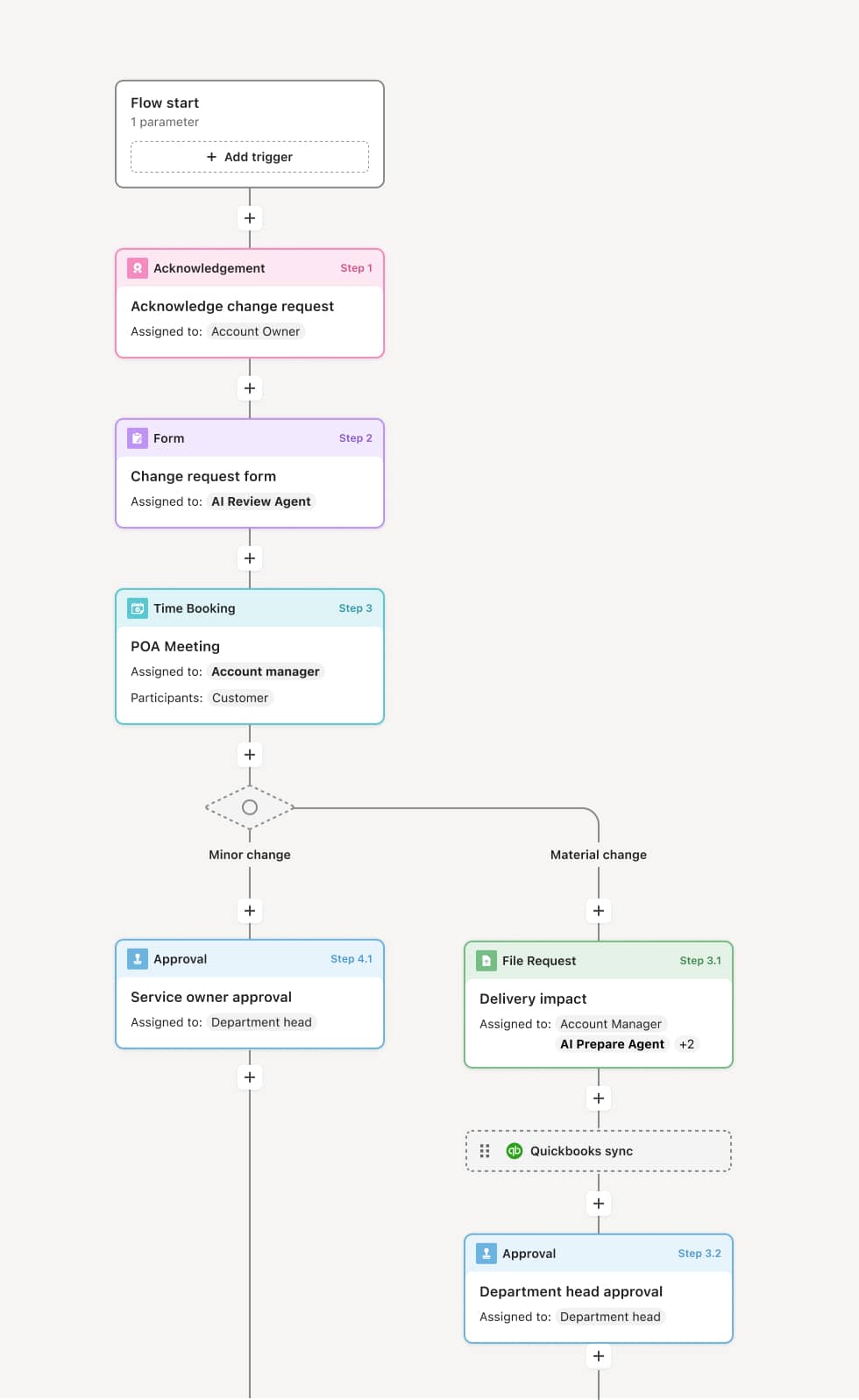
Your version of this process may vary based on roles, systems, data, and approval paths. Moxo’s flow builder can be configured with AI agents, conditional branching, dynamic data references, and sophisticated logic to match how your organization runs this workflow. The steps below illustrate one example.
Proposal submission
The process begins when a project sponsor or manager submits a project proposal that includes the project objective, scope, expected outcomes, estimated budget, timeline, resource requirements, and strategic rationale. An AI Agent may assist by checking the proposal against a standard template, flagging missing sections, and identifying whether similar projects have been proposed or are currently in progress.
Feasibility and risk assessment
The proposal is reviewed by the PMO, resource manager, and relevant subject matter experts for feasibility. This includes evaluating whether the timeline and budget are realistic, whether the required resources and skills are available, and whether the project introduces risks that need mitigation. Dependencies on other projects, systems, or external parties are identified. If feasibility concerns are significant, the proposal may be returned for rescoping.
Financial review
The finance team evaluates the project’s business case, including cost projections, expected return on investment, budget availability, and the financial impact on the organization’s portfolio. If the project competes with other initiatives for the same budget, the finance review includes a comparative assessment. If the business case does not meet organizational thresholds, the proposal may be returned with recommendations for adjustment.
Prioritization and authorization
With feasibility and financial review complete, the proposal is presented to the executive sponsor, steering committee, or leadership team for the authorization decision. The decision-maker reviews the complete package, including the proposal, feasibility assessment, financial analysis, and risk profile. The project may be approved, deferred, conditionally approved with scope modifications, or declined. The decision and its rationale are formally documented.
Initiation and handoff
Once approved, the project is formally initiated. The project manager receives authorization to mobilize resources, and the project is added to the organization’s active portfolio. All proposal details, assessments, and the authorization record are retained as a structured project record that serves as the foundation for project governance throughout execution.
This process commonly relies on inputs such as the project proposal, business case, resource plans, budget forecasts, risk assessments, and portfolio prioritization criteria. It may be triggered by a strategic initiative, a client request, a regulatory requirement, or a periodic planning cycle. Systems such as a PPM tool like Planview or Microsoft Project, an ERP, or a finance platform like NetSuite may provide portfolio data, budget status, and resource availability.
Key decision points include whether the project scope and timeline are feasible given available resources, whether the business case meets the organization’s financial thresholds for investment, whether the project aligns with current strategic priorities, and whether the risk profile is acceptable or requires additional mitigation before authorization.
Incomplete proposals, when submissions lack sufficient detail on scope, budget, or resource needs, forcing reviewers to request information iteratively. Resource conflicts, when a project is approved without confirming that the required team members are available, leading to delays at initiation. Optimistic financial projections, when business cases overstate returns or understate costs, setting the project up for budget overruns. Portfolio misalignment, when individual projects are approved in isolation without considering their cumulative impact on organizational capacity and priorities.
Orchestrates the full project approval lifecycle from proposal submission through feasibility assessment, financial review, prioritization, and initiation handoff in a single coordinated process.
AI Agents check proposals for completeness and surface related active projects so reviewers evaluate each submission in the context of the broader portfolio.
Routes proposals through the appropriate review path based on project size, type, and risk ensuring small initiatives move quickly while significant investments receive thorough evaluation.
Extends existing PPM and finance platforms such as Planview, Microsoft Project, or NetSuite by connecting portfolio data and budget status directly into the approval workflow.
Captures a complete record of every proposal, assessment, and authorization decision so governance teams can trace any active project back to its business case and approval chain.