Project manager
Engagement lead
Billing operations manager
Finance controller
Client partner
Revenue operations lead

This process is used whenever a project-based organization prepares to invoice a client for completed work, whether on a time-and-materials, fixed-fee, milestone, or hybrid billing model. It is triggered by a billing cycle deadline, a milestone completion, or a deliverable acceptance event. Project billing approval becomes especially important when invoices are high-value, when multiple billing models are in play across a single engagement, or when prior invoices have been disputed. This process is relevant in consulting, IT services, legal, architecture, engineering, marketing agencies, and any organization billing clients for project-based work.
Project billing approval typically involves the project manager who compiles the billing package, the delivery team that confirms work completion, a finance or billing operations team that validates amounts against the contract, an engagement lead who reviews the overall billing relationship, and the client who may acknowledge or approve the invoice before or after issuance.
Accurate and defensible invoices by validating every line item against the contract, approved scope, and confirmed work completion before billing. Reduced invoice disputes through structured pre-billing review that catches discrepancies before the client receives the invoice. Improved cash flow predictability by ensuring invoices are issued on time with correct amounts, reducing delays from corrections and resubmissions. Clear billing accountability with every validation, adjustment, and authorization recorded as part of the project’s financial record.
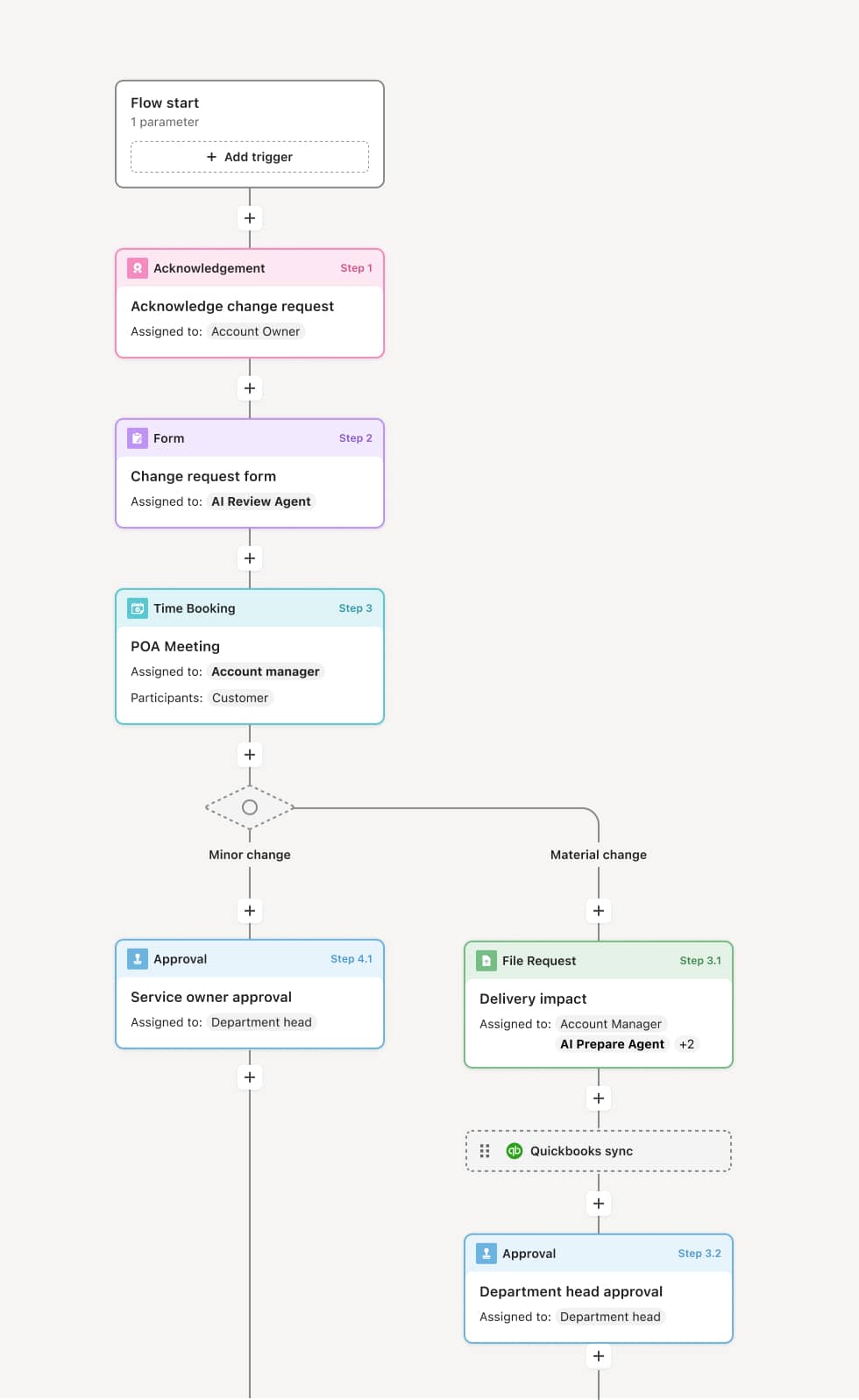
Your version of this process may vary based on roles, systems, data, and approval paths. Moxo’s flow builder can be configured with AI agents, conditional branching, dynamic data references, and sophisticated logic to match how your organization runs this workflow. The steps below illustrate one example.
Billing package preparation
The process begins when the project manager compiles the billing package for the review period or milestone. This includes approved time entries, completed deliverables, reimbursable expenses, and any change orders or scope adjustments. An AI Agent may assist by comparing the proposed billing against the contract terms, flagging entries that exceed approved rates or fall outside the statement of work, and preparing a summary that highlights any variances from the project budget.
Delivery confirmation
The delivery team or project lead confirms that the work reflected in the billing package has been completed to the expected standard. For milestone billing, this includes verifying that the milestone acceptance criteria have been met. For time-and-materials billing, this includes confirming that the reported hours are accurate and the work described was performed. If any items are in dispute or incomplete, they are excluded or flagged for resolution before billing proceeds.
Financial validation
The finance or billing operations team validates the billing package against the engagement contract. This includes checking rates, applying any contractual adjustments such as volume discounts or retainer offsets, verifying that cumulative billing does not exceed the contract ceiling, and confirming that all reimbursable expenses meet the contract’s expense policy. If corrections are needed, the package is returned to the project manager with specific line-item feedback.
Approval and invoicing
With delivery confirmation and financial validation complete, the billing package is authorized for invoicing. The engagement lead or finance controller provides final sign-off based on the overall billing relationship and any client-specific considerations. The invoice is generated and issued to the client. If the engagement requires client pre-approval of billing, the summary is shared with the client for acknowledgment before the invoice is finalized.
Post-invoicing tracking
After the invoice is issued, the billing record is linked to the project, and payment is tracked through the collections process. Any client questions or disputes are managed with reference to the validated billing package. The complete billing record, including the original package, delivery confirmations, financial validation, and authorization, is retained as part of the engagement’s financial history.
This process commonly relies on inputs such as approved time entries, deliverable acceptance records, expense reports, engagement contracts, rate cards, change orders, and prior billing history. It may be triggered by a billing cycle deadline, a milestone event, or a client-requested invoice. Systems such as a PSA platform like OpenAir or Kantata, an ERP like NetSuite, or a billing system may provide time data, contract terms, and invoice generation capabilities.
Key decision points include whether the reported work has been completed and meets the engagement’s acceptance criteria, whether the billing amounts are accurate and consistent with the contract, whether cumulative billing remains within the contract ceiling, and whether client pre-approval is required before the invoice is issued.
Billing for incomplete deliverables, when milestone invoices are submitted before acceptance criteria are fully met, leading to client pushback. Rate or contract misalignment, when invoice amounts do not match the agreed rates or terms, requiring corrections and reissuance. Missed billing windows, when the billing package is not prepared on time, delaying revenue recognition and cash flow. Undocumented scope changes, when work performed under change orders is not reflected in the billing package because the change order was not formally linked to the engagement.
Orchestrates the full project billing lifecycle from package preparation through delivery confirmation, financial validation, authorization, and post-invoicing tracking in a single coordinated process.
AI Agents compare billing against contract terms and flag variances so reviewers focus on exceptions rather than manually verifying every line item.
Enables parallel delivery confirmation and financial validation so both operational and financial reviews can happen simultaneously rather than sequentially.
Extends existing PSA and billing platforms such as OpenAir, Kantata, or NetSuite by connecting time data, contract terms, and billing history directly into the approval workflow.
Captures a complete record of every billing package, validation, and authorization so engagement and finance teams can defend any invoice with its full supporting documentation and approval chain.