HR manager
Department head
People operations lead
Compensation analyst
Executive leader
Team leader

This process is used when a manager or team leader nominates an employee for promotion, or when a promotion cycle is initiated as part of an annual or semi-annual review period. It applies when the promotion involves a change in level, title, compensation, or reporting structure that requires cross-functional review. Promotion approval is triggered by performance review outcomes, succession planning decisions, organizational restructuring, or retention-driven requests. It is common across all industries, particularly in organizations with defined career frameworks, compensation bands, or regulatory requirements around pay equity.
The nominating manager or team leader initiates the promotion request and provides performance evidence. HR reviews the request against policy, equity, and organizational guidelines. The compensation or finance team evaluates the budget impact and pay band alignment. Department heads or executive leaders provide final approval, particularly when the promotion crosses grade thresholds or involves significant compensation changes. In some organizations, a review committee may evaluate promotions collectively to ensure consistency.
Consistent promotion decisions across departments by applying the same criteria, review steps, and approval authority to every request. Reduced cycle time from nomination to decision by routing requests directly to the right reviewers with all supporting evidence assembled upfront. Clear compensation and budget alignment because finance reviews are built into the process before commitments are made, preventing post-approval surprises. Stronger retention outcomes because promotions are processed efficiently, signaling organizational commitment to employee growth. Auditable promotion history tied to performance evidence, policy checks, and approver decisions for every promotion across the organization.
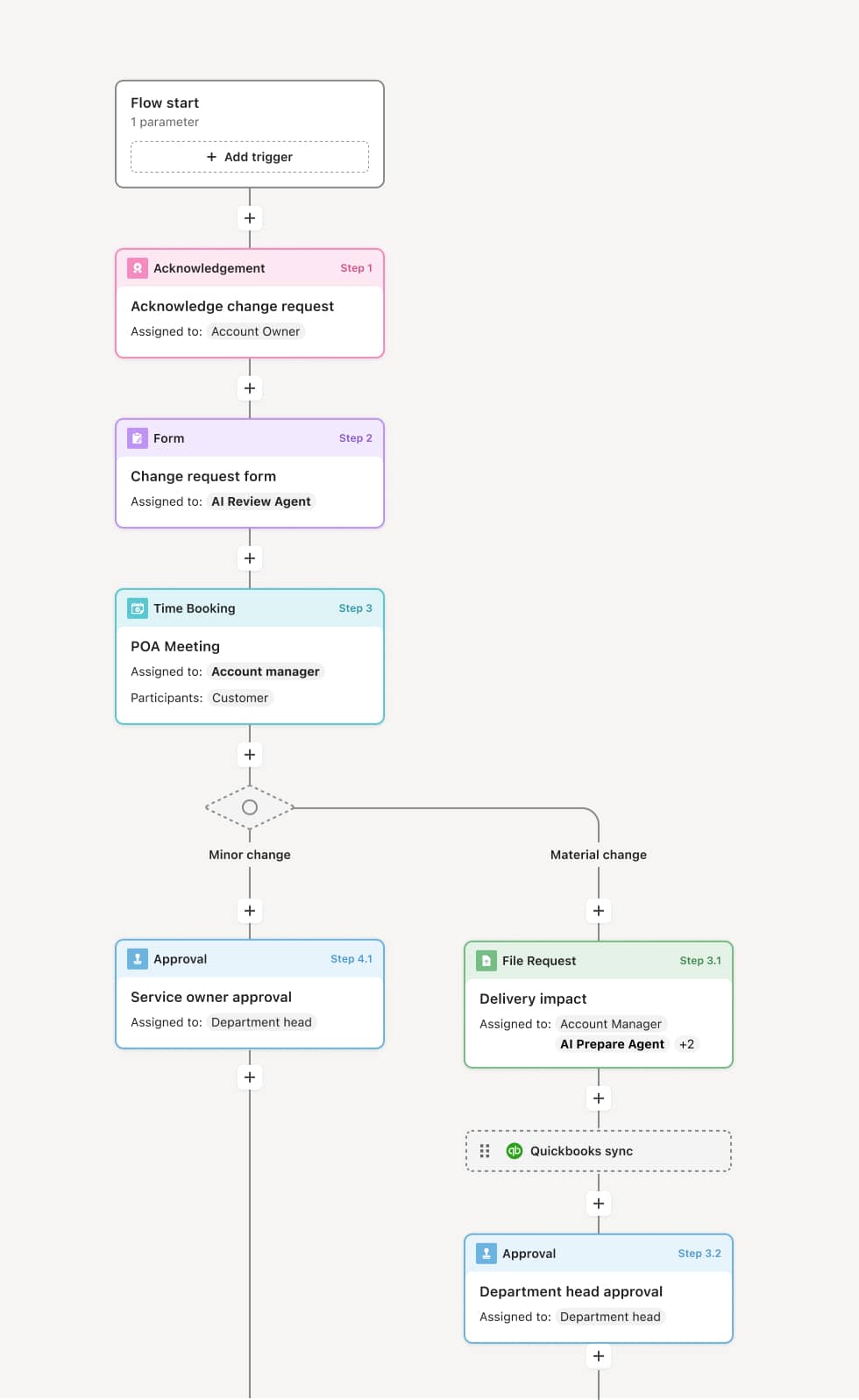
Your version of this process may vary based on roles, systems, data, and approval paths. Moxo’s flow builder can be configured with AI agents, conditional branching, dynamic data references, and sophisticated logic to match how your organization runs this workflow. The steps below illustrate one example.
Nomination and evidence submission
The process begins when a manager or team leader submits a promotion nomination for an employee. The submission includes performance summaries, accomplishments, peer feedback, tenure data, and a justification for the proposed new level or title. An AI agent can assist by pre-populating relevant employee data from connected HR systems and validating that all required fields and supporting documents are present before the request moves forward.
HR policy and equity review HR reviews the nomination against organizational policies, including career framework requirements, pay equity guidelines, and any applicable regulatory considerations. If the nomination does not meet policy criteria—for example, minimum tenure or performance rating requirements—it is returned to the nominating manager with specific feedback. HR may also assess whether the proposed promotion is consistent with recent decisions across the organization to maintain equity.
Compensation and budget impact assessment
The compensation or finance team evaluates the proposed promotion’s impact on payroll, pay band alignment, and departmental budget. If the promotion falls within standard parameters, it proceeds to final approval. If the compensation change exceeds predefined thresholds or creates a pay equity concern, the process branches to require additional justification or executive review before proceeding.
Final approval by department head or executive
The promotion request, along with HR and finance assessments, is routed to the department head or designated executive for final decision. This approver evaluates the request in the context of organizational priorities, headcount plans, and strategic alignment. If approved, the process moves to implementation. If denied or deferred, the rationale is documented and communicated back to the nominating manager. AI agents can prepare a summary of the full review chain to give the final approver complete context without requiring them to review each prior assessment individually.
Implementation and employee notification
Upon approval, the promotion is implemented in HR and payroll systems. Records are updated to reflect the new title, level, and compensation. The nominating manager is notified to communicate the promotion to the employee, and the employee receives formal confirmation. Any downstream actions—such as updating organizational charts, adjusting reporting lines, or initiating onboarding for the new role—are triggered as part of the process closure.
This process commonly relies on inputs such as performance review data, employee tenure records, compensation band information, organizational charts, and budget availability reports. It may be triggered by a promotion nomination form, a performance review cycle event, or a manager’s direct request. Connected systems such as Workday, BambooHR, or ADP provide employee and compensation data, while ERP or finance systems like NetSuite supply budget and payroll information.
Key decision points include whether the nomination meets HR policy and career framework requirements, whether the compensation change falls within approved budget and pay band parameters, whether additional executive review is required for promotions that cross grade thresholds or create equity concerns, and whether the final approver grants, denies, or defers the promotion. If any condition is not met, the process branches to remediation, additional justification, or escalation.
Incomplete nomination packages that lack performance evidence or justification, causing HR to return requests and delaying the cycle. Compensation misalignment discovered after approval, creating payroll issues or equity concerns that should have been caught earlier. Inconsistent criteria applied across departments, leading to perceptions of unfairness and undermining the integrity of the promotion process. Manager communication delayed, so employees learn about promotion decisions through informal channels rather than a structured notification. Budget approval disconnected from promotion timing, causing approved promotions to stall at implementation.
Orchestrates promotion requests across managers, HR, finance, and executive approvers in a structured sequence that ensures every review happens in the right order with complete context.
AI agents assist with nomination readiness by pre-populating employee data from connected HRIS systems and flagging missing evidence or policy gaps before the request enters the review chain.
Routes compensation-sensitive promotions to additional review automatically when thresholds are exceeded, ensuring budget and equity checks are built into the process rather than handled ad hoc.
Connects to Workday, BambooHR, ADP, or NetSuite to pull employee records, compensation data, and budget availability directly into the promotion workflow, extending existing HR infrastructure.
Maintains a complete record of every nomination, review, decision, and rationale, providing an auditable promotion history that supports governance, equity analysis, and organizational planning.