Product manager
Engineering lead
Design director
Quality assurance manager
Operations director
R&D manager

This process is used when a prototype has reached a stage where a formal go or no-go decision is required before committing resources to production, development, or the next design iteration. It is triggered when prototypes complete testing phases, when client or partner review is needed on a sample, or when cross-functional teams must align on design, cost, and feasibility before production tooling or development investment begins. Prototype approval is common in manufacturing, consumer products, technology, pharmaceutical development, and any industry where iterative design validation precedes full-scale production.
The engineering or design team develops the prototype and submits it for review. The product manager evaluates alignment with market requirements and product strategy. Quality assurance assesses whether the prototype meets testing and compliance standards. Finance or operations evaluates production cost and feasibility. External stakeholders—such as clients, suppliers, or regulatory bodies—may provide feedback or formal acceptance. Executive leadership may be involved for high-investment or high-risk prototypes.
Confident production decisions because prototypes are evaluated against defined criteria before resources are committed, reducing the risk of costly rework after launch. Faster design iteration cycles by structuring feedback from all reviewers in a single coordinated process rather than collecting input through scattered channels. Clear go/no-go accountability at each review stage, so there is never ambiguity about who authorized production advancement or requested additional revisions. Better cross-functional alignment because engineering, business, quality, and cost perspectives are evaluated together rather than in isolation. Reduced time to market by identifying and resolving design, cost, or compliance issues during the prototype stage rather than after production has begun.
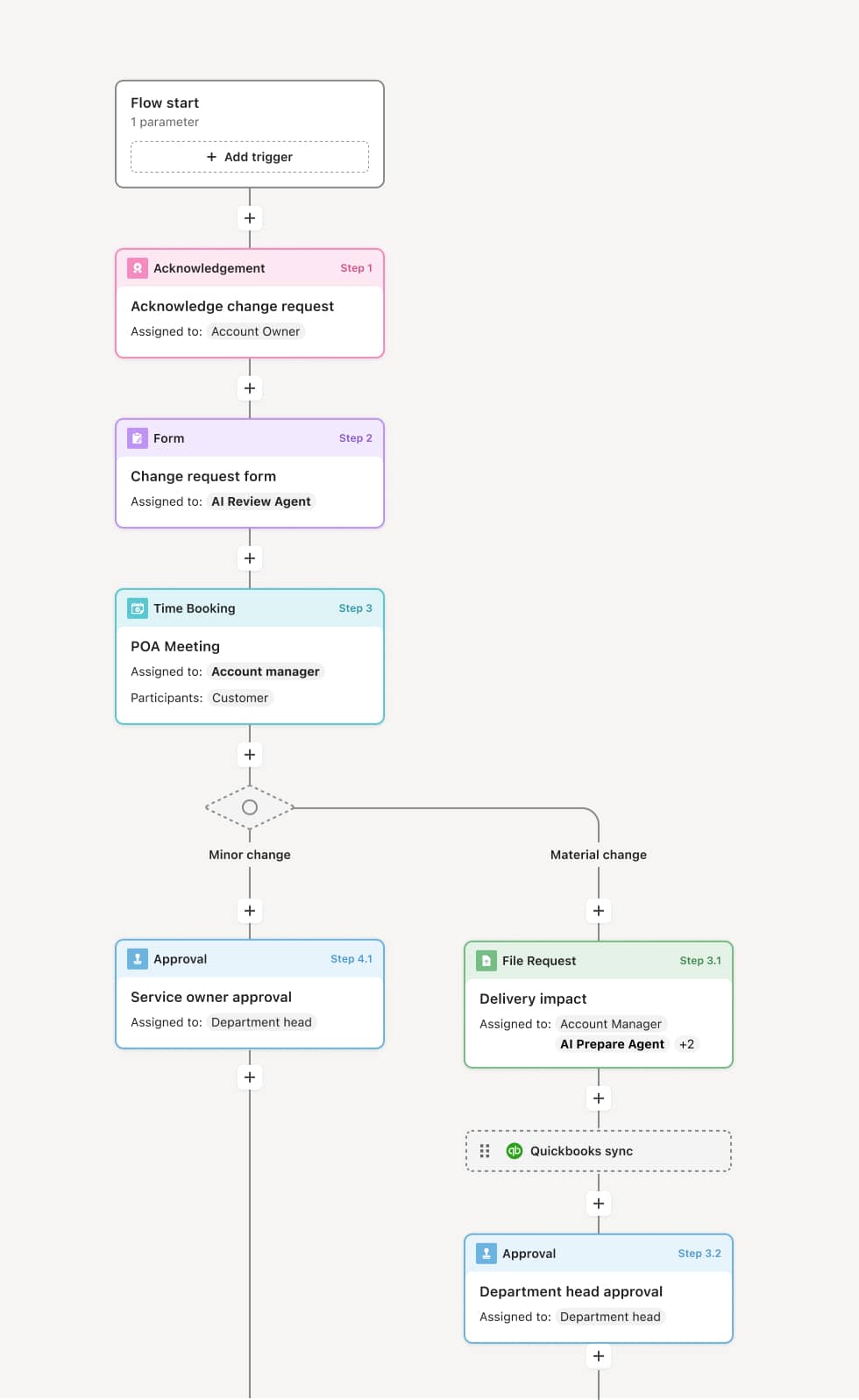
Your version of this process may vary based on roles, systems, data, and approval paths. Moxo’s flow builder can be configured with AI agents, conditional branching, dynamic data references, and sophisticated logic to match how your organization runs this workflow. The steps below illustrate one example.
Prototype submission and documentation
The process begins when the engineering or design team submits the prototype for formal review. The submission includes design specifications, test results, photographs or samples, cost estimates, and any deviations from the original requirements. An AI agent can assist by compiling relevant data from prior design phases, validating that all required documentation is present, and flagging any missing test results or specification gaps.
Technical and quality review
The prototype is evaluated by the quality assurance team and technical reviewers against functional, performance, and compliance criteria. Testing data is assessed to confirm the prototype meets defined standards. If the prototype fails any critical test or falls outside acceptable tolerances, it is returned to the design team with specific feedback for revision. If testing is passed, the review proceeds to business and cost evaluation.
Business and cost feasibility assessment
The product manager and finance or operations teams assess whether the prototype aligns with market requirements, production cost targets, and supply chain feasibility. This includes evaluating unit cost, tooling investment, lead times, and any sourcing dependencies. If the prototype is feasible within business parameters, it advances to stakeholder review. If cost or feasibility concerns arise, the process branches to determine whether design modifications, vendor changes, or scope adjustments can address them.
External stakeholder and client review
When the prototype involves a client deliverable, partner collaboration, or regulatory requirement, external stakeholders are engaged for review and feedback. They may evaluate samples, provide acceptance criteria, or raise concerns that must be addressed before production authorization. The process ensures that external feedback is captured within the workflow rather than through disconnected communications. AI agents can summarize feedback themes and surface priority items for the design team.
Go/no-go decision and production authorization
Based on the accumulated reviews—technical, business, and stakeholder—the designated decision-maker or review committee makes a formal go or no-go determination. If approved, the process triggers downstream actions such as production tooling orders, supplier engagement, and manufacturing scheduling. If the prototype requires further iteration, the process loops back to the design phase with documented requirements for the next version. The complete decision record—including all review inputs, feedback, and rationale—is retained.
This process commonly relies on inputs such as design specifications, test and inspection reports, cost estimates, supplier quotations, and compliance documentation. It may be triggered by a design phase completion milestone, a testing cycle conclusion, or a submission from the engineering team. Connected systems such as PLM platforms (e.g., Arena, Teamcenter), ERP systems like NetSuite or SAP, and quality management tools provide design, cost, and compliance data.
Key decision points include whether the prototype passes technical and quality testing criteria, whether the cost and feasibility assessment supports production viability, whether external stakeholders accept or require modifications to the prototype, and whether the final go/no-go decision authorizes production or mandates further design iteration. If the prototype fails any critical evaluation, the process loops back to the design team rather than advancing.
Incomplete test data submitted with the prototype, forcing quality reviewers to delay their assessment until results are available. Cost analysis disconnected from the design review, leading to production authorization for prototypes that are not financially viable. External stakeholder feedback collected outside the process, creating version confusion and undocumented design changes. Go/no-go criteria not defined before the prototype phase begins, making the approval decision subjective rather than evidence-based. Design iteration loops without clear exit criteria, causing the prototype phase to extend indefinitely without reaching a production decision.
Orchestrates prototype reviews across engineering, quality, business, and external stakeholders in a structured sequence that ensures every perspective is evaluated before a production decision is made.
AI agents assist with documentation assembly by compiling test results, design specifications, and cost data from prior phases, reducing manual preparation and ensuring completeness.
Routes prototypes to different review paths based on product type, risk level, or regulatory requirements, so standard prototypes move quickly while complex ones receive the appropriate depth of evaluation.
Connects to PLM, ERP, and quality management systems such as Arena, SAP, or NetSuite to pull design and cost data directly into the review process, extending existing product development infrastructure.
Maintains a complete record of every review, test result, stakeholder feedback, and go/no-go decision, providing traceability from initial prototype through production authorization.