Credentialing manager
Medical staff coordinator
Provider enrollment specialist
Chief medical officer
Compliance officer
Network development director

This process is used when a healthcare provider applies to join an insurance network, obtain medical staff privileges at a hospital or facility, or become authorized to deliver care under the organization’s umbrella. It applies when education, training, licensure, board certification, work history, malpractice claims, and regulatory sanctions must be verified from primary sources and assessed against organizational and regulatory standards. It is common when credentialing staff, the provider, verification agencies, and a credentialing committee must coordinate within NCQA, CMS, and state regulatory timelines. Ideal for health plans, hospitals, health systems, group practices, and credentialing verification organizations.
The credentialing process typically involves credentialing specialists who manage the application and verification process, the provider applicant who submits their application and supporting documentation, primary source verification agencies that confirm credentials, credentialing committee members who review completed files and make approval decisions, and compliance officers who ensure the process meets regulatory and accreditation standards.
Verified provider qualifications through primary source verification of every required credential before the provider is authorized to practice or participate. Faster credentialing timelines by managing the application, verification, and committee review in a coordinated workflow rather than a fragmented manual process. Reduced credentialing gaps because applications are tracked from submission through approval with visibility into outstanding verifications. Regulatory and accreditation compliance with NCQA, CMS, Joint Commission, and state requirements for credentialing processes and documentation. Complete credentialing files that withstand audit, accreditation review, and regulatory inspection.
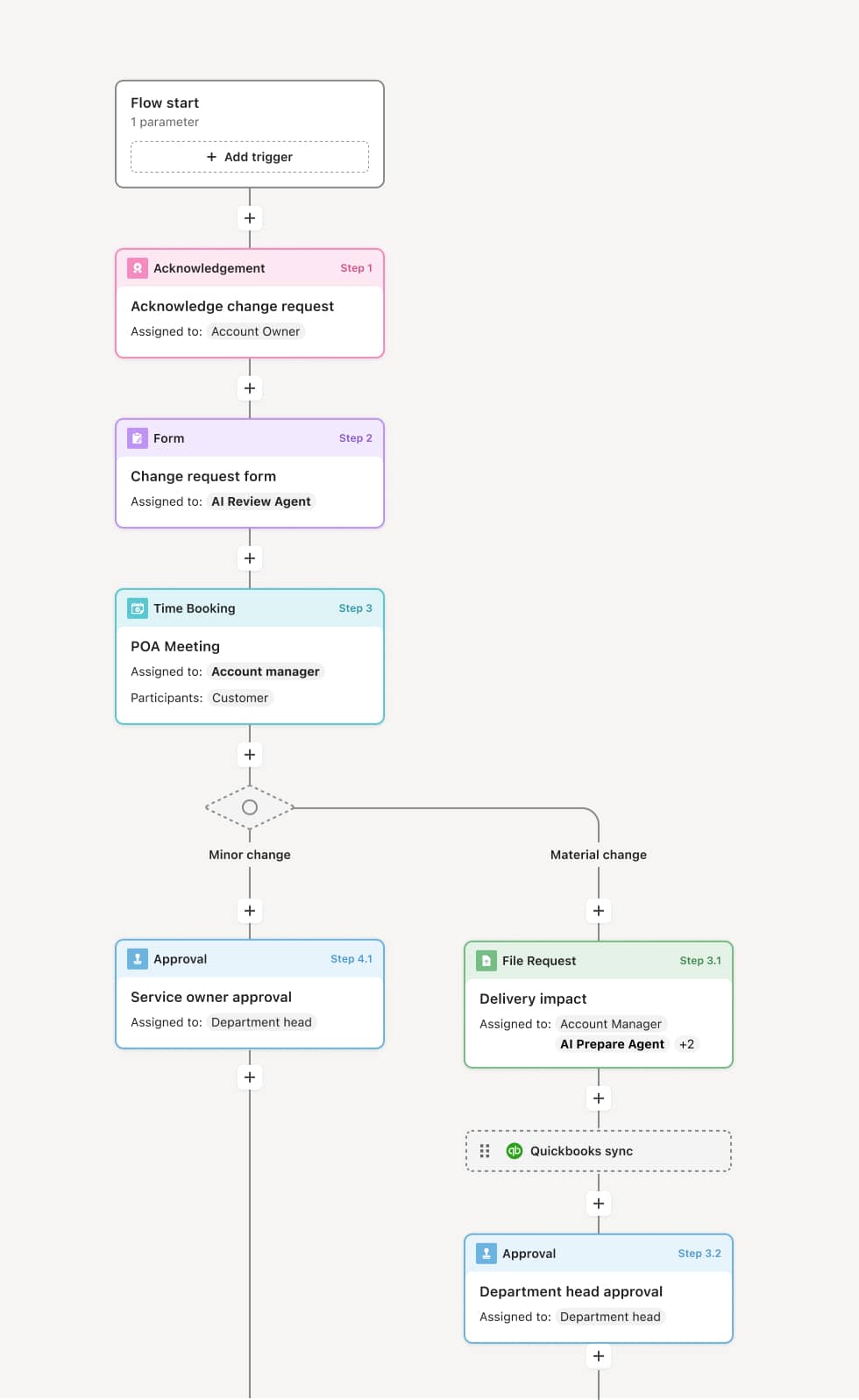
Your version of this process may vary based on roles, systems, data, and approval paths. Moxo’s flow builder can be configured with AI agents, conditional branching, dynamic data references, and sophisticated logic to match how your organization runs this workflow. The steps below illustrate one example.
Application submission
The process begins when a provider submits a credentialing application with supporting documentation including curriculum vitae, copies of licenses and certifications, education and training records, malpractice insurance certificates, work history, and disclosure of any disciplinary actions or malpractice claims. An AI Agent can assist by reviewing the application for completeness and flagging missing documents before verification begins.
Primary source verification
Credentialing staff initiate verification of the provider’s credentials from primary sources. This includes verification of medical education, residency and fellowship training, state licensure, board certification, DEA registration, malpractice insurance, National Practitioner Data Bank query, and sanctions screening. Verifications are conducted through direct contact with issuing institutions, national databases, and verification organizations.
Malpractice and disciplinary review
The credentialing team reviews the provider’s malpractice history and any reported disciplinary actions, sanctions, or exclusions. If the provider’s history includes reportable events, additional documentation or explanation may be requested. An AI Agent may track verification status across all credential categories and flag items that are overdue.
File completion and review
Once all verifications are complete, the credentialing file is assembled for committee review. The file includes the application, all verification results, disclosure responses, and any supporting documentation.
Credentialing committee decision
The credentialing committee reviews the completed file and makes an approval, conditional approval, deferral, or denial decision. The committee’s decision and rationale are documented.
Notification and enrollment
The provider is notified of the committee’s decision. If approved, the provider is enrolled in the network, granted privileges, or authorized to practice. The credentialing file is preserved, and the provider enters the recredentialing cycle.
This process commonly relies on inputs such as the credentialing application, CV, license copies, board certification documents, malpractice insurance certificates, DEA registration, NPDB query results, and disclosure responses. It may be triggered by a new provider application, a network expansion, or a facility privileges request. Connected systems often include credentialing management platforms like Cactus, CredentialStream, or Modio Health, NPDB, state licensing boards, and payer enrollment portals.
Key decision points include whether the application is complete and all required documentation has been submitted, whether primary source verifications confirm the provider’s credentials as reported, whether malpractice history or disciplinary disclosures require additional review, and whether the credentialing committee approves the provider.
Incomplete applications that delay the verification process because required documents or disclosures are missing. Slow primary source responses from licensing boards or training programs that extend the credentialing timeline. Verification results not tracked centrally, making it difficult to identify outstanding credentials. Committee scheduling delays that extend the time between file completion and approval. Credentialing files not maintained for recredentialing, requiring re-gathering of documentation.
Orchestrates credentialing from application through committee decision across credentialing staff, providers, verification sources, and committee members in a single coordinated flow.
Engages providers directly within the workflow for application submission, document requests, and status updates.
AI Agents verify application completeness at submission and track verification status across all credential categories, flagging overdue items.
Supports parallel verification tracks so education, licensure, board certification, and malpractice verifications proceed concurrently.
Connects to credentialing platforms and verification databases like Cactus, CredentialStream, and NPDB so verification data flows into the credentialing file.
Preserves the complete credentialing record including applications, verification results, committee decisions, and notification documentation for audit, accreditation, and recredentialing.