Credentialing verification specialist
Medical staff coordinator
Credentialing manager
Compliance officer
Provider enrollment lead
Quality assurance analyst

This process is used as part of initial credentialing and recredentialing when each reported credential must be independently verified from primary sources before the provider can be approved. It applies when licensing boards, educational institutions, specialty boards, training programs, malpractice insurers, and national databases must each be contacted to confirm the provider’s reported qualifications. Ideal for credentialing verification organizations, health plans, hospitals, and any entity performing primary source verification.
This process typically involves credentialing verification specialists who initiate and track verification requests, primary source contacts at licensing boards, medical schools, training programs, and certification bodies, the provider applicant who may need to facilitate access to certain records, and credentialing management who oversees turnaround times and quality standards.
Verified credentials from primary sources for every required qualification before the credentialing decision is made. Faster verification turnaround by managing all verification requests concurrently and tracking response status in real time. Fewer verification gaps because outstanding and overdue verifications are identified and escalated before they delay the credentialing timeline. Audit-ready verification documentation that demonstrates primary source confirmation for every credential. Consistent verification standards applied across all providers regardless of specialty or verification complexity.
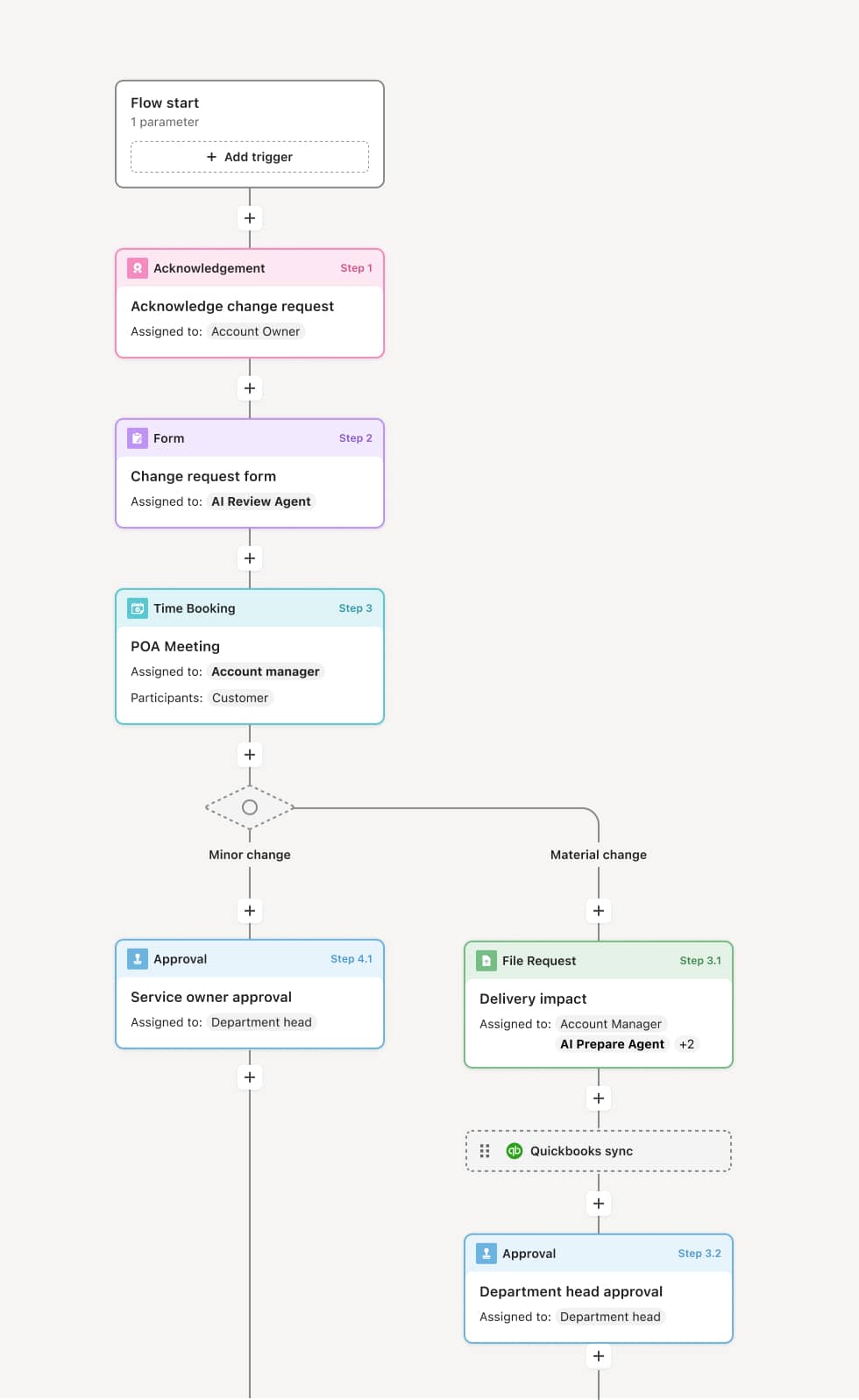
Your version of this process may vary based on roles, systems, data, and approval paths. Moxo’s flow builder can be configured with AI agents, conditional branching, dynamic data references, and sophisticated logic to match how your organization runs this workflow. The steps below illustrate one example.
Verification initiation
The process begins when the credentialing application is accepted and the verification specialist identifies all credentials that require primary source confirmation. These typically include medical education, state licensure, board certification, DEA registration, malpractice insurance, and NPDB query. An AI Agent can assist by generating the verification checklist based on the provider’s specialty and the organization’s requirements.
Concurrent verification requests
Verification requests are submitted simultaneously to all applicable primary sources — medical schools, training programs, state licensing boards, specialty boards, malpractice insurers, and the NPDB. Each request includes the provider’s identifying information and the specific credential to be verified.
Response tracking and follow-up
The verification specialist monitors responses from each source, logging confirmations as they arrive. An AI Agent may track response status, flag overdue responses, and generate follow-up communications to unresponsive sources.
Discrepancy resolution
If a verification response does not match the provider’s reported credentials, the specialist investigates the discrepancy. The provider may be contacted for clarification. Material discrepancies are documented and flagged for the credentialing committee.
Verification completion and file assembly
Once all verifications are completed, the results are assembled into the credentialing file. Each verified credential includes the source, date of verification, and confirmation details. The file is reviewed for completeness before advancing to the credentialing committee.
This process commonly relies on inputs such as the provider’s application data, credential details, contact information for primary sources, and organizational verification requirements. It may be triggered by a new credentialing application or a recredentialing cycle. Connected systems often include credentialing management platforms like Cactus, CredentialStream, or Modio Health, the NPDB, AMA Physician Masterfile, state licensing board portals, and specialty board verification services.
Key decision points include which credentials require primary source verification based on the provider’s specialty and organizational requirements, whether verification responses confirm the provider’s reported qualifications, whether any discrepancies are material and require further investigation, and whether all required verifications are complete before the file advances to committee.
Slow primary source responses from licensing boards or training programs that delay the overall credentialing timeline. Verification requests sent to incorrect contacts, requiring re-submission. Discrepancies not investigated promptly, delaying file completion. Verification status not tracked centrally, making it difficult to identify outstanding credentials across a portfolio of providers. Documentation standards not met when verification results lack sufficient detail for audit purposes.
Orchestrates concurrent verification requests across all primary sources in a single workflow that tracks every credential from request through confirmation.
AI Agents generate verification checklists based on the provider’s specialty and organizational requirements, ensuring no required verification is missed.
Tracks response status in real time and flags overdue verifications for follow-up, keeping the credentialing timeline on track.
Manages discrepancy investigation within the workflow so the provider can be contacted and the resolution documented in context.
Connects to credentialing platforms and verification databases like Cactus, NPDB, and state licensing portals so verification data flows directly into the credentialing file.
Preserves audit-ready verification records for every credential, including the source, verification date, confirmation details, and any discrepancy resolutions.