Procurement manager
Finance controller
Operations manager
Supply chain lead
Accounts payable manager
Department head

This process is used when a purchase order must be formally reviewed and authorized before it is sent to a vendor or supplier. It is triggered after a purchase request has been approved and a purchase order has been generated, or when a direct purchase order is created based on a contract, blanket order, or replenishment schedule. Purchase order approval is critical when orders involve significant expenditure, new vendors, non-standard terms, or quantities that deviate from forecasted procurement plans. It is common in manufacturing, retail, healthcare, construction, and any organization with structured procurement operations.
Procurement originates or generates the purchase order based on approved requests or contract terms. Finance validates that the PO aligns with budget allocations, payment terms, and accounting requirements. Operations or the requesting department confirms that quantities, specifications, and delivery timelines meet operational needs. For high-value or non-standard POs, executive or category-level approval may be required. Vendor management may review the PO if the vendor is new or the relationship requires special oversight.
Reduced order errors because purchase orders are validated against approved prices, quantities, and terms before they reach the vendor. Faster PO issuance by routing approvals based on order value and category, so routine orders are processed quickly while exceptions receive focused review. Clear financial accountability with budget checks built into the approval flow, preventing purchase orders from being issued against insufficient or misallocated funds. Improved vendor relationships because purchase orders arrive accurately and on time, reducing disputes and change orders after issuance. Consistent procurement governance across departments and locations, ensuring that PO approval policies are applied uniformly regardless of who initiates the order.
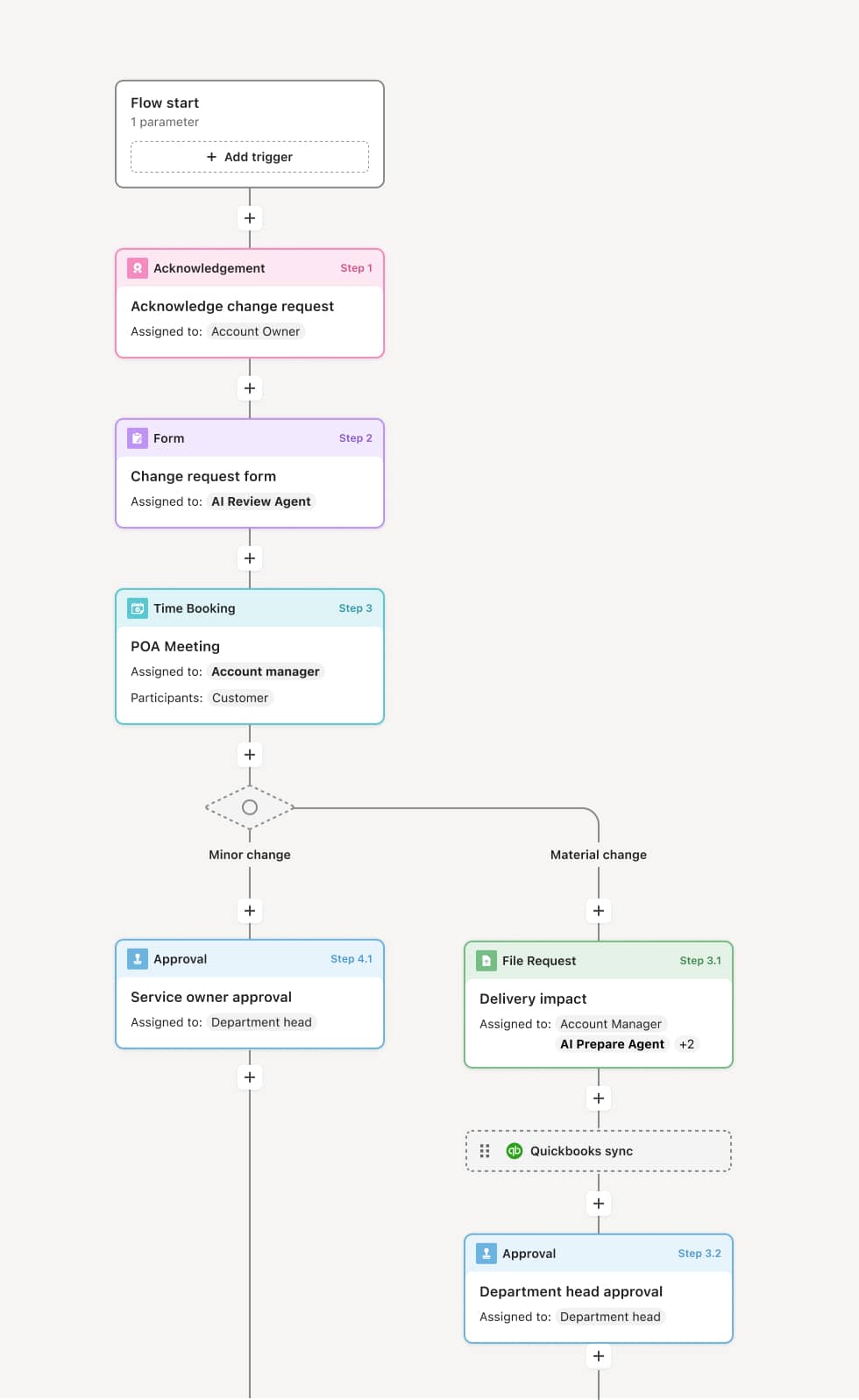
Your version of this process may vary based on roles, systems, data, and approval paths. Moxo’s flow builder can be configured with AI agents, conditional branching, dynamic data references, and sophisticated logic to match how your organization runs this workflow. The steps below illustrate one example.
Purchase order generation and validation
The process begins when a purchase order is generated—either from an approved purchase request, a contract-based schedule, or a replenishment trigger. The PO includes vendor details, line items, pricing, quantities, delivery dates, and payment terms. An AI agent can assist by cross-referencing the PO against the original request or contract, validating pricing against agreed rates, and flagging any discrepancies in quantities or terms before the PO enters the approval flow.
Budget and financial review
Finance reviews the purchase order to confirm that the expenditure is covered by the assigned budget or cost center, that payment terms align with cash flow and accounting policies, and that the PO complies with financial controls. If the PO exceeds budget limits or introduces unfavorable payment terms, the process branches to request budget reallocation, negotiate terms, or escalate for executive review. AI agents can surface current budget utilization from connected ERP systems to support the finance review.
Operational and specification confirmation
The requesting department or operations team confirms that the PO accurately reflects the specifications, quantities, and delivery schedule required. This step prevents orders from being issued with incorrect items, wrong quantities, or delivery dates that do not align with operational timelines. If discrepancies are found, the PO is returned to procurement for correction.
Tier-based approval authorization
The PO is routed to the appropriate approver based on its total value, category, and organizational approval matrix. Standard orders within pre-authorized limits may be approved by a procurement manager or department head. High-value orders, capital expenditures, or orders involving new vendors may require additional authorization from executive leadership or a purchasing committee. The routing is determined by the order’s attributes, not by manual judgment about where to send it.
PO issuance and vendor communication
Once fully approved, the purchase order is finalized and issued to the vendor. The approved PO is transmitted through the appropriate channel—whether via the ERP system, email, or a vendor portal—and a confirmation of issuance is recorded. Stakeholders are notified, and the PO becomes the binding document for the transaction. Any downstream receiving, invoicing, or payment processes reference this approved PO as their source of authority.
This process commonly relies on inputs such as approved purchase requests, vendor contracts, pricing agreements, budget allocation data, and item specifications. It may be triggered by a purchase request approval event, a contract schedule, or an inventory replenishment signal. Connected systems such as SAP, Oracle, or NetSuite provide procurement, budget, and vendor data, while inventory management and supply chain systems feed demand and specification inputs.
Key decision points include whether the PO matches the approved purchase request or contract terms, whether the budget can support the expenditure, whether specifications and delivery timelines are accurate, and whether the PO value requires escalation to a higher approval authority. If any validation fails, the process routes back to procurement or the requesting team for correction before the PO can be issued.
PO pricing not validated against contracted rates, leading to overpayment or vendor disputes after issuance. Budget checks performed after PO issuance, creating commitments that exceed available funds. Specifications or quantities not confirmed by the requesting team, resulting in incorrect orders and costly change orders. Approval routing based on manual judgment rather than defined thresholds, causing inconsistent authorization and delays. PO transmitted to the vendor before all approvals are complete, undermining procurement governance and creating liability exposure.
Routes purchase orders to the correct approval chain based on value, category, and organizational authority matrix, ensuring every PO follows the right path automatically.
AI agents assist with PO validation by cross-referencing pricing, quantities, and terms against approved requests, contracts, and vendor agreements before the PO reaches approvers.
Orchestrates budget validation, operational confirmation, and tier-based approval as structured steps within a single process, eliminating disconnected approvals across email and spreadsheets.
Connects to ERP and procurement systems such as SAP, Oracle, or NetSuite to pull real-time budget and vendor data, and to push approved POs directly into issuance and receiving workflows.
Maintains a complete record of every validation, approval, and issuance action for each purchase order, supporting procurement governance, vendor management, and financial audit requirements.