Procurement manager
Supply chain manager
Finance controller
Operations manager
Vendor relationship manager
Accounts payable lead

This process is used when a change to an existing purchase order is required after the PO has been issued to a vendor. Changes may be triggered by demand shifts, specification updates, pricing renegotiations, delivery schedule adjustments, or corrections to errors in the original PO. It applies when the change has a financial impact that requires budget revalidation, when contractual terms must be renegotiated, or when the modification affects downstream receiving, invoicing, or production schedules. Purchase order change management is common in manufacturing, retail, healthcare, construction, and any industry with complex supply chain operations.
The requester or procurement team identifies the need for a change and submits the modification request. Finance reviews the financial impact of the change, including budget implications and variance against the original commitment. Operations or the requesting department confirms that the change aligns with updated requirements. The vendor may need to confirm acceptance of the revised terms. For changes that exceed defined thresholds, executive or category-level approval may be required before the revised PO is issued.
Controlled change management that prevents unauthorized modifications to purchase orders, protecting budget integrity and vendor relationships. Faster change processing by routing modification requests to the appropriate reviewers based on change type and financial impact, minimizing delays in supply chain execution. Reduced financial surprises because every PO change is assessed for budget impact before the revised order is communicated to the vendor. Clear vendor communication with a single, authorized version of the purchase order issued after all internal approvals are obtained, reducing confusion and disputes. Complete change history for every purchase order, providing traceability from the original order through each modification for audit, vendor management, and cost analysis.
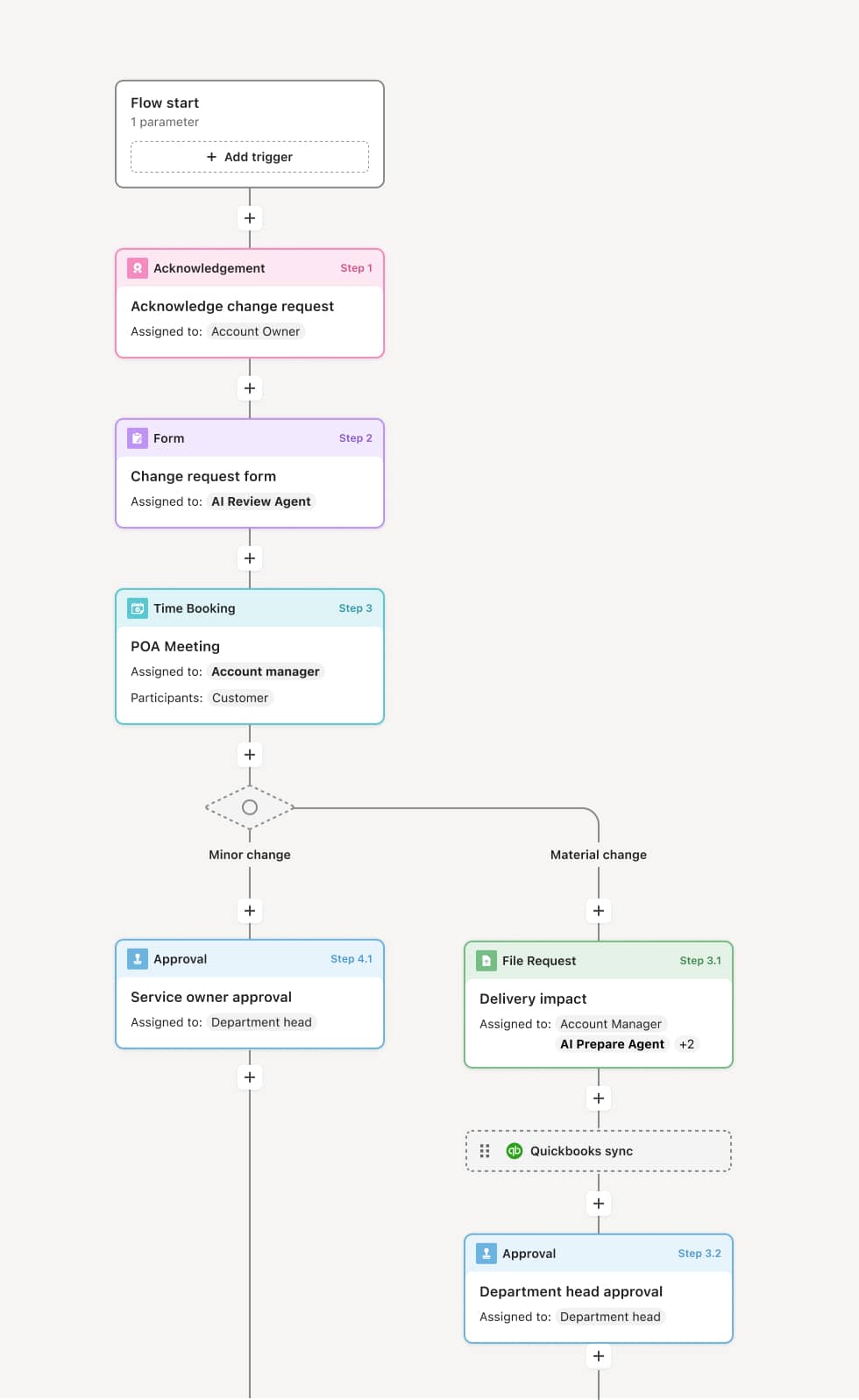
Your version of this process may vary based on roles, systems, data, and approval paths. Moxo’s flow builder can be configured with AI agents, conditional branching, dynamic data references, and sophisticated logic to match how your organization runs this workflow. The steps below illustrate one example.
Change request submission and impact identification
The process begins when a team member, procurement specialist, or system event identifies the need to modify an existing purchase order. The change request includes a description of the modification, the reason for the change, the affected PO line items, and the proposed revised values. An AI agent can assist by pulling the original PO data from connected procurement systems, calculating the financial variance, and flagging whether the change triggers additional approval thresholds.
Financial impact assessment
Finance reviews the proposed change against the current budget, assessing whether the modification increases cost, shifts payment timing, or affects financial forecasts. If the change is budget-neutral or within tolerance, it proceeds to operational review. If the change creates a material financial impact, the process branches to require budget reallocation, additional justification, or escalation to a senior financial approver.
Operational and specification review
The requesting department or operations team confirms that the proposed change reflects actual requirements—updated quantities, revised specifications, or adjusted delivery schedules. This step ensures that the change addresses the underlying operational need rather than introducing new misalignments. If the change does not fully resolve the issue, it is sent back for further refinement before approval.
Vendor confirmation and negotiation
If the change affects vendor-facing terms—such as pricing, quantities, or delivery dates—the vendor is engaged to confirm acceptance or negotiate adjusted terms. The process ensures that vendor responses are captured within the workflow rather than through informal channels. If the vendor rejects or counters the proposed change, the process loops back to procurement and the requesting team to evaluate alternatives.
Change approval and revised PO issuance
Once financial, operational, and vendor reviews are complete, the change is authorized by the appropriate approver based on the magnitude and nature of the modification. The revised purchase order is generated, incorporating all approved changes, and issued to the vendor as the new governing document. The change record—including the original PO, the change request, all reviews, and the final approval—is retained as part of the procurement history.
This process commonly relies on inputs such as the original purchase order, change request forms, updated specifications, vendor correspondence, and budget utilization data. It may be triggered by an internal request, a vendor notification, a demand planning update, or a system-generated alert from an ERP platform. Connected systems such as SAP, Oracle, or NetSuite provide original PO data and budget context, while supply chain and inventory systems feed updated demand and specification inputs.
Key decision points include whether the proposed change has a material financial impact requiring additional authorization, whether the modification aligns with operational requirements and does not introduce new risks, whether the vendor accepts the revised terms or requires negotiation, and whether the change magnitude triggers escalation to a higher approval authority. If any review results in rejection, the process routes back to the requester or procurement team for revision.
Changes communicated to the vendor before internal approval is obtained, creating unauthorized commitments and potential disputes. Financial impact not assessed before change approval, leading to budget overruns discovered only during reconciliation. Multiple change requests on the same PO processed independently, causing conflicting modifications and version confusion. Vendor confirmation not captured within the process, leaving uncertainty about whether the supplier has agreed to the revised terms. Original PO data not referenced during the change review, preventing reviewers from understanding the cumulative effect of modifications.
Orchestrates the full change management lifecycle from request through vendor confirmation and revised PO issuance, ensuring every step happens in the right sequence with the right participants.
AI agents assist with impact assessment by calculating financial variance, referencing the original PO terms, and flagging whether the change triggers additional approval thresholds before the request reaches reviewers.
Engages vendors within the same process for confirmation or negotiation, so vendor responses are captured as part of the change record rather than in disconnected emails or side conversations.
Connects to ERP and procurement systems such as SAP, Oracle, or NetSuite to pull original PO data, validate budget availability, and push approved changes directly into the procurement system of record.
Maintains a complete, linked history of every change request, review, vendor response, and approval decision for each purchase order, supporting procurement governance, cost analysis, and vendor performance tracking.