Procurement manager
Finance director
Department manager
Budget owner
Operations lead
Controller

This process is used when an employee or department submits a requisition requesting authorization to purchase goods or services. It is triggered before any commitment is made to a vendor, serving as the pre-commitment control that precedes purchase order creation. Purchase requisition approval applies when purchases exceed pre-approved thresholds, fall outside standard catalog items, require budget validation, or involve capital expenditures subject to governance policies. It is common across manufacturing, healthcare, education, government, and any organization with formal procurement controls.
The requester initiates the requisition with a description of need, estimated cost, and business justification. The department manager or budget owner provides initial authorization and confirms alignment with departmental priorities. Finance validates budget availability and spending category compliance. Procurement reviews vendor selection considerations and confirms whether existing contracts cover the request. For high-value or capital requisitions, executive-level approval may be required based on organizational spending authority.
Earlier spending control by validating need, budget, and policy compliance before any vendor commitment is made, preventing unauthorized purchases at the source. Faster requisition-to-PO cycle by routing approvals based on amount, category, and urgency so that standard requests move quickly while exceptions receive appropriate review. Clear budget ownership because every requisition is tied to a specific budget or cost center and validated before it advances to procurement. Reduced procurement rework because requisitions arrive at the procurement team fully approved and validated, eliminating back-and-forth over justification or budget coverage. Consistent policy application across departments and locations, ensuring that all purchases follow the same requisition standards regardless of who initiates the request.
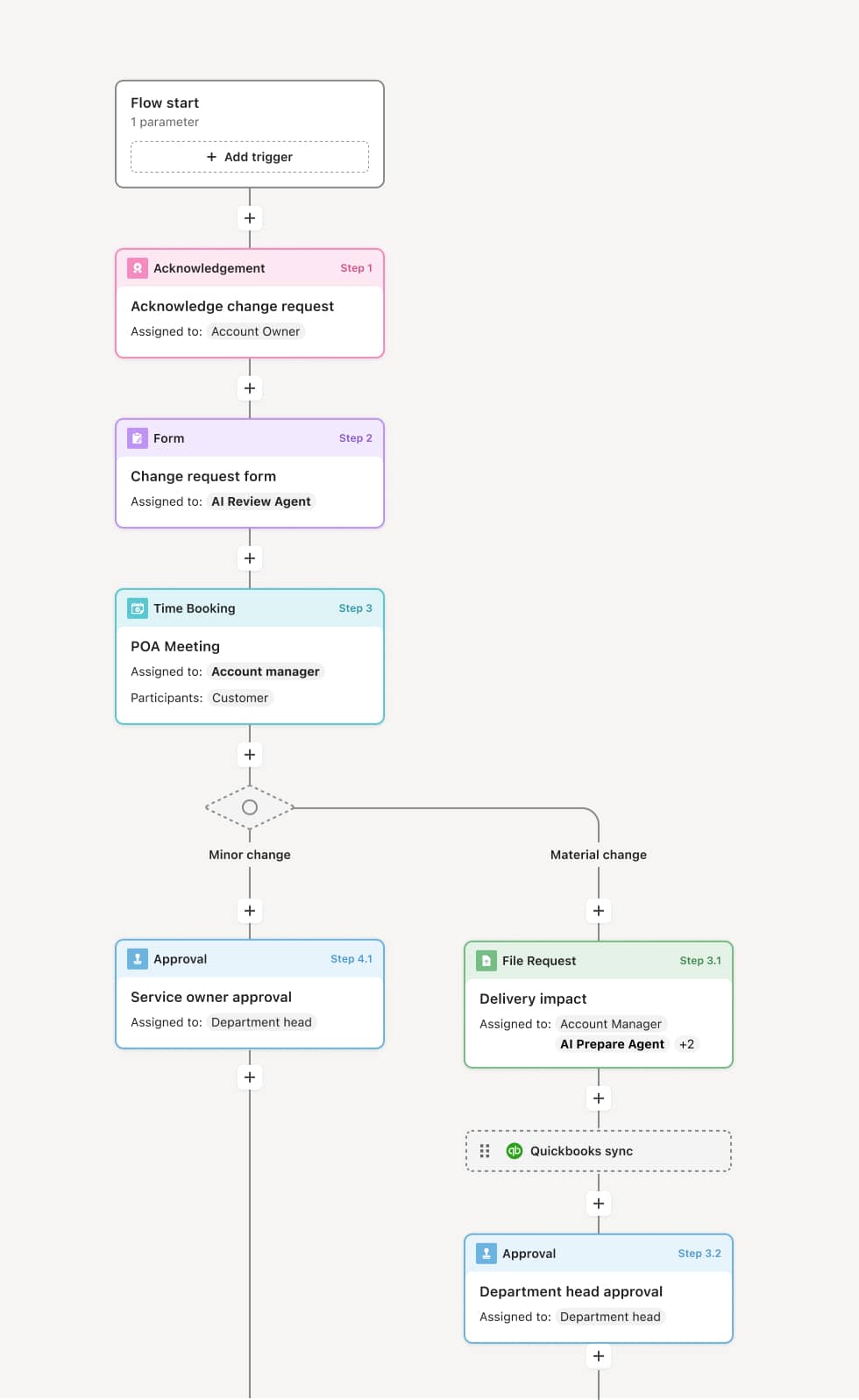
Your version of this process may vary based on roles, systems, data, and approval paths. Moxo’s flow builder can be configured with AI agents, conditional branching, dynamic data references, and sophisticated logic to match how your organization runs this workflow. The steps below illustrate one example.
Requisition submission and initial validation
The process begins when an employee or department submits a purchase requisition, including the item or service description, estimated cost, quantity, preferred vendor if applicable, delivery requirements, and the budget or cost center to be charged. An AI agent can assist by checking whether the requested item is available through an existing contract or catalog, validating that all required fields are complete, and flagging any information gaps before the requisition enters the approval chain.
Department and budget owner review
The requisition is routed to the requester’s manager or designated budget owner for initial authorization. This reviewer evaluates whether the purchase aligns with departmental priorities, is operationally justified, and falls within their approval authority. If the requisition exceeds the reviewer’s spending limit, it is escalated to the next tier of authority. If the justification is insufficient, the requisition is returned to the requester with specific feedback.
Budget validation and financial compliance
Finance or the budget management function verifies that sufficient funds exist in the designated budget or cost center and that the requisition complies with organizational spending policies. This includes confirming the correct account coding, checking against any active spending freezes or restrictions, and assessing whether the purchase aligns with approved budget categories. If budget is unavailable or the requisition raises compliance concerns, the process branches to request reallocation, deferral, or additional justification. AI agents can cross-reference current budget utilization data from connected financial systems to accelerate this review.
Procurement readiness check
Once budget approval is confirmed, the procurement team reviews the requisition to assess sourcing options. This may include confirming whether an existing contract or preferred vendor applies, whether competitive bidding is required, or whether the requisition can be consolidated with other pending requests for better pricing. If procurement identifies issues—such as an expired contract or a vendor that requires onboarding—the process accommodates those steps before the requisition is cleared for PO creation.
Final authorization and PO generation trigger
After all reviews are complete, the requisition receives final authorization from the appropriate approver based on the amount and category. The approved requisition is then released to procurement for purchase order creation. The requester and relevant stakeholders are notified, and the complete requisition record—including all reviews, approvals, and conditions—is retained as part of the organization’s procurement governance documentation.
This process commonly relies on inputs such as requisition forms, cost estimates, item catalogs, budget allocation data, and vendor or contract records. It may be triggered by a form submission, a system request from an inventory or planning tool, or a direct submission from the requester. Connected systems such as SAP, Oracle, or NetSuite provide budget and procurement data, while inventory management and contract platforms supply catalog and vendor information.
Key decision points include whether the requisition is justified and aligns with departmental priorities, whether the budget has sufficient funds and the correct account coding, whether existing contracts or preferred vendors cover the request, and whether the requisition amount requires escalation to a higher approval authority. If any condition is not met, the process branches to remediation, reallocation, or deferral before the requisition can advance to PO creation.
Requisitions submitted with vague or incomplete justification, causing approvers to return them repeatedly and delaying the procurement cycle. Budget validation performed after PO creation, leading to commitments against insufficient funds. Duplicate requisitions submitted for the same need, creating confusion and potential double-ordering. Procurement not consulted on sourcing before approval, resulting in missed contract pricing or unnecessary vendor onboarding. Approval routing not aligned with current spending authority, causing requisitions to stall at the wrong reviewer.
Routes requisitions to the correct approval chain based on amount, category, and organizational spending authority, ensuring every request follows the right path without manual routing or email chains.
AI agents assist with requisition validation by checking completeness, cross-referencing existing contracts and catalogs, and flagging budget availability issues before the request reaches approvers.
Orchestrates budget validation, department review, and procurement readiness as structured steps within a single process, eliminating disconnected approvals across spreadsheets and email.
Connects to ERP and procurement systems such as SAP, Oracle, or NetSuite to pull real-time budget data and push approved requisitions directly into purchase order generation workflows.
Maintains a complete record of every requisition, review, budget check, and approval decision, supporting procurement governance, spend analysis, and audit requirements.