Pricing manager
Revenue operations lead
Finance director
Sales director
Contract manager
Operations lead

This process is used when a change to an existing rate structure is proposed, whether due to cost increases, market adjustments, contract renewals, regulatory changes, or strategic pricing decisions. It is triggered when the proposed change affects customer-facing pricing, partner or vendor rates, internal transfer pricing, or fee schedules that are governed by contracts or regulatory frameworks. Rate change approval is critical when the change has revenue impact, affects customer relationships, or requires coordination across sales, finance, and operations teams. It is common in financial services, insurance, telecommunications, healthcare, professional services, and manufacturing.
The pricing or commercial team initiates the rate change proposal with supporting analysis. Finance evaluates revenue impact, margin implications, and alignment with financial plans. Sales or account management assesses customer impact and retention risk. Legal or contract management reviews whether the change complies with existing agreements and notification requirements. For significant rate changes, executive leadership provides final authorization.
Controlled rate governance that prevents unauthorized pricing changes from reaching customers, protecting revenue integrity and contractual compliance. Faster rate change implementation by routing proposals to the right reviewers based on change magnitude and affected customer segments, minimizing delays in pricing updates. Clear customer impact visibility because every rate change is assessed for retention risk and communication requirements before implementation. Reduced revenue leakage through structured validation that ensures rate changes are accurately reflected across billing systems, contracts, and customer communications. Consistent pricing authority across regions and business units, ensuring that rate change thresholds and approval levels are applied uniformly.
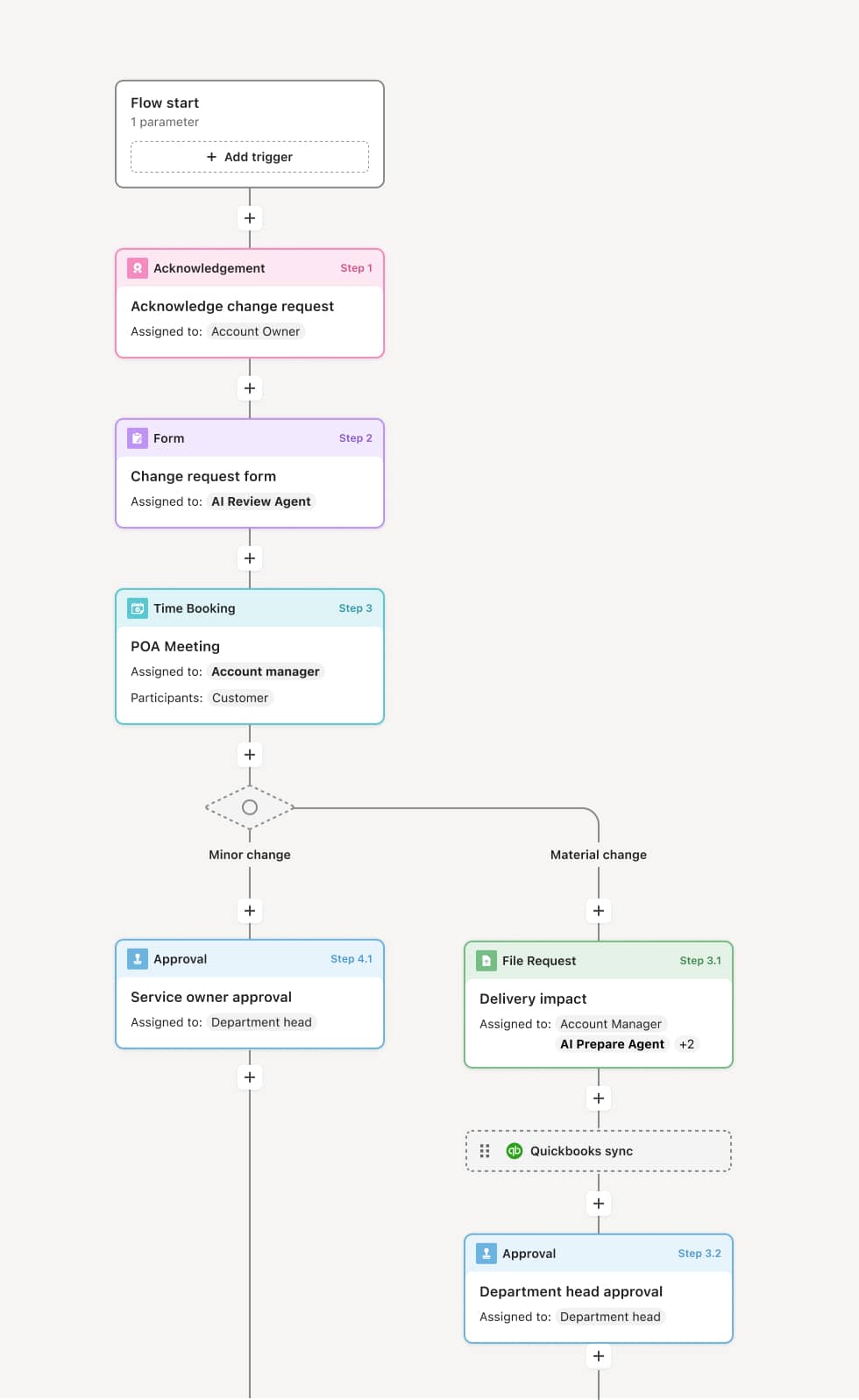
Your version of this process may vary based on roles, systems, data, and approval paths. Moxo’s flow builder can be configured with AI agents, conditional branching, dynamic data references, and sophisticated logic to match how your organization runs this workflow. The steps below illustrate one example.
Rate change proposal and impact analysis
The process begins when the pricing team or a business unit proposes a rate change. The proposal includes the current rate, proposed new rate, effective date, affected products or services, customer segments impacted, competitive rationale, and projected revenue impact. An AI agent can assist by pulling current rate data from connected billing or pricing systems, calculating the revenue impact across affected accounts, and flagging any contractual constraints that may limit the change.
Financial and revenue review
Finance evaluates the proposed rate change against financial plans, margin targets, and revenue forecasts. This includes assessing the aggregate revenue impact, the effect on customer lifetime value, and any implications for revenue recognition or financial reporting. If the change is within approved parameters, it proceeds. If the financial impact exceeds thresholds or introduces forecast risk, the process branches to require additional justification or executive review.
Customer impact and retention assessment
Sales or account management evaluates the potential impact on customer relationships, renewal rates, and competitive positioning. For significant rate increases, this may include identifying at-risk accounts, developing retention strategies, and planning customer communication timelines. If the retention risk is elevated, the process may branch to require a phased implementation plan or customer-specific exceptions before the rate change is approved.
Legal and contractual compliance review
Legal or contract management reviews the proposed change against existing agreements, regulatory requirements, and notification obligations. This includes confirming that contracts permit rate adjustments, that required notice periods are observed, and that the change complies with any applicable regulatory frameworks. If contractual or regulatory issues are identified, the rate change may be modified or its timeline adjusted.
Executive authorization and implementation
Once all reviews are complete, the rate change is submitted for final authorization to the appropriate executive or pricing committee. Upon approval, the implementation plan is activated—including updates to billing systems, contract amendments, customer notifications, and sales enablement materials. The complete record of the rate change—from proposal through approval and implementation—is retained for pricing governance and audit purposes.
This process commonly relies on inputs such as current rate schedules, proposed rate changes, revenue impact analyses, customer account data, contract terms, and competitive benchmarking. It may be triggered by a pricing review cycle, a cost increase from suppliers, a contract renewal event, or a strategic pricing decision. Connected systems such as Salesforce, billing platforms, or ERP systems like NetSuite or SAP provide pricing, revenue, and customer data.
Key decision points include whether the proposed rate change falls within pre-approved financial parameters, whether the customer impact assessment indicates acceptable retention risk, whether existing contracts and regulatory requirements permit the change, and whether the overall magnitude requires executive authorization. If any review identifies concerns, the process branches to require modification, phased implementation, or customer-specific exceptions before approval.
Rate changes implemented before all approvals are obtained, creating billing discrepancies and customer disputes. Customer impact not assessed before approval, leading to unexpected churn or relationship damage after implementation. Contractual notification requirements missed, exposing the organization to compliance risk or breach claims. Billing systems not updated simultaneously with rate approval, causing invoicing errors and revenue leakage. Rate change communication to customers delayed or inconsistent, undermining trust and creating confusion across sales and support teams.
Orchestrates rate change reviews across pricing, finance, sales, legal, and executive teams in a structured process that ensures every perspective is evaluated before implementation.
AI agents assist with impact analysis by calculating revenue effects across affected accounts, flagging contractual constraints, and surfacing competitive benchmarking data before the proposal reaches reviewers.
Routes rate changes to the appropriate approval authority based on change magnitude, affected customer segments, and revenue impact, ensuring minor adjustments move quickly while significant changes receive executive attention.
Connects to billing, CRM, and ERP systems such as Salesforce, NetSuite, or SAP to pull current rate data and push approved changes into the systems that govern pricing and invoicing.
Maintains a complete record of every rate change proposal, review, customer impact assessment, and approval decision, supporting pricing governance, audit requirements, and historical rate analysis.