Customer service manager
Finance controller
Operations manager
Accounts receivable lead
Team leader
Regional manager

This process is used when a customer requests a refund for a product, service, or transaction and the request requires validation and authorization before the refund is issued. It is triggered when a refund request is received through a customer service channel, when a return is processed that qualifies for a monetary return, or when a billing error or service failure is identified that warrants a refund. Refund approval applies when the refund amount exceeds frontline authority, when the reason for refund falls outside standard policy, or when cross-functional review is needed. It is common in retail, e-commerce, financial services, healthcare, hospitality, and subscription-based businesses.
The customer service representative receives the initial request and documents the refund reason and supporting evidence. The customer service manager or team leader reviews the request against refund policy and authorizes within their spending limit. Finance or accounts receivable validates the transaction, confirms the refund amount, and processes the payment. For high-value refunds, disputed cases, or policy exceptions, regional management or executive approval may be required.
Faster refund resolution by routing requests to the correct authority level immediately based on amount, reason, and customer history. Reduced refund fraud risk because every request is validated against transaction records and refund policy before authorization. Consistent policy application across locations and channels, ensuring that refund decisions are made using the same criteria regardless of which representative handles the request. Improved customer satisfaction because refunds are processed predictably and communicated clearly, reducing follow-up inquiries and complaints. Clear financial accountability with every refund tied to a validated transaction, an authorized approver, and a documented reason for issuance.
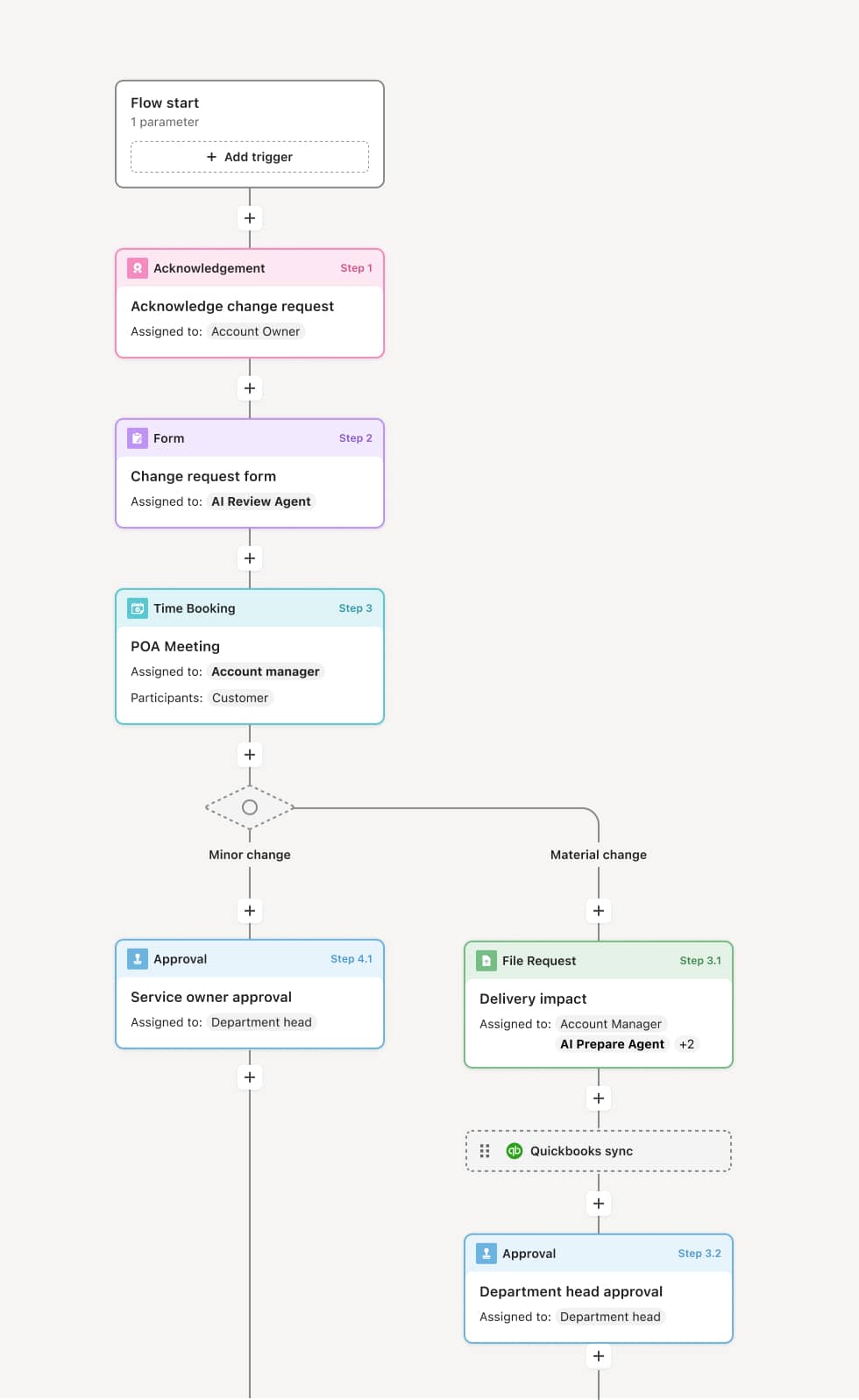
Your version of this process may vary based on roles, systems, data, and approval paths. Moxo’s flow builder can be configured with AI agents, conditional branching, dynamic data references, and sophisticated logic to match how your organization runs this workflow. The steps below illustrate one example.
Refund request capture and initial validation
The process begins when a customer service representative receives a refund request and documents the reason, original transaction details, customer information, and any supporting evidence such as receipts or correspondence. An AI agent can assist by pulling the original transaction from connected systems, validating the purchase date against the refund policy window, and flagging any prior refund history for the same customer or transaction to identify potential patterns.
Policy review and frontline authorization
The customer service manager or team leader reviews the request against the organization’s refund policy. If the request meets standard criteria—for example, within the return window, valid reason code, and within the reviewer’s authorization limit—it is approved and forwarded for processing. If the request falls outside policy parameters or exceeds the reviewer’s limit, the process branches to require additional justification or escalation to a higher authority.
Financial validation and amount confirmation
Finance or accounts receivable confirms the refund amount against the original transaction, verifies that the correct payment method will be credited, and checks for any outstanding balances or offsets that may apply. This step ensures that the refund is accurate and does not create unintended financial exposure. If discrepancies are found between the requested and validated amounts, the process routes back for clarification before the refund is issued.
Exception and escalation handling
For refunds that exceed standard thresholds, involve disputed transactions, or fall outside policy guidelines, the request is escalated to regional management or an executive approver. The escalated reviewer receives the full request context—including the original transaction, customer history, policy assessment, and any prior refund activity—and makes a final determination. AI agents can prepare a summary of the request and highlight any risk indicators to help the escalated approver decide efficiently.
Refund issuance and customer notification
Once authorized, the refund is processed through the appropriate channel—credit card reversal, account credit, check, or other method. The customer is notified of the refund and the expected timeline for receipt. The complete refund record—including the request, validation, approval chain, and issuance confirmation—is retained for financial reconciliation and audit purposes.
This process commonly relies on inputs such as customer refund request forms, original transaction records, product return documentation, customer communication history, and refund policy guidelines. It may be triggered by a customer service interaction, a return processing event, or a billing dispute. Connected systems such as Salesforce, Shopify, or a customer service platform provide customer and transaction data, while ERP or accounting systems like NetSuite or QuickBooks supply financial records and payment processing capabilities.
Key decision points include whether the refund request meets standard policy criteria, whether the amount falls within the reviewer’s authorization limit, whether the transaction records support the requested refund amount, and whether exception circumstances warrant escalation to a higher authority. If the request is denied or modified, the rationale is documented and communicated to the customer.
Refund requests processed without validating the original transaction, leading to overpayments or credits against non-existent purchases. Authorization limits not enforced consistently, allowing high-value refunds to be approved without appropriate oversight. Customer refund history not reviewed, missing patterns that indicate potential abuse or fraud. Refund issued before financial validation is complete, creating reconciliation problems and potential write-offs. Customer notification delayed or unclear, generating follow-up inquiries that increase service workload.
Routes refund requests to the correct approval authority based on amount, reason code, and customer history, ensuring frontline approvals are fast while exceptions receive the right level of review.
AI agents assist with request validation by pulling original transaction data, checking policy compliance, and flagging refund patterns before the request reaches human reviewers.
Orchestrates policy review, financial validation, and escalation handling within a single structured process, eliminating disconnected approvals across email and spreadsheets.
Connects to customer service, CRM, and accounting systems such as Salesforce, Shopify, or NetSuite to pull transaction records and push refund issuance directly into payment processing workflows.
Maintains a complete record of every refund request, validation, approval, and issuance for each transaction, supporting financial reconciliation, fraud detection, and audit requirements.