VP of customer operations
Finance director
Compliance manager
Customer experience lead
Revenue operations analyst
Head of service delivery

This process is used when an organization needs to establish or improve a consistent, governed approach to handling refund requests across channels, locations, or business units. It is triggered when refund volumes are high enough to require standardized controls, when inconsistent refund decisions are creating financial or customer satisfaction issues, or when compliance or audit requirements demand documented refund governance. It applies when refund authority must be tiered across organizational levels, when trend analysis is needed to identify root causes, or when the refund process spans multiple teams and systems. It is common in financial services, insurance, retail, subscription services, healthcare, and telecommunications.
Customer-facing representatives capture and document refund requests. Service managers apply initial policy review and authorize within defined limits. Finance validates transaction accuracy and manages payment processing. Compliance reviews refund patterns and ensures regulatory adherence. Revenue operations or analytics teams monitor refund trends and provide insights for process improvement. Executive leadership sets refund policy and authorizes exceptions that exceed standard thresholds.
Standardized refund governance across all channels and locations, ensuring every request follows the same validated path regardless of where or how it originates. Reduced refund leakage through structured financial validation that catches errors, duplicates, and policy violations before funds are released. Actionable trend insights because refund data is captured consistently and can be analyzed to identify root causes, product issues, or service failures driving refund volume. Faster resolution for straightforward requests because tiered authorization allows low-risk refunds to be processed without unnecessary escalation. Stronger compliance posture with documented decision rationale, approval chains, and exception handling that satisfies audit and regulatory requirements.
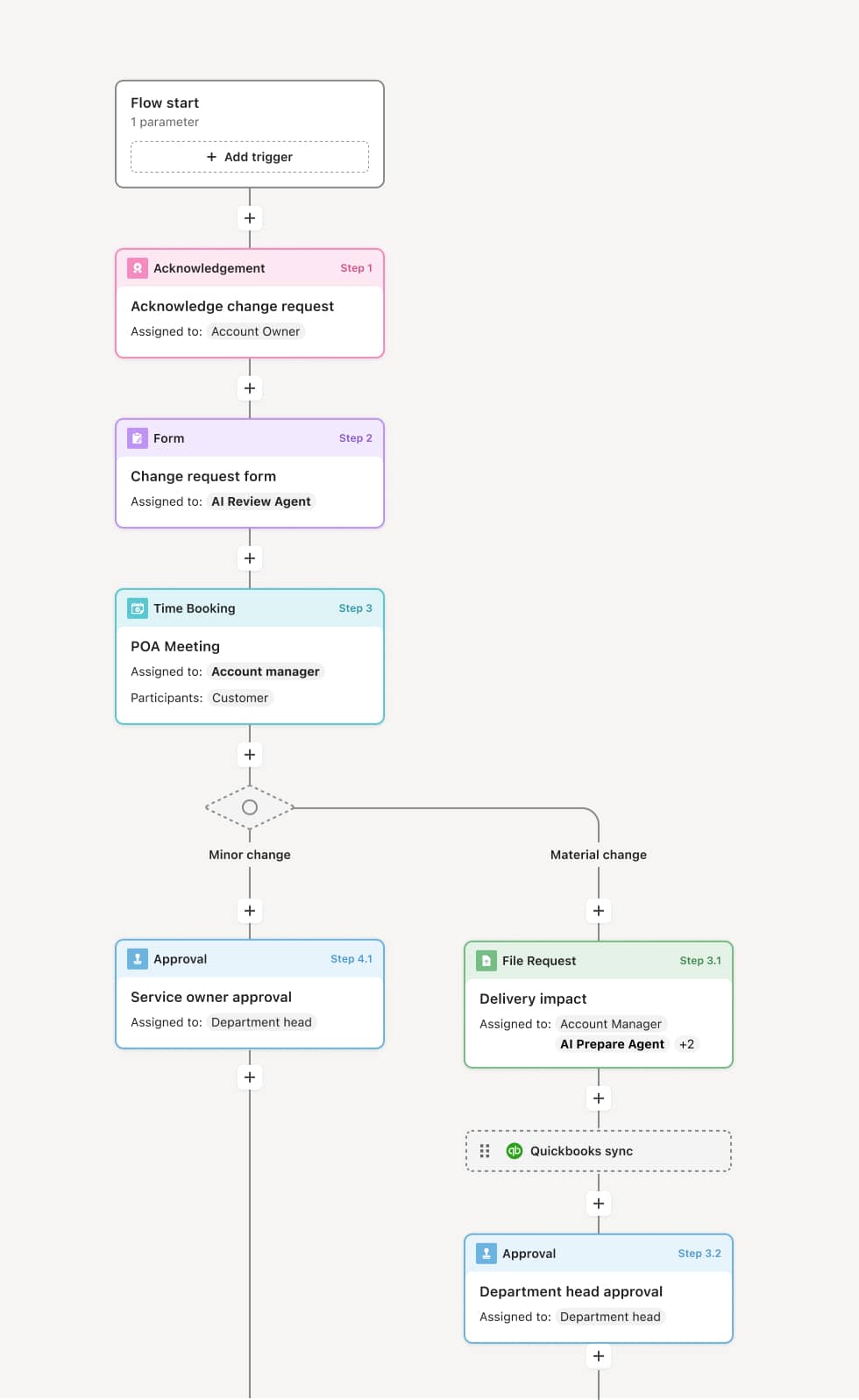
Your version of this process may vary based on roles, systems, data, and approval paths. Moxo’s flow builder can be configured with AI agents, conditional branching, dynamic data references, and sophisticated logic to match how your organization runs this workflow. The steps below illustrate one example.
Request intake and standardized capture
The process begins when a refund request is received through any channel—customer service, self-service portal, email, or in-person. The request is captured in a standardized format that includes the customer identity, transaction reference, refund reason, requested amount, and any supporting documentation. An AI agent can assist by pre-populating transaction details from connected systems, categorizing the refund reason against a defined taxonomy, and validating that all required information is present before the request enters the review workflow.
Tiered policy review and authorization
The request is routed to the appropriate reviewer based on amount, reason category, and customer segment. Straightforward requests within standard policy and low-value thresholds are authorized by frontline managers. Requests that exceed frontline authority, involve disputed transactions, or fall outside standard policy are escalated to senior reviewers or exception committees. Each tier has defined criteria and authority limits, ensuring that decisions are made at the right level without unnecessary bottlenecks. AI agents can flag requests that match known exception patterns or that involve customers with elevated refund history.
Financial validation and cross-reference
Finance validates the refund against the original transaction, confirms payment method and amount accuracy, checks for outstanding balances or offsetting charges, and ensures the refund complies with accounting policies. If the refund involves a partial amount, a credit rather than cash return, or a cross-currency transaction, finance confirms the correct treatment. This step prevents financial errors and ensures accurate general ledger posting.
Compliance and pattern monitoring
The compliance team or an automated monitoring function reviews refund patterns to identify potential fraud, policy abuse, or systemic issues. This includes tracking refund frequency by customer, product, location, and representative. If patterns indicate a compliance concern, the process branches to initiate an investigation or flag the account for enhanced review. Trend data is also used to inform policy adjustments and process improvements.
Issuance, notification, and post-refund analysis
Once authorized and validated, the refund is issued through the appropriate payment channel and the customer is notified with clear details on amount and timing. The complete refund record is finalized and stored. On a periodic basis, refund data is aggregated and analyzed to identify trends, root causes, and opportunities to reduce refund volume through product, service, or process improvements. This analysis feeds back into policy updates and operational adjustments.
This process commonly relies on inputs such as refund request data, original transaction records, customer account history, refund policy documentation, and compliance monitoring reports. It may be triggered by a customer request, a return event, a billing dispute, or a periodic refund review cycle. Connected systems such as Salesforce, Zendesk, or a customer service platform provide request and customer data, while ERP or accounting systems like NetSuite, SAP, or QuickBooks supply transaction and financial records.
Key decision points include which authorization tier the request is routed to based on amount and reason, whether the financial validation confirms the refund amount and payment method, whether compliance monitoring identifies patterns that require investigation, and whether exception cases are approved by the appropriate authority. If a request is denied or modified at any stage, the rationale is documented and communicated to the customer.
Inconsistent capture of refund reasons, making trend analysis unreliable and preventing root cause identification. Authorization tiers not enforced, allowing high-value or exception refunds to bypass appropriate oversight. Financial validation performed after issuance, creating reconciliation errors and potential write-offs. Compliance monitoring disconnected from the refund workflow, delaying fraud detection and allowing abuse patterns to persist. Post-refund analysis not conducted regularly, missing opportunities to reduce refund volume through upstream improvements.
Orchestrates the full refund lifecycle from capture through authorization, financial validation, compliance monitoring, issuance, and trend analysis within a single governed process.
AI agents assist with request categorization and validation by pre-populating transaction data, classifying refund reasons, and flagging pattern anomalies before requests reach human reviewers.
Routes requests to tiered authorization levels based on amount, reason, customer segment, and history, ensuring straightforward refunds are processed quickly while exceptions receive appropriate scrutiny.
Connects to CRM, customer service, and ERP systems such as Salesforce, Zendesk, NetSuite, or SAP to pull transaction data, process refund payments, and feed trend data back into operational reporting.
Maintains a complete, auditable record of every refund request, decision, and issuance and provides aggregated refund analytics that support compliance, fraud prevention, and continuous process improvement.