HR manager
IT security lead
Department manager
Legal or tax compliance analyst
People operations lead
Office or facilities manager

This process is used when an employee requests to work remotely on a regular or permanent basis, or when a manager proposes a remote or hybrid arrangement for a team member. It is triggered when the request involves a change to the employee’s standard work location, when the arrangement crosses state or national boundaries with tax or legal implications, or when the role requires IT security or equipment provisions that differ from standard office setups. Remote work approval is especially important when organizational policy requires multi-department review, when the employee will work from a jurisdiction with different labor or tax laws, or when the arrangement affects team operations. It applies across all industries and organizational sizes.
The employee initiates the request with details on the proposed arrangement. The department manager evaluates whether the role and team dynamics support remote work. HR reviews the request against organizational remote work policy and employment considerations. IT security assesses whether the employee’s remote setup meets security and infrastructure requirements. Legal or tax compliance evaluates jurisdictional implications, particularly for cross-border or cross-state arrangements. Facilities or office management may be involved if the arrangement affects workspace allocation.
Consistent remote work decisions across the organization by applying the same policy criteria, review steps, and approval authority to every request. Reduced compliance risk because legal and tax implications are evaluated before the arrangement begins, preventing retroactive issues with jurisdiction-specific labor, tax, or data privacy laws. Faster request resolution by routing reviews to HR, IT, legal, and management in parallel where possible, reducing the time from request to decision. Clear IT security alignment because remote setup requirements are validated as part of the approval process, ensuring that security and access standards are met before work begins. Better employee experience because remote work requests are processed through a transparent, structured process rather than informal or inconsistent channels.
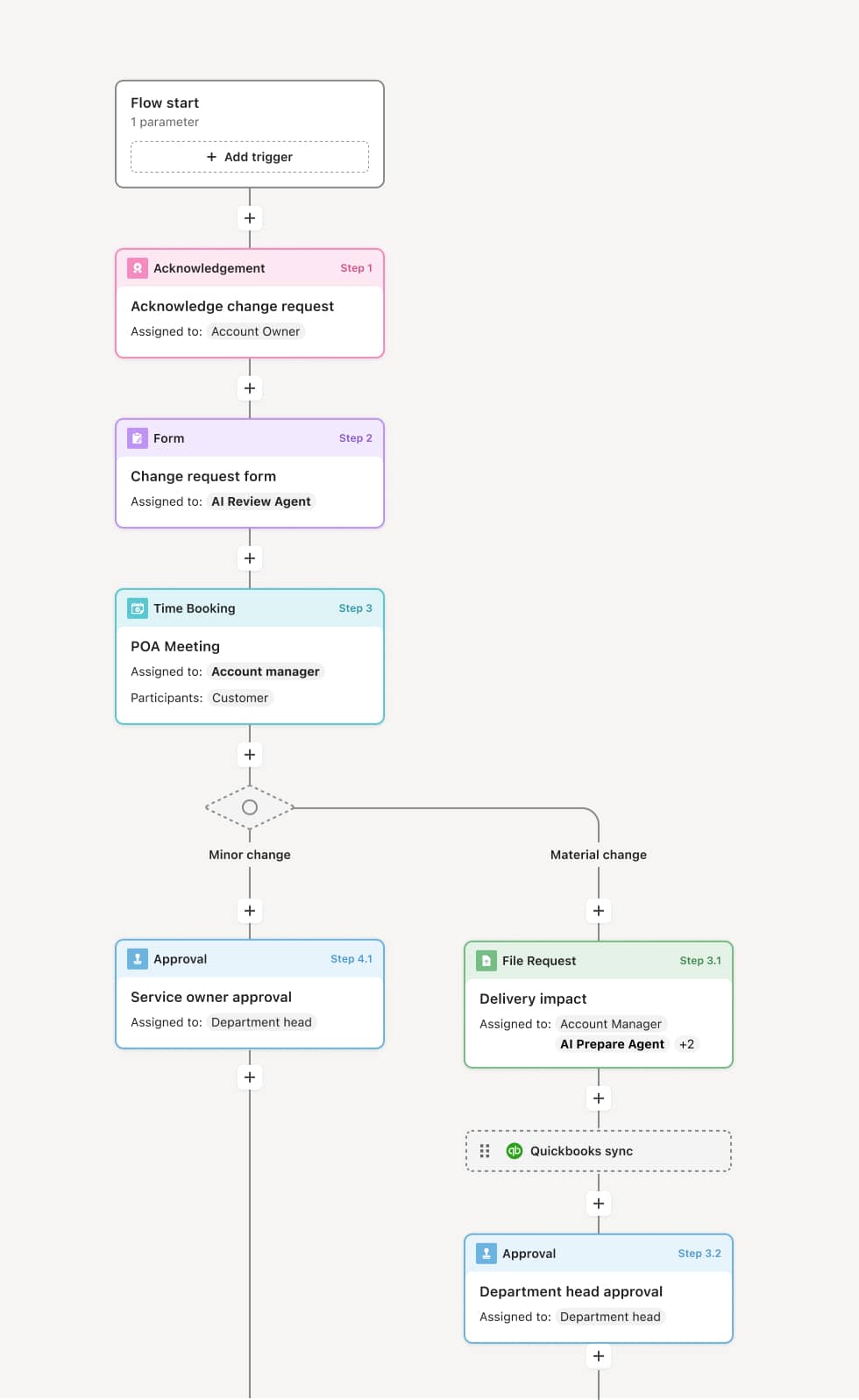
Your version of this process may vary based on roles, systems, data, and approval paths. Moxo’s flow builder can be configured with AI agents, conditional branching, dynamic data references, and sophisticated logic to match how your organization runs this workflow. The steps below illustrate one example.
Request submission and initial assessment
The process begins when an employee submits a remote work request, including the proposed schedule, work location, reason for the request, and any relevant personal or role-related considerations. An AI agent can assist by pre-populating the employee’s current role, location, and team information from connected HR systems, and flagging whether the proposed location introduces jurisdictional considerations that will require legal or tax review.
Manager review and role suitability assessment
The department manager evaluates whether the employee’s role, responsibilities, and team dependencies support the proposed remote arrangement. This includes assessing whether the role requires physical presence, whether team collaboration will be significantly affected, and whether performance can be effectively managed remotely. If the manager does not support the arrangement, the request is returned to the employee with feedback. If the manager approves, the request proceeds to cross-functional review.
HR policy and employment compliance review HR reviews the request against the organization’s remote work policy, including eligibility criteria, tenure requirements, performance standing, and any applicable collective bargaining or employment agreement terms. If the arrangement introduces considerations related to accommodations, leave, or employment classification, HR addresses those before the request moves forward.
IT security and infrastructure assessment IT security evaluates whether the employee’s remote environment meets organizational security standards, including network security, device management, data protection, and access controls. If the remote setup requires additional equipment, VPN configuration, or security measures, those are identified and assigned. If the remote location introduces data residency or sovereignty concerns, IT coordinates with legal to address them.
Legal and tax compliance review
For remote work arrangements that cross state or national boundaries, legal or tax compliance evaluates the jurisdictional implications. This includes assessing tax nexus, payroll tax obligations, labor law compliance, and data privacy regulations applicable in the employee’s remote location. If the arrangement creates compliance exposure, the process may branch to require modifications, limitations, or executive approval before proceeding.
Final approval and arrangement implementation
Once all reviews are complete, the remote work arrangement is formally approved by the appropriate authority—typically the department manager with HR concurrence, or executive leadership for arrangements with significant compliance implications. The approved arrangement is documented, and any required actions—such as IT provisioning, payroll adjustments, or policy acknowledgments—are initiated. The employee is notified of the approved terms, and the arrangement record is retained for HR governance and compliance purposes.
This process commonly relies on inputs such as remote work request forms, employee role and location data, organizational remote work policy, IT security standards, and jurisdictional tax and labor law references. It may be triggered by an employee request form, a manager nomination, or an organizational policy change. Connected systems such as Workday, BambooHR, or ADP provide employee data, while IT asset management and security tools supply infrastructure and compliance information.
Key decision points include whether the employee’s role is suitable for remote work, whether the request meets organizational policy criteria, whether the remote setup meets IT security standards, whether the proposed location introduces legal or tax compliance issues, and whether any compliance concerns require executive authorization or arrangement modifications. If any review identifies a blocker, the process branches to require remediation or adjustment before the arrangement can be approved.
Manager approval treated as the only required review, bypassing IT, HR, and legal assessments that are necessary for compliance. Jurisdictional tax implications not identified before the arrangement begins, creating retroactive payroll and tax filing obligations. IT security requirements not communicated clearly to the employee, resulting in remote setups that do not meet organizational standards. Remote work policy not applied consistently across departments, leading to perceptions of unfairness and potential legal exposure. Arrangement changes not tracked after initial approval, causing the organization to lose visibility into where employees are actually working.
Orchestrates remote work reviews across HR, IT, legal, management, and the employee in a structured process that ensures every relevant perspective is evaluated before a decision is made.
AI agents assist with request intake by pre-populating employee data from connected HRIS systems and flagging jurisdictional considerations that will require legal or tax review.
Routes requests through parallel review paths where possible, so that HR policy, IT security, and legal assessments happen concurrently rather than sequentially, reducing the overall decision timeline.
Connects to HRIS, IT asset management, and payroll systems such as Workday, BambooHR, or ADP to pull employee data and push approved arrangements into the systems that manage payroll, benefits, and compliance.
Maintains a complete record of every request, review, decision, and arrangement term, supporting HR governance, compliance documentation, and organizational visibility into remote work across the workforce.