Sales operations manager
Revenue operations lead
Deal desk analyst
Finance reviewer
Account executive
Procurement manager

This process is used when a renewal quote must be reviewed for pricing accuracy, discount compliance, or commercial terms before being shared with a client or procurement team. It applies when renewal quotes involve non-standard discounts, multi-year commitments, bundled services, or changes from the original agreement that require cross-functional validation. It is common when deal desk, finance, and sales leadership must align on pricing strategy before a quote is finalized. Ideal for SaaS, technology, professional services, and any organization with structured quoting and renewal cycles.
This process typically involves account executives or renewal managers who prepare and submit the quote, deal desk or sales operations analysts who validate pricing against current guidelines, finance reviewers who assess margin and revenue impact, and senior approvers who authorize exceptions or high-value quotes. Procurement contacts on the client side may also engage once the quote is approved internally.
Faster quote turnaround by routing quotes to the correct reviewers immediately based on deal size, discount level, or exception type. Fewer pricing errors reaching clients because every quote is validated against current rate cards and discount policies before delivery. Clear approval authority so non-standard terms are escalated to the right decision-maker without confusion or delay. Consistent commercial discipline across the renewal book, ensuring margin protection and policy adherence at scale. Reduced back-and-forth between sales, deal desk, and finance through structured review with full context provided upfront.
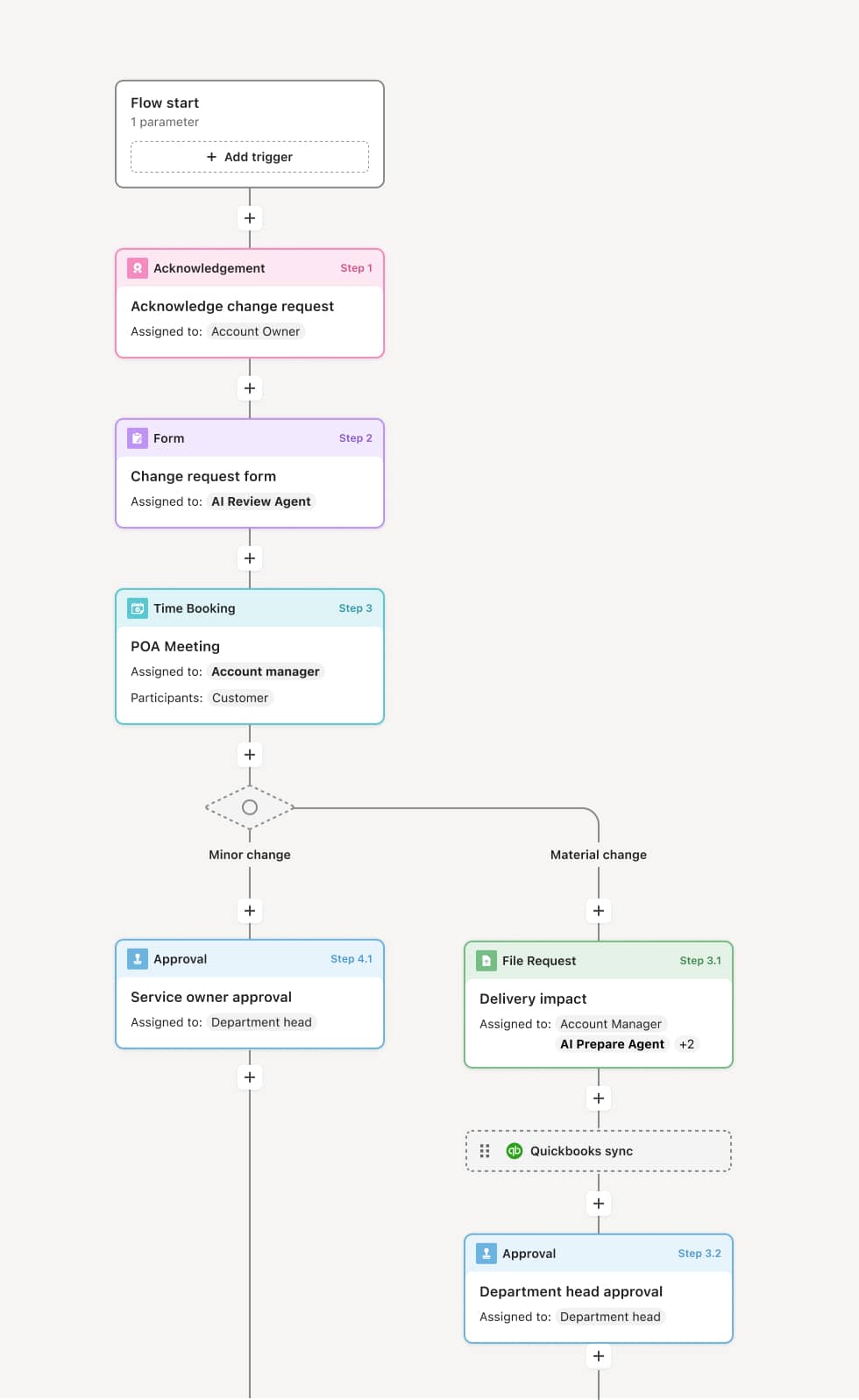
Your version of this process may vary based on roles, systems, data, and approval paths. Moxo’s flow builder can be configured with AI agents, conditional branching, dynamic data references, and sophisticated logic to match how your organization runs this workflow. The steps below illustrate one example.
Quote preparation and submission
The process begins when an account executive or renewal manager prepares a renewal quote reflecting proposed pricing, terms, and any modifications from the current contract. This may be triggered by an upcoming renewal date flagged in a CRM or CPQ system. An AI Agent can assist by pre-populating the quote with current contract data, standard rate card pricing, and account-specific discount history.
Policy and pricing validation
The deal desk or sales operations team reviews the submitted quote against current pricing policies, approved discount bands, and commercial guidelines. If the quote falls within standard parameters, it advances. If exceptions are present — such as a discount exceeding thresholds, non-standard payment terms, or bundled services outside policy — the review flags those items for escalation.
Financial review
Finance assesses the revenue and margin impact of the proposed quote, particularly for high-value renewals or those involving significant pricing adjustments. If the financial impact exceeds defined thresholds, the quote is routed to a senior finance approver. An AI Agent may summarize the financial comparison between the current and proposed terms to accelerate review.
Approval decision
The designated approver — whether deal desk lead, finance director, or sales leadership — reviews the complete quote package with all supporting context. If additional revision is needed, the quote is returned to the submitter with specific guidance. If approved, the quote is authorized for client delivery.
Quote delivery and client engagement
The approved quote is shared with the client or their procurement contact. The client reviews terms, may request clarifications or adjustments, and ultimately confirms or negotiates. If revisions are requested, the process loops back through the relevant review stages.
Closure and system update
Once the client accepts the quote, the agreement is executed, and connected systems such as CRM, CPQ, and billing are updated. All quote versions, approvals, and communications are recorded as part of the process history.
This process commonly relies on inputs such as the current contract, proposed quote details, rate cards, discount policies, and account history. It may be triggered by a CPQ-generated quote, a CRM renewal alert, or a manual submission from an account executive. Connected systems often include Salesforce or HubSpot for account data, CPQ tools like DealHub or Salesforce CPQ for quote generation, and NetSuite or ERP platforms for financial validation.
Key decision points include whether the proposed pricing and discounts fall within approved policy bands or require exception review, whether the financial impact triggers escalation to senior leadership, whether the quote requires legal review due to modified terms, and whether the client accepts or requests revisions to the approved quote.
Quotes submitted with stale pricing data, leading to rework when rate cards or discount policies have changed since the original contract. Unclear exception criteria, causing deal desk to either over-escalate routine quotes or under-escalate risky ones. Approval bottlenecks at finance when high-value quotes arrive without sufficient financial context or margin analysis. Disconnected quote versions circulating between sales and client when revisions are tracked outside the approval workflow.
Orchestrates the entire quote approval cycle from submission through client acceptance across sales, deal desk, finance, and the client in a single flow.
Routes quotes based on discount levels and deal value so standard renewals are approved quickly and exceptions reach the right authority.
AI Agents pre-populate quote context by pulling current contract data, pricing history, and policy guidelines into the review package automatically.
Integrates with CPQ and CRM systems like Salesforce CPQ and HubSpot so quote data flows directly into the approval process without re-entry.
Supports iterative review loops so revisions requested by approvers or clients route back through the right checkpoints without losing context.
Preserves the complete quote history including every version, approval decision, and communication, providing a clear record for audit and future renewals.