Operations director
Finance manager
Compliance officer
Department head
Analytics lead
Regulatory affairs manager

This process is used when a business report requires formal review and sign-off before it can be shared internally, submitted to regulators, or distributed to external stakeholders. It applies when reports contain financial figures, compliance data, or operational metrics that must be validated by subject matter experts. It is common when multiple reviewers across departments must assess different aspects of a report — such as data accuracy, narrative clarity, and regulatory alignment — before final authorization. Ideal for financial services, healthcare, manufacturing, professional services, and any regulated or data-driven environment.
The report approval process typically involves report authors or analysts who draft and submit the report, subject matter reviewers who validate data accuracy and methodology, department heads or functional leads who assess conclusions and recommendations, compliance or legal reviewers who verify regulatory alignment where applicable, and a final approver who authorizes the report for distribution.
Higher report accuracy through structured, multi-stage review that catches data errors, inconsistencies, and omissions before distribution. Faster review cycles by routing each section or aspect of the report to the right reviewer simultaneously rather than sequentially. Clear version control so every revision is tracked and the final approved version is unambiguous. Reduced compliance risk for regulated reports by ensuring mandatory review steps are completed and documented. Accountable sign-off with a clear record of who reviewed, what they approved, and when.
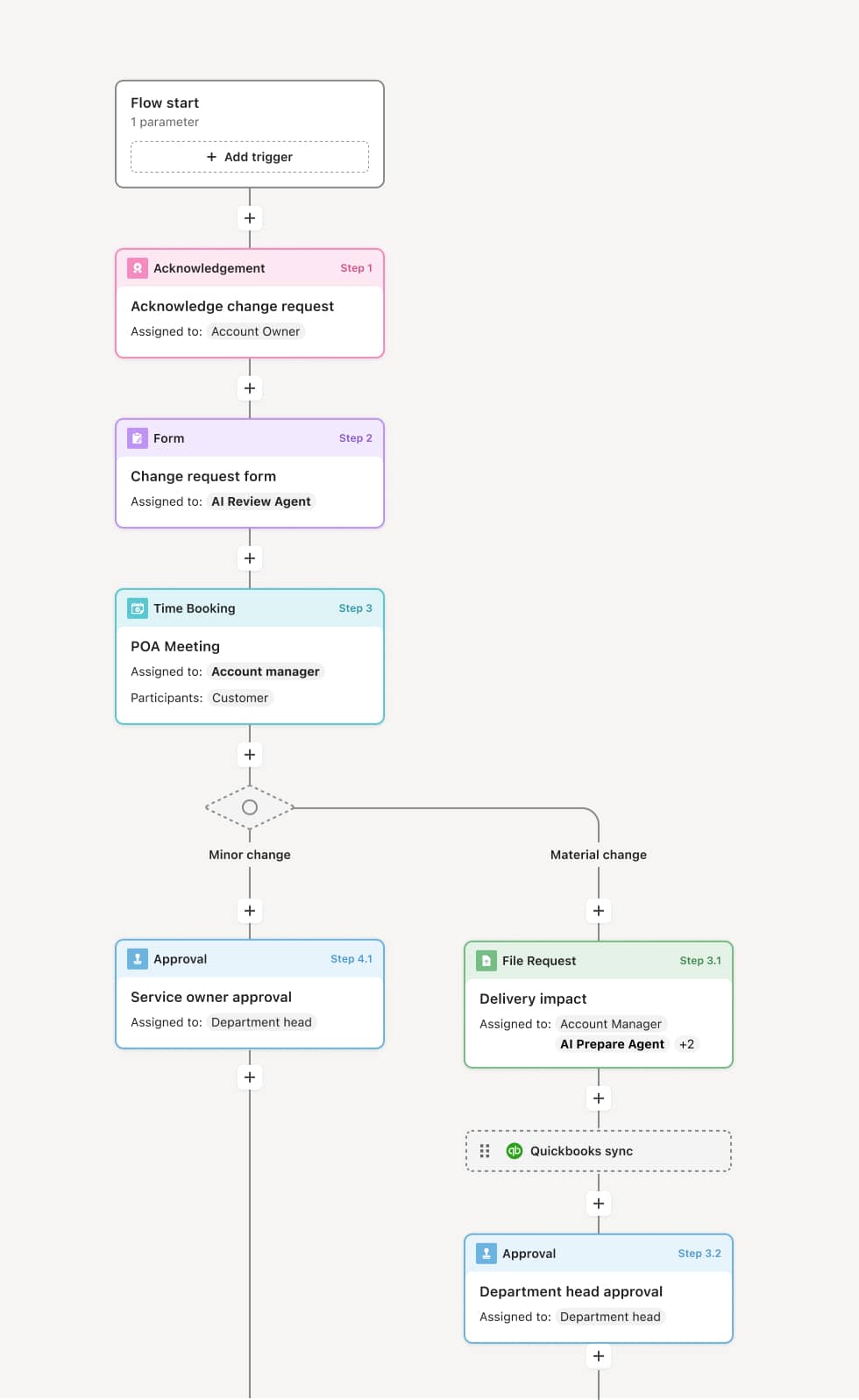
Your version of this process may vary based on roles, systems, data, and approval paths. Moxo’s flow builder can be configured with AI agents, conditional branching, dynamic data references, and sophisticated logic to match how your organization runs this workflow. The steps below illustrate one example.
Report submission
The process begins when a report author completes a draft and submits it for review. This may be triggered by a reporting deadline, a scheduled cycle, or a manual submission. An AI Agent can assist by validating that required sections, data fields, and supporting attachments are present before the report enters the review queue.
Subject matter review
The report is routed to one or more subject matter reviewers based on its type and content. For example, a financial report may go to a finance analyst for data validation and simultaneously to a compliance reviewer for regulatory checks. Reviewers assess accuracy, methodology, and completeness. If issues are identified, the report is returned to the author with specific feedback.
Revision and resubmission
If revisions are required, the author addresses the feedback and resubmits. An AI Agent may flag which sections were changed and summarize the revisions for reviewers, reducing the effort needed to re-review the full document.
Management review
Once subject matter review is complete, the report advances to a department head or management-level reviewer who assesses the overall conclusions, recommendations, and readiness for distribution. If the report is intended for external audiences or regulators, additional scrutiny may apply.
Final approval
The designated approver provides formal authorization. If the report meets all requirements, it is approved for distribution. If additional revisions are needed at this stage, the process routes back to the appropriate phase.
Distribution and record-keeping
Upon approval, the report is distributed to its intended audience — internal leadership, regulators, clients, or external stakeholders. The final version, along with all review comments, revision history, and approval records, is preserved as part of the process record.
This process commonly relies on inputs such as draft reports, supporting data sets, prior period comparisons, and review checklists. It may be triggered by a reporting calendar, a system-generated reminder, or a manual submission. Connected systems often include reporting tools like Tableau or Power BI, ERP systems like NetSuite or SAP for financial data, and document management platforms for version control.
Key decision points include whether the submitted report is complete and ready for review, whether data accuracy or methodology issues require revision before advancement, whether the report requires additional compliance or legal review based on its content or audience, and whether the final approver authorizes distribution or requests further changes.
Reports submitted without required data or sections, triggering unnecessary review cycles and delays. Sequential review bottlenecks when multiple reviewers must sign off one at a time rather than in parallel. Version confusion when edits are made outside the approval workflow and the wrong version is distributed. Unclear revision guidance from reviewers, causing authors to make incomplete corrections that require additional rounds of review.
Orchestrates multi-stage review across authors, subject matter experts, management, and compliance in a single coordinated flow.
Routes report sections to parallel reviewers so data validation, compliance checks, and narrative review happen concurrently rather than sequentially.
AI Agents validate report completeness at submission, flagging missing sections or attachments before the review cycle begins.
Supports revision loops that route corrected reports back to the right reviewers with tracked changes and revision summaries.
Connects to reporting and data systems so supporting data from tools like Tableau, Power BI, or NetSuite flows into the review process.
Preserves the complete approval record including every review comment, revision, and sign-off, supporting audit requirements and future reference.