Sales operations manager
Deal desk lead
Account executive
Finance director
VP of sales
General counsel

This process is used when a sales deal requires formal approval before commitment to a customer, particularly when it involves non-standard pricing, significant discounts, custom terms, multi-year commitments, or bundled offerings that fall outside standard sales playbooks. It applies when multiple functions — sales leadership, finance, legal, and sometimes product or delivery — must validate different aspects of the deal before authorization. Ideal for B2B SaaS, technology, professional services, manufacturing, and any organization with structured deal approval workflows.
The sales deal approval process typically involves account executives or sales managers who submit the deal, deal desk analysts who validate pricing and terms against commercial policy, finance reviewers who assess margin and revenue impact, legal reviewers who evaluate non-standard contract language, and sales leadership or executive approvers who authorize high-value or exception deals.
Faster deal velocity by routing deals to the right approvers immediately based on deal size, discount level, and exception type. Protected margins through structured validation of pricing, discounts, and terms against current commercial policies before customer commitment. Reduced deal desk bottlenecks because approvers receive complete deal context upfront, minimizing back-and-forth requests for information. Consistent commercial discipline across the sales organization, ensuring all deals are held to the same standards. Clear approval authority so non-standard terms are escalated to the right decision-maker without ambiguity.
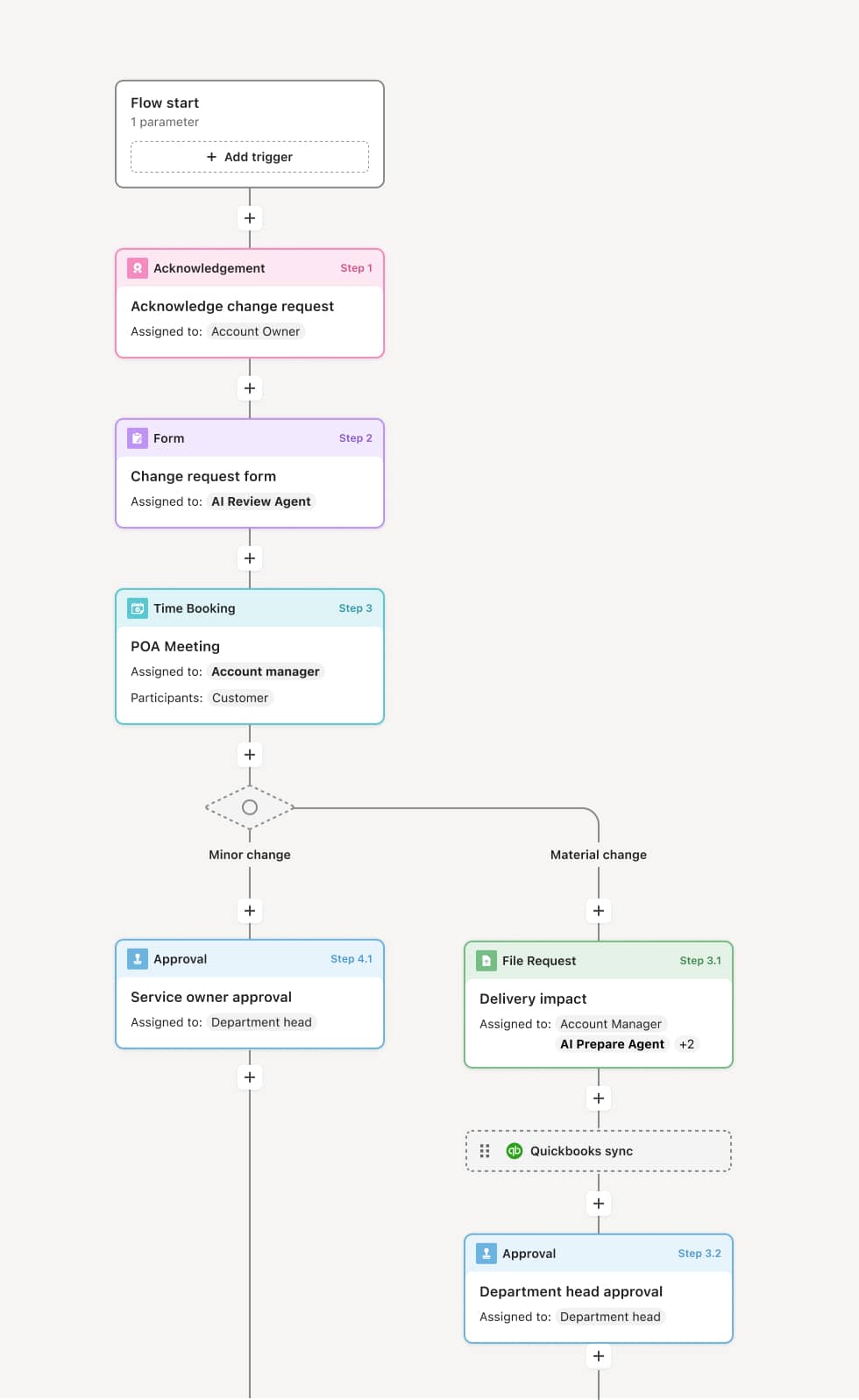
Your version of this process may vary based on roles, systems, data, and approval paths. Moxo’s flow builder can be configured with AI agents, conditional branching, dynamic data references, and sophisticated logic to match how your organization runs this workflow. The steps below illustrate one example.
Deal submission
The process begins when an account executive or sales manager submits a deal for approval, including deal size, proposed pricing, discount levels, contract terms, and any non-standard commitments. This may be triggered by a CRM stage change (e.g., deal moved to “negotiation” in Salesforce) or a manual submission. An AI Agent can assist by pulling account history, prior deal terms, and standard pricing from connected systems to pre-populate the submission.
Commercial policy review
The deal desk reviews the submission against current commercial policies — pricing bands, discount thresholds, approved contract templates, and bundling rules. Standard deals that fall within policy parameters are approved at this level. Deals with exceptions are flagged and routed to the appropriate escalation path.
Financial review
For deals exceeding financial thresholds or involving significant discounts, finance reviews the margin impact, revenue recognition implications, and alignment with forecast targets. An AI Agent may prepare a financial summary comparing the proposed deal terms against standard benchmarks and similar recent deals.
Legal review
If the deal includes non-standard contract language, custom SLAs, liability modifications, or unusual indemnification terms, it is routed to legal for review. This may proceed in parallel with the financial review to reduce cycle time.
Approval decision
The deal is routed to the appropriate approver — deal desk lead, VP of sales, or executive sponsor — based on its value and exception level. The approver reviews the complete package, including commercial validation, financial assessment, and legal input. The deal is either approved, approved with conditions, or returned for revision.
Customer commitment and execution
Once approved, the deal terms are finalized and the contract is prepared for customer execution. An AI Agent can assist by generating the contract from the approved terms. E-signatures are collected, and the deal moves to fulfillment.
Closure and system update
Upon execution, the CRM, billing systems, and revenue tracking tools are updated. The full deal record — including all submissions, reviews, approvals, and contract documents — is preserved.
This process commonly relies on inputs such as deal proposals, pricing sheets, discount requests, contract drafts, and account history. It may be triggered by a CRM stage change in Salesforce or HubSpot, a deal desk submission form, or a direct request from sales leadership. Connected systems often include Salesforce or HubSpot for deal data, CPQ tools for pricing and quoting, NetSuite or ERP platforms for financial validation, and contract management tools for document execution.
Key decision points include whether the deal falls within standard commercial policy or requires exception review, whether the financial impact meets margin and revenue recognition requirements, whether non-standard contract terms require legal approval, and at what level of authority the deal must be approved based on its value and exception profile.
Incomplete deal submissions that lack pricing justification or account context, causing deal desk to request additional information and stalling the review. Over-escalation of routine deals when approval thresholds are unclear, burdening senior leaders with standard approvals. Legal review delays when non-standard terms are identified late in the process rather than flagged at submission. Lost deal momentum when the approval process takes longer than the customer’s decision timeline, risking competitive loss.
Orchestrates deal approval across sales, deal desk, finance, legal, and executive approvers in a single flow that moves at the speed of the deal.
Routes deals based on value, discount level, and exception type so standard deals are approved quickly and complex deals reach the right authority.
AI Agents prepare deal review packages by pulling account data, pricing history, and policy references from CRM and CPQ systems automatically.
Supports parallel financial and legal review so both workstreams proceed concurrently, reducing total approval time.
Connects to Salesforce, HubSpot, and CPQ systems so deal data flows directly into the approval process and updates flow back upon closure.
Preserves the complete deal record including every submission, review, approval, and contract version for audit, governance, and future reference.