Sales enablement manager
Marketing director
Brand manager
Compliance officer
Account executive
VP of sales

This process is used when sales presentations or pitch materials must be reviewed before customer-facing use, particularly when they include product claims, pricing details, competitive comparisons, case studies, or regulatory disclosures that require cross-functional validation. It applies when customized decks deviate from standard templates and need review by marketing, legal, or product teams. It is common in regulated industries where client-facing materials must meet specific disclosure or compliance requirements. Ideal for financial services, healthcare, technology, professional services, and any organization with brand or compliance standards for sales content.
The sales deck approval process typically involves account executives or sales reps who create or customize the deck, sales enablement managers who review alignment with current messaging and templates, marketing or brand reviewers who assess visual consistency and positioning, product teams who validate technical claims or feature descriptions, and compliance or legal reviewers who ensure regulatory disclosures and claims accuracy.
Consistent brand and messaging across all client-facing presentations, reducing the risk of off-brand or inaccurate materials reaching prospects. Faster deck turnaround by routing reviews to the right teams based on content type, rather than requiring every deck to go through every reviewer. Reduced compliance risk for regulated sales materials through mandatory review steps that document sign-off before customer use. Fewer last-minute revision cycles because common issues like outdated pricing, unsupported claims, or missing disclosures are caught early. Clear accountability for approval so every customer-facing deck has a documented review and authorization trail.
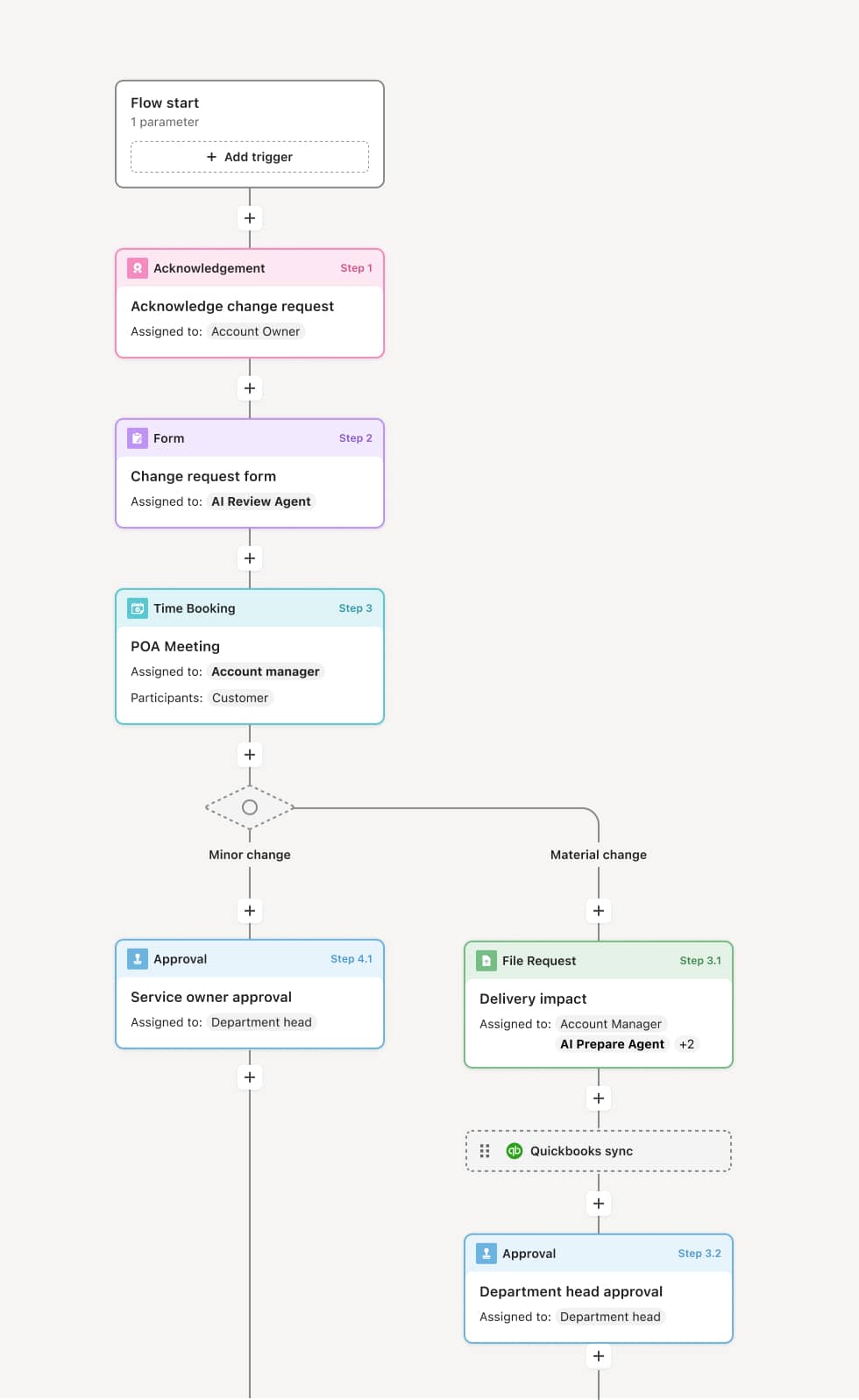
Your version of this process may vary based on roles, systems, data, and approval paths. Moxo’s flow builder can be configured with AI agents, conditional branching, dynamic data references, and sophisticated logic to match how your organization runs this workflow. The steps below illustrate one example.
Deck submission
The process begins when a sales rep or account executive submits a presentation for review. The submission includes the deck file, a description of the intended audience, the stage of the sales cycle, and a note on any customizations made to the standard template. An AI Agent can assist by flagging whether the deck deviates from the current approved template or contains elements that typically require compliance review.
Messaging and brand review
Marketing or sales enablement reviews the deck for alignment with current positioning, messaging guidelines, and brand standards. If the deck uses outdated messaging, makes unsupported claims, or deviates from visual identity guidelines, it is returned with specific feedback.
Product and technical review
If the deck includes product feature descriptions, technical specifications, competitive comparisons, or roadmap references, it is routed to the product team for validation. This may proceed in parallel with the brand review.
Compliance review
In regulated industries, decks that include financial projections, performance claims, case study data, or regulatory disclosures are routed to compliance or legal for review. An AI Agent may flag known trigger phrases or content patterns that typically require compliance sign-off.
Revision and resubmission
If any reviewer requires changes, the deck is returned to the submitter with consolidated feedback. The revised deck is resubmitted and re-routed to the reviewers who flagged issues.
Final approval and release
Once all required reviews are complete, the deck is approved for customer use. The approved version, along with the review history and approval record, is stored and optionally pushed to the sales content library.
Distribution and record-keeping
The approved deck is made available to the sales team, and all review comments, revision history, and approvals are preserved for future reference and audit.
This process commonly relies on inputs such as the presentation file, messaging guidelines, brand style guides, product fact sheets, and compliance disclosure requirements. It may be triggered by a sales rep submission, a CRM deal stage change, or a content request form. Connected systems often include content management platforms, CRM tools like Salesforce or HubSpot, and digital asset management systems for approved templates and brand assets.
Key decision points include whether the deck deviates from the approved template enough to require brand or messaging review, whether product claims or technical content require product team validation, whether regulatory disclosures or performance claims require compliance sign-off, and whether revisions adequately address all reviewer feedback before final approval.
Decks customized without using the current template, requiring extensive rework and delaying the sales cycle. Reviewers unclear on which changes require their attention, leading to full reviews of material that only needed a minor check. Compliance-triggering content not identified early, causing late-stage review additions that slow delivery. Approved decks edited after approval and shared with clients without going back through the review process.
Orchestrates deck review across sales enablement, marketing, product, and compliance in a single flow that keeps the sales cycle on track.
Routes decks to the right reviewers based on content type so standard decks move quickly while customized or regulated materials receive the appropriate scrutiny.
AI Agents flag content that may require compliance or product review at submission, reducing the risk of late-stage surprises.
Supports parallel review tracks so brand, product, and compliance reviews happen concurrently rather than sequentially.
Connects to content management and CRM systems so approved decks feed directly into the sales content library and deal records.
Preserves the complete review and approval record for every deck, supporting brand governance, compliance audits, and continuous improvement of sales materials.