Customer success manager
Finance controller
Billing operations lead
Account manager
VP of customer operations
Revenue operations manager

This process is used when a customer or client requests or is owed a credit due to a service disruption, SLA breach, billing error, or goodwill concession. It applies when the credit amount must be reviewed against contractual terms, validated by the appropriate authority, and recorded in financial systems. It is common when multiple teams — customer success, billing operations, and finance — must coordinate to assess the claim, determine the appropriate credit, and authorize the financial adjustment. Ideal for SaaS, managed services, telecommunications, professional services, and any subscription or contract-based business with defined service level commitments.
The service credit approval process typically involves customer success managers or account managers who initiate the credit request with supporting context, billing or revenue operations teams who validate the claim against contractual terms and account history, finance reviewers who assess the financial impact and authorize the adjustment, and senior leaders who approve credits above defined thresholds. The customer or client may also participate in confirming the resolution.
Faster credit resolution by routing requests to the right reviewer based on credit type, amount, and contractual terms, avoiding delays from unclear approval paths. Accurate credit validation so every issued credit is tied to a documented service failure, SLA metric, or contractual provision. Protected revenue through consistent authorization thresholds that prevent over-crediting or unauthorized concessions. Improved client relationships because credit requests are handled promptly and transparently, with clear communication at each stage. Clean financial records because every credit is authorized, recorded, and reconciled against the appropriate account and period.
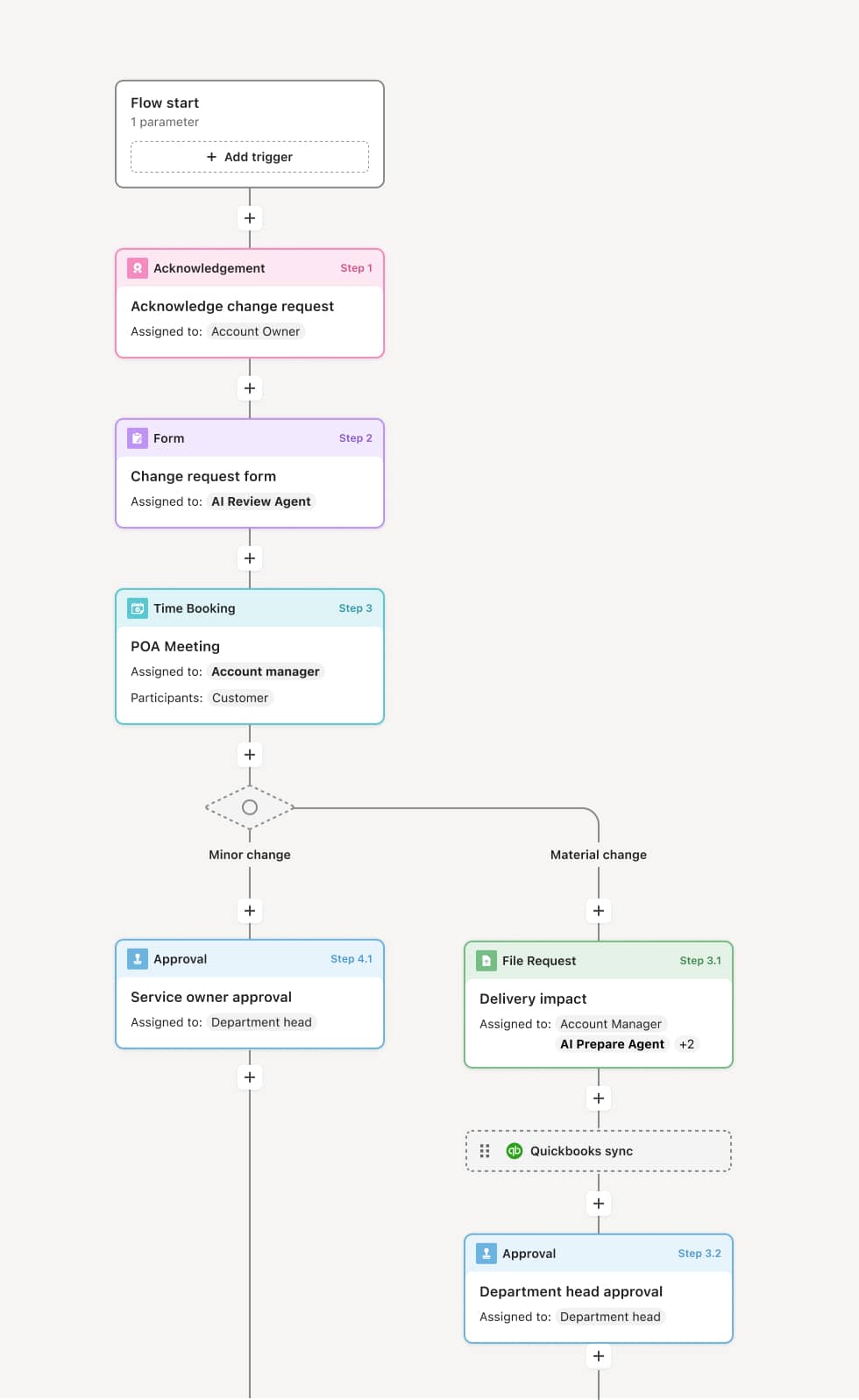
Your version of this process may vary based on roles, systems, data, and approval paths. Moxo’s flow builder can be configured with AI agents, conditional branching, dynamic data references, and sophisticated logic to match how your organization runs this workflow. The steps below illustrate one example.
Credit request initiation
The process begins when a customer success manager, account manager, or billing team member submits a service credit request. The submission includes the customer account, the reason for the credit (SLA breach, billing error, service failure, or goodwill), and supporting documentation such as incident reports, SLA metrics, or billing records. An AI Agent can assist by pulling relevant account data, SLA terms, and incident history from connected systems.
Claim validation
Billing operations or revenue operations reviews the request against the customer’s contractual terms, SLA definitions, and account history. The review confirms whether the claimed service failure qualifies for a credit under the agreement and determines the correct credit amount based on contractual formulas or precedent. If the claim does not meet the criteria, it is returned with a documented explanation.
Financial impact assessment
For credits above defined thresholds, finance reviews the revenue impact, including the effect on recognized revenue, deferred revenue, and any forecasting implications. If the credit is material, it may require additional approval from a finance director or CFO. An AI Agent may prepare a financial summary showing the credit impact relative to the account’s total contract value and recent credit history.
Approval decision
The credit is routed to the appropriate approver based on the amount and type. Standard credits within defined limits may be approved by a billing operations lead or customer success director. Higher-value credits or those outside contractual provisions are escalated to finance leadership. The approver authorizes the credit, requests additional justification, or denies the request.
Credit application and client notification
Upon approval, the credit is applied to the customer’s account in the billing system. The customer is notified of the credit amount, the reason, and how it will be reflected. An AI Agent can prepare the notification with the relevant details pulled from the approval record.
Closure and reconciliation
The credit is reconciled in financial records, and the complete request — including claim documentation, validation, approval, and application — is preserved as part of the account and financial record.
This process commonly relies on inputs such as the credit request form, SLA performance data, incident or outage reports, billing records, and contract terms. It may be triggered by a customer request, an internal SLA monitoring alert, or a billing dispute. Connected systems often include CRM platforms like Salesforce for account data, billing systems like Zuora or NetSuite for financial records, and incident management tools like ServiceNow or PagerDuty for service failure documentation.
Key decision points include whether the claimed service failure meets the contractual criteria for a credit, whether the proposed credit amount aligns with SLA formulas or requires exception handling, whether the financial impact triggers escalation to senior finance leadership, and whether the customer accepts the credit amount and resolution as satisfactory.
Credit requests submitted without adequate documentation, requiring back-and-forth to gather incident reports or SLA data before review can begin. Inconsistent application of SLA terms across accounts, leading to over- or under-crediting depending on who handles the request. Financial impact not assessed for credits that individually seem small but accumulate to material amounts across the customer base. Slow resolution timelines that erode client trust even when the credit is ultimately approved. Credits applied without proper authorization, creating reconciliation and audit issues downstream.
Orchestrates the full credit lifecycle from request through application across customer success, billing, finance, and the client in a single coordinated flow.
Routes credits based on amount and type so standard credits are approved quickly while material or non-standard credits reach the right financial authority.
AI Agents assemble credit context by pulling SLA data, incident records, and account history from connected systems automatically, reducing preparation time.
Connects to billing and CRM systems like Zuora, NetSuite, and Salesforce so credit data flows into the approval process and financial adjustments are applied accurately.
Supports client-facing resolution so customers are notified and can confirm satisfaction within the same workflow.
Preserves the complete credit record including claim documentation, validation, approval rationale, and financial reconciliation for audit and governance.