Finance controller
Collections manager
Accounts receivable lead
Chief financial officer
Internal auditor
Revenue operations manager

This process is used when the organization determines that a receivable is uncollectible, inventory is damaged or obsolete, or an asset is impaired, and the amount must be written off the books. It applies when the write-off amount requires formal justification and authorization at the appropriate level of financial authority. It is common when collections, accounts receivable, inventory management, and finance leadership must coordinate to document the justification, assess the financial impact, and authorize the write-off in compliance with accounting standards and internal policies. Ideal for financial services, healthcare, manufacturing, retail, SaaS, and any organization managing receivables, inventory, or depreciable assets.
The write-off approval process typically involves the collections team or business unit owner who documents the justification for the write-off, accounts receivable or inventory management staff who compile supporting data, finance reviewers who assess the financial impact and policy compliance, and the finance controller, CFO, or an authorized finance committee who approve write-offs at the appropriate threshold level. Internal audit may review write-offs periodically for governance.
Accurate financial reporting because write-offs are properly justified and authorized before they affect the books. Consistent application of write-off policies across business units, customer segments, and asset categories. Faster resolution of uncollectible accounts by routing write-off requests to the right authority based on amount and type without manual escalation guesswork. Reduced audit findings through documented justification, supporting evidence, and authorization records for every write-off. Better receivables and inventory visibility because items that should be written off are processed promptly rather than lingering as stale records.
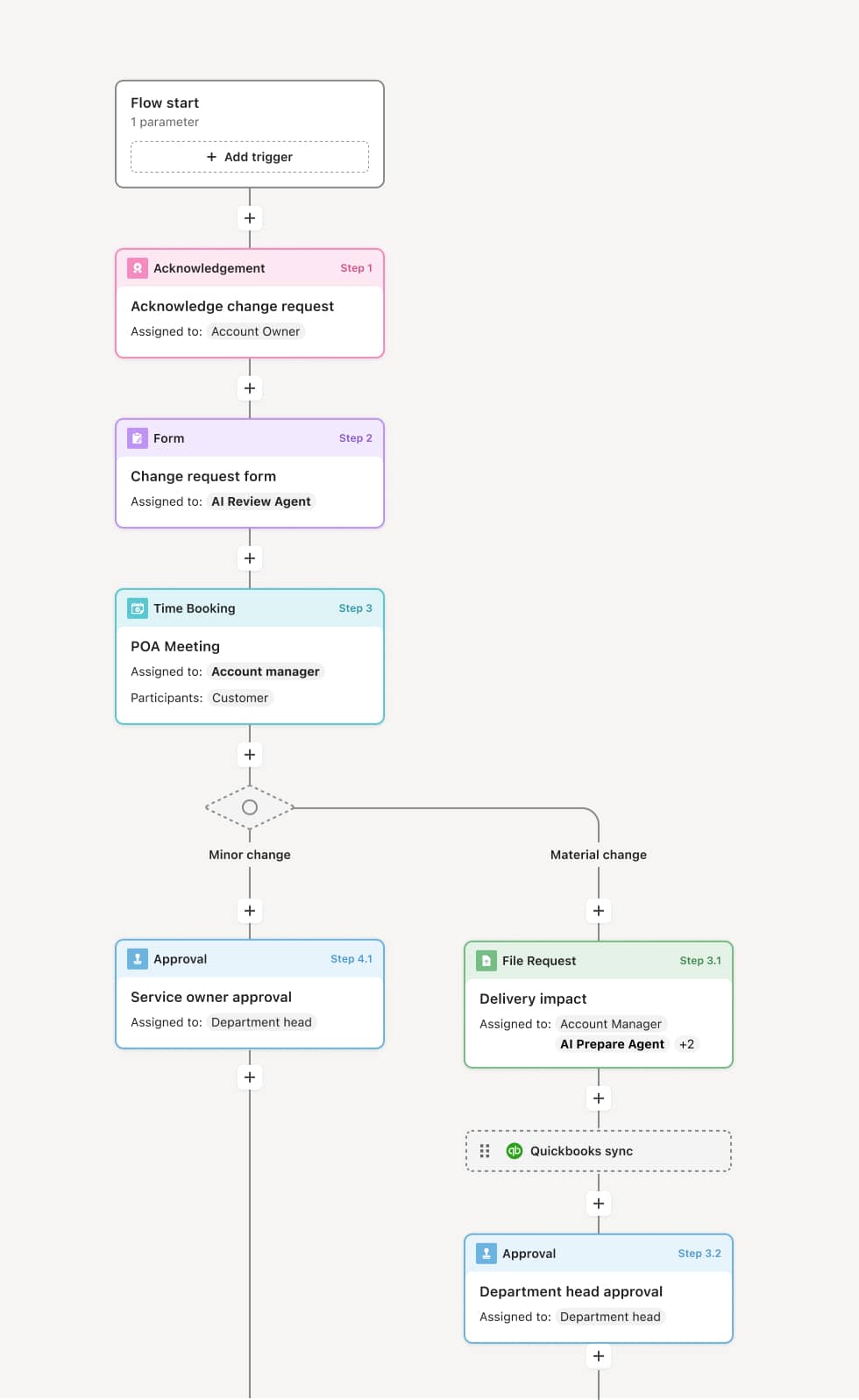
Your version of this process may vary based on roles, systems, data, and approval paths. Moxo’s flow builder can be configured with AI agents, conditional branching, dynamic data references, and sophisticated logic to match how your organization runs this workflow. The steps below illustrate one example.
Write-off request and justification
The process begins when the collections team, business unit, or inventory manager submits a write-off request with the amount, category (receivable, inventory, or asset), and detailed justification. Supporting documentation may include collection attempt history, customer correspondence, damage reports, obsolescence assessments, or impairment analyses. An AI Agent can assist by pulling relevant account history, aging data, and prior collection activity to enrich the justification package.
Policy and threshold review
Finance reviews the request against the organization’s write-off policy, including minimum documentation requirements, aging thresholds, and authority limits. If the request does not meet policy criteria or lacks sufficient documentation, it is returned for additional information.
Financial impact assessment
For material write-offs or those affecting financial reporting periods, finance assesses the impact on revenue, reserves, allowances, and reported financial statements. If the write-off is significant, it may require review by the finance controller or CFO and may need to be disclosed in financial reporting.
Approval decision
The write-off is routed to the appropriate approver based on the amount. Write-offs within predefined limits may be approved by a collections manager or AR lead. Larger amounts are escalated to the finance controller, CFO, or a finance committee. The approver authorizes, requests additional justification, or declines the write-off.
Execution and system update
Upon approval, the write-off is processed in the accounting system — the receivable is removed, the inventory is adjusted, or the asset is retired. Allowances and reserves are updated accordingly. All supporting documentation and approvals are preserved.
Record preservation and periodic review
The complete write-off record is maintained for internal audit and external audit review. Write-off patterns are available for analysis to inform credit policies, inventory management, and collection strategies.
This process commonly relies on inputs such as the write-off request form, aging reports, collection activity history, damage or obsolescence documentation, and accounting policy references. It may be triggered by an aging threshold, a collection exhaustion determination, or an inventory review. Connected systems often include ERP platforms like NetSuite or SAP for receivables and inventory data, CRM tools like Salesforce for customer account history, and accounting systems for journal entry processing.
Key decision points include whether the write-off justification meets policy criteria and is supported by adequate documentation, whether the write-off amount falls within the approver’s authority or requires escalation, whether the financial impact is material enough to affect reported financial statements, and whether the write-off reveals a pattern that should trigger changes to credit, collection, or inventory policies.
Insufficient documentation submitted with the write-off request, requiring multiple rounds of information gathering before approval. Delayed processing of clearly uncollectible accounts, distorting aging reports and receivables metrics. Inconsistent authority application where similar write-off amounts receive different levels of scrutiny depending on the submitting team. Write-offs processed without proper authorization, creating audit findings and financial control weaknesses. Pattern analysis not performed, missing opportunities to improve credit policies or collection strategies based on write-off trends.
Orchestrates write-off review across collections, accounts receivable, finance, and leadership in a single structured flow that ensures proper authorization at every level.
Routes write-offs based on amount and category so routine items are processed efficiently while material write-offs reach the appropriate financial authority.
AI Agents enrich write-off requests by pulling aging data, collection history, and account context from connected systems automatically.
Enforces policy compliance by validating documentation requirements and authority thresholds within the workflow before routing to approvers.
Connects to ERP and CRM systems like NetSuite, SAP, and Salesforce so write-off processing and financial adjustments are synchronized with accounting records.
Preserves the complete write-off record including justification, supporting evidence, approval decisions, and financial impact for audit, governance, and trend analysis.