AML investigation lead
BSA/AML compliance officer
Financial crimes analyst
Chief compliance officer
Regulatory affairs director
Special investigations manager

This process is used when an AML alert, a referral from the business, or an external inquiry has been escalated to a formal case investigation because the activity is complex, involves multiple accounts or entities, or may indicate a broader pattern of suspicious behavior that requires deeper analysis. It applies when the investigation must go beyond single-alert review to examine networks of related accounts, beneficial ownership structures, geographic risk patterns, and transaction flows across a longer time horizon. Ideal for banks, broker-dealers, money services businesses, and any financial institution managing complex AML investigations.
The case investigation process typically involves senior AML investigators who conduct the detailed analysis, compliance analysts who support research and documentation, BSA officers who review findings and authorize SAR filings, legal counsel who advise on law enforcement referrals and regulatory exposure, and quality assurance reviewers who assess investigation completeness.
Thorough case analysis that examines the full scope of suspicious activity across accounts, entities, and time periods. Defensible investigation documentation that demonstrates a comprehensive and risk-based approach during regulatory examination. Timely SAR filing when suspicious activity is confirmed, with narratives that clearly communicate the findings to law enforcement. Identified network connections that reveal related accounts, entities, or typologies not visible in single-alert reviews. Actionable intelligence that informs the organization’s risk management, enhanced due diligence, and monitoring model tuning.
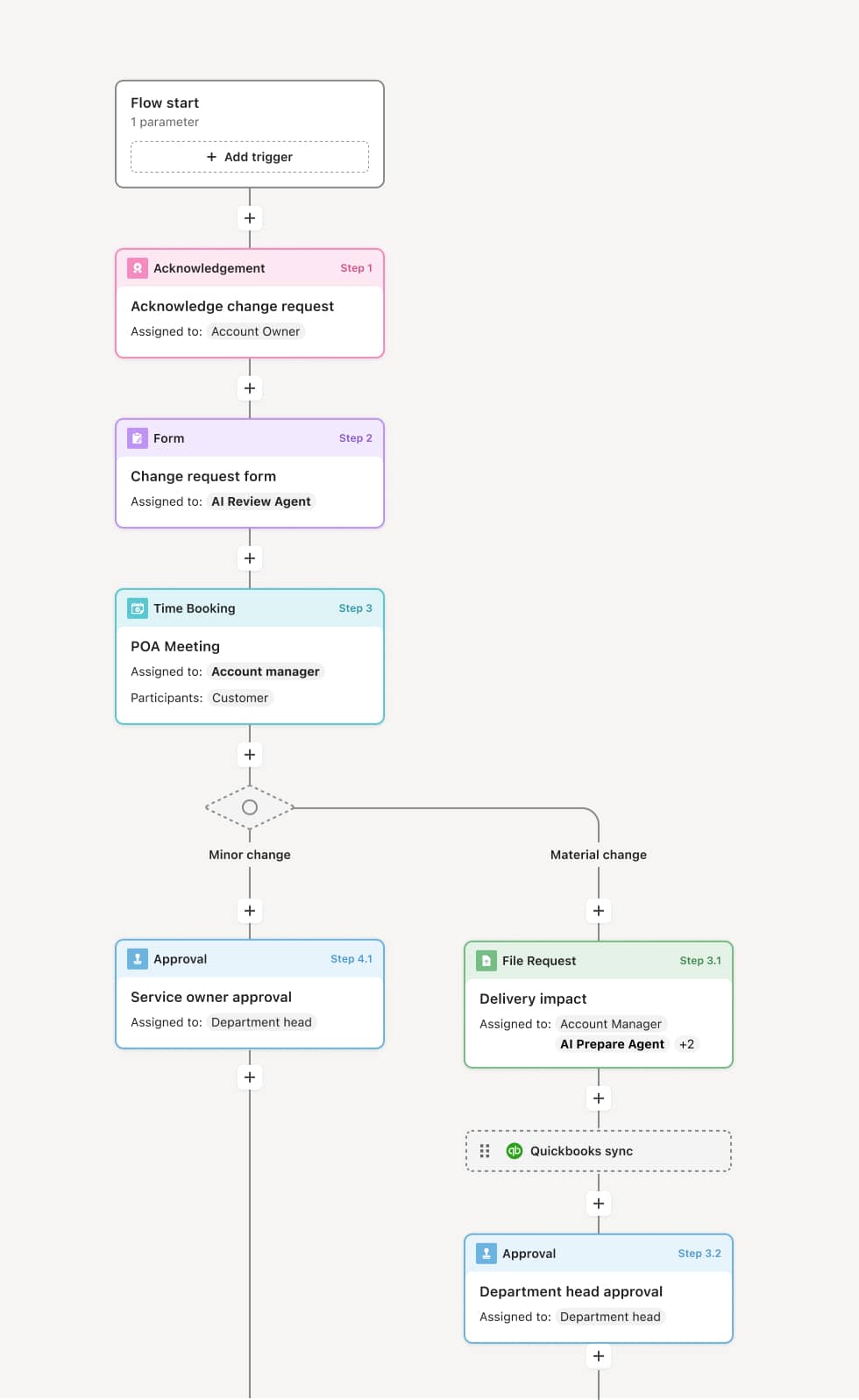
Your version of this process may vary based on roles, systems, data, and approval paths. Moxo’s flow builder can be configured with AI agents, conditional branching, dynamic data references, and sophisticated logic to match how your organization runs this workflow. The steps below illustrate one example.
Case initiation and scope definition
The process begins when a case is opened based on an escalated alert, a business referral, a law enforcement inquiry, or a pattern identified through proactive analysis. The lead investigator defines the scope of the investigation, including the subjects, accounts, time period, and key questions to be addressed. An AI Agent can assist by compiling prior alerts, existing SARs, KYC data, and transaction summaries for the subjects involved.
Data gathering and transaction analysis
The investigator gathers transaction data, account records, KYC documentation, beneficial ownership information, and any external data relevant to the case. Transaction analysis examines flows of funds, counterparties, geographic patterns, and deviations from expected activity. An AI Agent may identify related accounts, common counterparties, and network connections that expand the scope of the investigation.
Entity and network analysis
For complex cases involving multiple subjects or accounts, the investigator maps relationships between entities, beneficial owners, and transaction counterparties to identify patterns consistent with known money laundering typologies. Negative news, sanctions, and PEP screening results are integrated into the analysis.
Findings documentation and risk assessment
The investigator documents the findings, including a narrative of the activity, the analysis performed, the evidence supporting or refuting suspicious intent, and an overall risk assessment. If the activity is determined to be suspicious, the rationale for SAR filing is documented. If not suspicious, the rationale for closing the case is equally detailed.
SAR filing and law enforcement referral
If a SAR is warranted, the investigator prepares the SAR narrative and the BSA officer reviews and authorizes filing with FinCEN. If the case warrants law enforcement referral, legal counsel advises on the referral and any voluntary disclosure. The SAR is filed within the 30-day regulatory timeline.
Case closure and quality review
The case is closed with a complete record of all investigation activities, findings, and dispositions. Quality assurance reviews the case for completeness, analytical rigor, and documentation standards. The case record is preserved for examination and regulatory review.
This process commonly relies on inputs such as escalated alert data, transaction records, KYC and CDD documentation, beneficial ownership records, sanctions and PEP screening results, prior SARs, and law enforcement inquiries. It may be triggered by alert escalation, a business unit referral, or an external inquiry. Connected systems often include case management platforms, transaction monitoring systems like Actimize or Verafin, KYC platforms, network analysis tools, and FinCEN’s BSA E-Filing system.
Key decision points include whether the investigation scope should be expanded based on network connections or newly identified subjects, whether the analyzed activity meets the threshold for suspicious activity under BSA/AML regulations, whether a SAR should be filed and how the narrative should characterize the activity, and whether the case warrants law enforcement referral or additional internal risk management actions.
Investigation scope too narrow, missing related accounts or entities that are part of the same suspicious pattern. Transaction analysis performed without sufficient context about the customer’s business, resulting in inaccurate conclusions about whether the activity is unusual. Findings documentation insufficient to support the disposition decision during a regulatory examination. SAR narratives generic or template-driven, failing to communicate the specific suspicious activity to law enforcement effectively. Investigation timelines exceeded because complex cases are not tracked against SLA and regulatory deadlines.
Orchestrates complex AML case investigations from initiation through SAR filing and closure across investigators, compliance analysts, BSA officers, and legal in a single coordinated flow.
AI Agents compile investigation packages at case opening, pulling prior alerts, KYC data, transaction summaries, and screening results for the subjects involved.
Supports network and entity analysis by surfacing related accounts and common counterparties within the investigation workflow.
Tracks investigation timelines and SAR filing deadlines so complex cases are completed within regulatory expectations.
Connects to case management, transaction monitoring, and KYC platforms like Actimize, Verafin, and FinCEN E-Filing so investigation data and regulatory filings are managed seamlessly.
Preserves the complete case record including scope definition, transaction analysis, findings, disposition rationale, SAR documentation, and quality review for examination readiness.