Compliance manager
Client operations director
Legal operations lead
Finance controller
Business development manager
Vendor management coordinator

This process is used when a customer, counterparty, or business partner sends the organization a due diligence questionnaire or documentation request as part of their vendor qualification, onboarding, or periodic review process. It applies when the request requires gathering documentation from multiple internal departments — compliance, legal, finance, IT, and operations — and assembling a complete response package within the counterparty’s deadline. It is common when the organization receives dozens or hundreds of due diligence requests per year from different counterparties with varying requirements. Ideal for financial services firms, professional services firms, technology companies, and any organization that regularly responds to customer or partner due diligence requests.
The CDD response process typically involves compliance coordinators who manage the request and assemble the response, legal who reviews and approves sensitive disclosures, finance who provides financial statements and insurance documentation, IT or security who responds to information security questionnaires, and the requesting party who receives and evaluates the response.
Complete and timely responses that meet the counterparty’s requirements and deadline, preventing delays to the business relationship. Consistent response quality because documentation is assembled from verified, current sources rather than ad hoc searches each time. Reduced response effort by maintaining a library of standard responses and documentation that can be reused across requests. Protected sensitive information through legal review of disclosures before they are shared externally. Strengthened business relationships by demonstrating professionalism and compliance readiness in responding to due diligence.
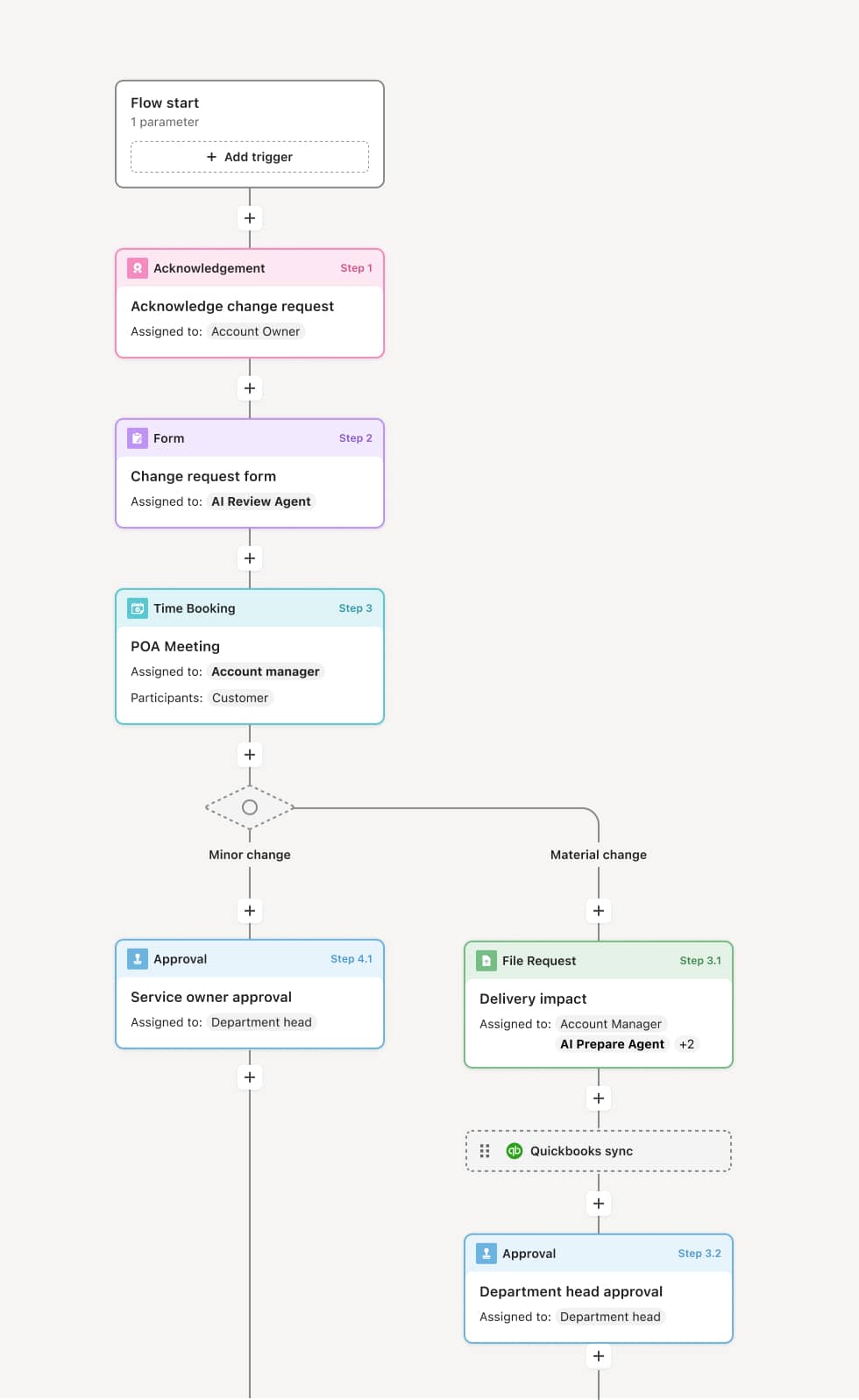
Your version of this process may vary based on roles, systems, data, and approval paths. Moxo’s flow builder can be configured with AI agents, conditional branching, dynamic data references, and sophisticated logic to match how your organization runs this workflow. The steps below illustrate one example.
Request intake and assessment
The process begins when a due diligence request is received from a customer or counterparty. The compliance coordinator reviews the request to identify the specific documentation, questionnaire responses, and certifications required. An AI Agent can assist by comparing the request against the organization’s standard due diligence response library and identifying which items are already available and which require fresh preparation.
Internal documentation gathering
The coordinator routes documentation requests to the appropriate internal teams. Finance provides financial statements, insurance certificates, and tax documentation. Legal provides corporate registrations, compliance certifications, and beneficial ownership information. IT or security completes information security questionnaires. Each team provides their portion within the workflow.
Response preparation and quality review
The coordinator assembles the complete response package, ensuring all requested items are addressed. An AI Agent may verify the response against the original request checklist to flag any missing items. Legal reviews the package for any sensitive disclosures that require redaction or additional context.
Approval and submission
The completed response is approved by the appropriate internal authority — typically compliance or legal — before submission to the requesting party. The response is submitted through the counterparty’s preferred channel along with any required cover documentation.
Follow-up and clarification
If the counterparty has follow-up questions or requests additional documentation, the coordinator manages the follow-up within the workflow, routing questions to the appropriate internal teams and submitting responses promptly.
Record retention and response library update
The complete request and response are documented and preserved. Any new or updated standard responses are added to the organization’s due diligence response library for reuse on future requests.
This process commonly relies on inputs such as the counterparty’s due diligence questionnaire, corporate registrations, financial statements, insurance certificates, compliance certifications, security assessments, and beneficial ownership documentation. It may be triggered by a customer onboarding request, a periodic vendor review, or a new business relationship. Connected systems often include document management systems, CRM platforms like Salesforce, compliance management platforms, and secure file sharing tools.
Key decision points include which documentation items can be fulfilled from existing standard responses and which require new preparation, whether any requested disclosures contain sensitive information requiring legal review or redaction, whether the response is complete against the counterparty’s full request before submission, and whether follow-up questions require additional internal coordination.
Requests not tracked centrally, causing responses to be missed or delayed. Documentation gathered from outdated sources, resulting in inaccurate responses that must be corrected. Internal teams not responsive to documentation requests, compressing the response timeline. Sensitive disclosures shared without legal review, creating risk exposure. Standard response library not maintained, requiring every request to be assembled from scratch.
Orchestrates due diligence response from request intake through submission and follow-up across compliance, legal, finance, IT, and the requesting party in a single coordinated flow.
AI Agents compare incoming requests against the standard response library and identify which items are already available, reducing preparation time.
Routes documentation requests to internal teams within the workflow with clear deadlines, eliminating email-based coordination across departments.
Manages legal review and approval of the response package before submission, ensuring sensitive disclosures are reviewed in context.
Engages the requesting party within the workflow for submission and follow-up, keeping all interactions documented.
Preserves the complete request and response record and updates the standard response library for reuse on future due diligence requests.