Chief data officer
Data governance manager
IT director
Compliance officer
Data steward
Business intelligence lead

This process is used on an ongoing basis to manage the organization’s data governance program, including policy development and enforcement, data quality monitoring and remediation, data stewardship assignments and accountability, data classification and access control management, and regulatory compliance for data privacy and security requirements. It applies when governance activities must be coordinated across data stewards in multiple business units, IT, compliance, and legal. Ideal for organizations managing data across multiple systems, business units, and regulatory jurisdictions — including financial services, healthcare, technology, and any enterprise with significant data assets.
The data governance process typically involves the data governance manager or chief data officer who oversees the program, data stewards in each business unit who are accountable for data quality and policy compliance within their domains, IT teams who implement technical controls and data management infrastructure, compliance officers who ensure regulatory data requirements are met, and business analysts who identify and report data quality issues.
Consistent data quality across the enterprise because data quality issues are identified, escalated, and resolved through a structured stewardship process. Enforced data policies with documented accountability for data classification, access, retention, and usage standards. Regulatory compliance with data privacy and protection requirements through documented governance controls and monitoring. Clear data ownership with assigned stewards accountable for the quality, integrity, and appropriate use of data within their domains. Reduced data-related risk through proactive identification and resolution of data quality, access, and lineage issues.
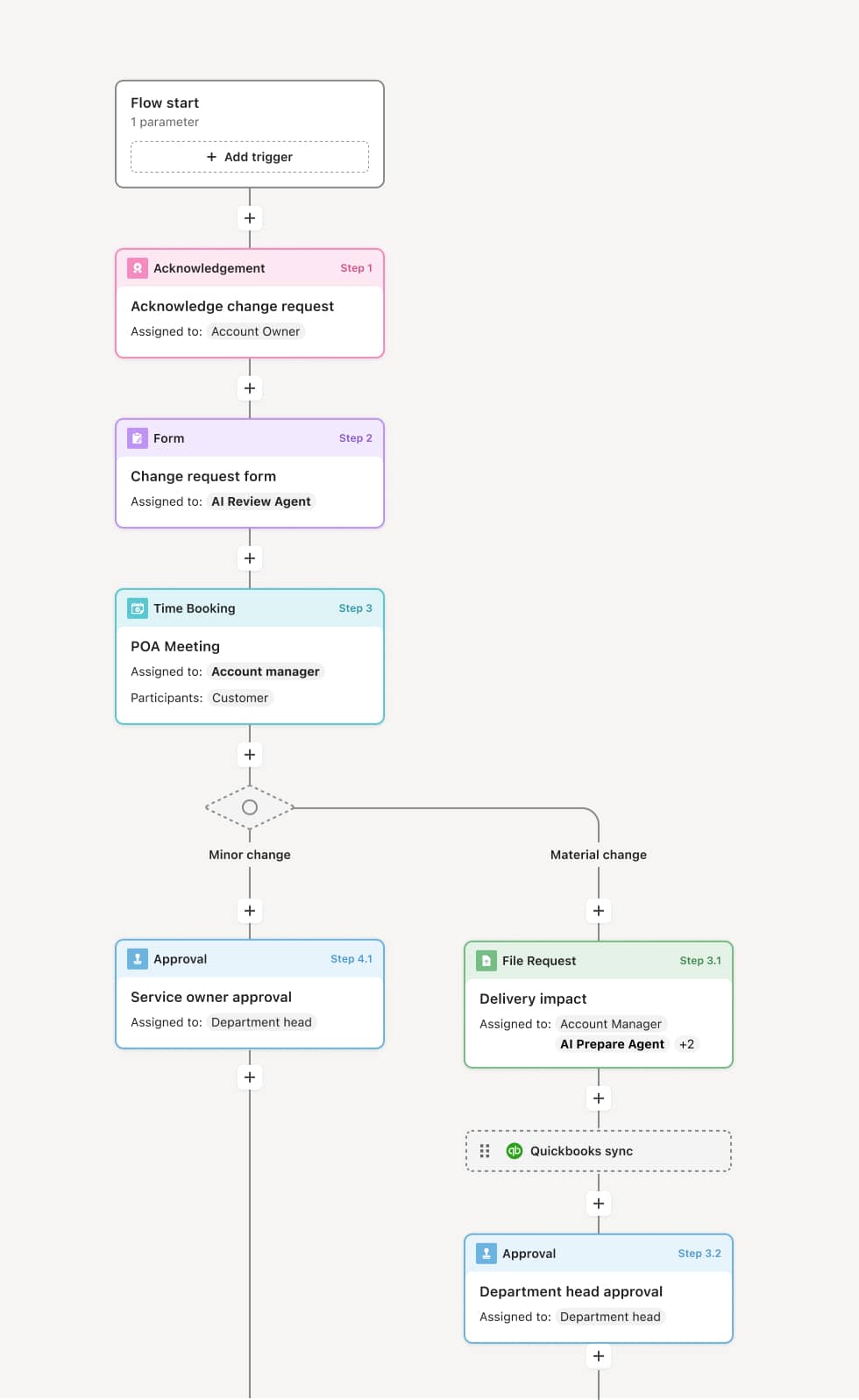
Your version of this process may vary based on roles, systems, data, and approval paths. Moxo’s flow builder can be configured with AI agents, conditional branching, dynamic data references, and sophisticated logic to match how your organization runs this workflow. The steps below illustrate one example.
Policy development and stewardship assignment
The process includes defining and maintaining data governance policies covering data quality standards, classification schemes, access control requirements, retention rules, and acceptable use. Data stewards are assigned for each major data domain and are responsible for policy compliance within their area. An AI Agent can assist by tracking policy review cycles and identifying domains without active steward assignments.
Data quality monitoring and issue identification
Data quality is monitored through automated profiling, business rules validation, and steward review. When data quality issues are identified — such as duplicates, missing values, inconsistencies, or lineage breaks — they are logged and assigned to the responsible steward for investigation and resolution.
Issue investigation and remediation
The data steward investigates the root cause of each data quality issue, determines the appropriate remediation, and coordinates with IT or the source system owner to implement the fix. An AI Agent may categorize issues by type and severity and track remediation progress against SLAs.
Data classification and access review
Data assets are classified according to the organization’s classification scheme, and access controls are reviewed to ensure that access is appropriate for the classification level. Stewards verify that access permissions align with policy and that sensitive data is protected with the required controls.
Compliance monitoring and reporting
The governance team monitors compliance with data governance policies across the enterprise. Compliance metrics — including data quality scores, issue resolution rates, policy adherence, and access review completion — are reported to the data governance council or steering committee.
Policy review and continuous improvement
Governance policies are reviewed and updated at defined intervals or when triggered by regulatory changes, system implementations, or material data incidents. Lessons learned from data quality issues and compliance gaps are incorporated into policy updates.
This process commonly relies on inputs such as data governance policies, data quality profiling results, stewardship assignments, classification schemes, access control records, and regulatory requirements. It may be triggered by scheduled governance activities, data quality alerts, regulatory changes, or system implementations. Connected systems often include data governance platforms like Collibra or Alation, data quality tools like Informatica or Talend, master data management systems, and identity and access management platforms.
Key decision points include which data domains require active stewardship and at what level of governance maturity, how data quality issues are prioritized and what remediation timelines are appropriate, whether data classification and access controls are aligned with current regulatory and organizational requirements, and how governance metrics inform policy updates and resource allocation.
Data stewards not actively engaged, reducing governance to a policy exercise without operational enforcement. Data quality issues identified but not remediated, allowing known problems to persist and degrade downstream analytics and reporting. Classification and access reviews not conducted, leaving sensitive data exposed to inappropriate access. Governance policies not updated after regulatory changes, system implementations, or organizational restructuring. Governance reporting not actionable, providing metrics without the context needed to drive improvement decisions.
Orchestrates the ongoing data governance program across the chief data officer, data stewards, IT, compliance, and business units in a coordinated workflow that keeps governance activities on schedule.
AI Agents track policy review cycles and stewardship assignments, flagging domains without active stewards and policies due for update.
Manages data quality issue resolution within the workflow, routing issues to the responsible steward with classification, severity, and SLA tracking.
Coordinates data classification and access reviews across stewards and IT within the workflow, ensuring reviews are completed and documented.
Connects to data governance and quality platforms like Collibra, Alation, and Informatica so governance activities, quality metrics, and issue tracking are synchronized.
Preserves the complete governance record including policies, stewardship assignments, quality issue resolution, access reviews, and compliance reporting for audit and regulatory review.