Corporate development director
General counsel
Chief financial officer
Compliance director
Investment committee member
Risk management officer

This process is used when the organization is considering a significant business transaction — such as a merger, acquisition, investment, joint venture, or major vendor engagement — that requires a comprehensive investigation of the target entity before the commitment is made. It applies when the diligence must cover financial performance, legal exposure, regulatory compliance, operational capability, intellectual property, and reputational risk, and when multiple workstreams must be coordinated across internal teams and external advisors. Ideal for private equity firms, corporate development teams, investment firms, and any organization conducting transactional or partnership due diligence.
The due diligence process typically involves the deal or transaction lead who manages the overall diligence timeline, financial analysts who evaluate financial statements and projections, legal counsel who reviews contracts, litigation, and regulatory exposure, compliance who assesses regulatory standing and anti-corruption risk, operational reviewers who evaluate business capabilities, and the target entity who provides documentation and responds to diligence requests.
Comprehensive risk assessment covering financial, legal, operational, regulatory, and reputational dimensions before the commitment is made. Identified deal risks and value adjustments that inform pricing, deal structure, representations, and post-close integration planning. Coordinated diligence execution with all workstreams managed to the transaction timeline rather than working in isolation. Documented findings and recommendations that provide decision-makers with a clear basis for proceeding, renegotiating, or declining. Protected organizational interests by identifying material risks, liabilities, or misrepresentations before closing.
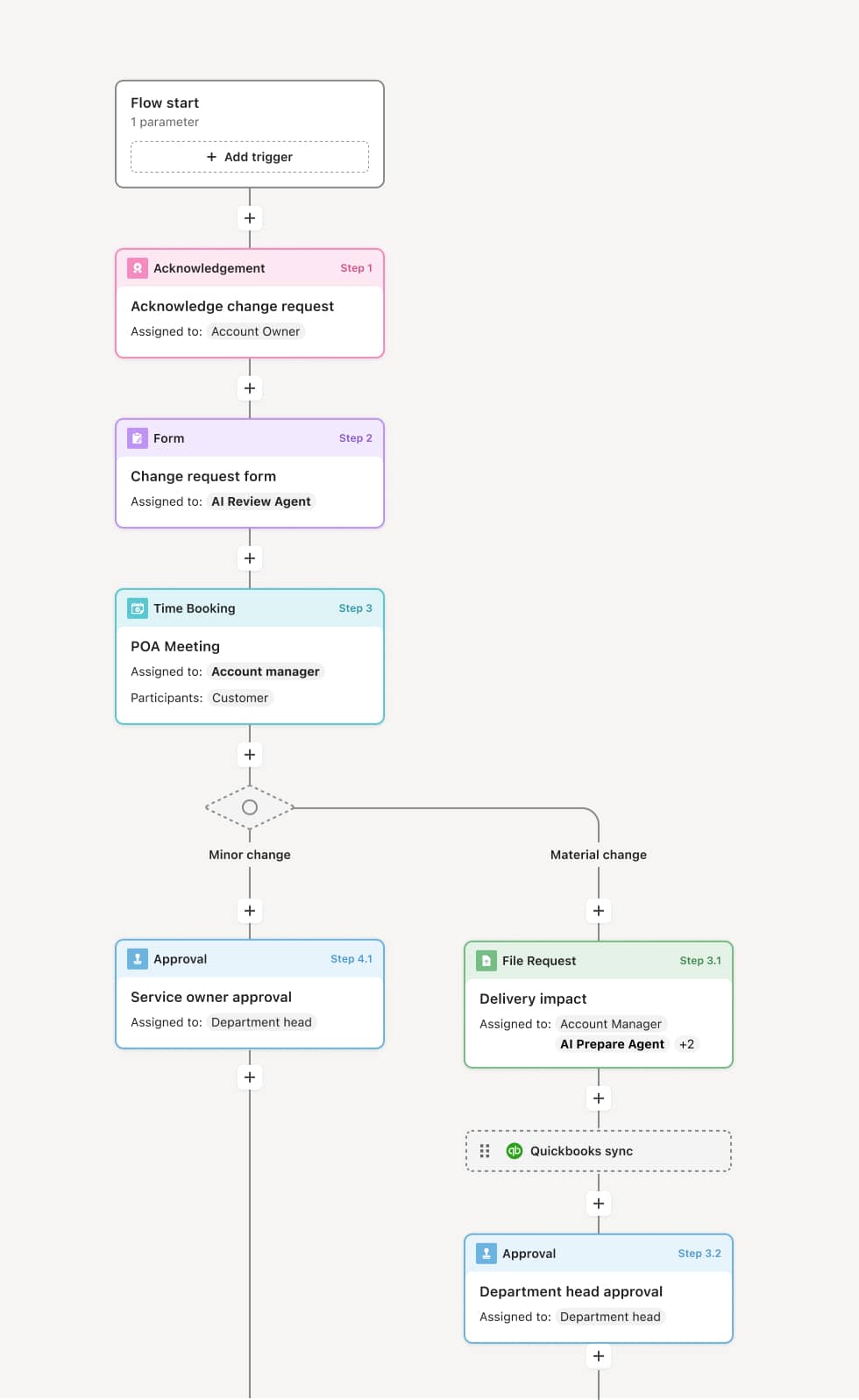
Your version of this process may vary based on roles, systems, data, and approval paths. Moxo’s flow builder can be configured with AI agents, conditional branching, dynamic data references, and sophisticated logic to match how your organization runs this workflow. The steps below illustrate one example.
Diligence planning and document request
The process begins when the transaction is approved for due diligence. The deal lead defines the diligence scope, workstream assignments, and timeline. A comprehensive document request list is prepared and sent to the target entity, covering financial records, contracts, legal matters, regulatory filings, employment data, IP, and operational information. An AI Agent can assist by generating the document request list based on the transaction type and the organization’s standard diligence framework.
Document collection and data room management
The target entity provides requested documentation, typically through a virtual data room. The diligence team tracks document availability against the request list and follows up on missing or incomplete items. An AI Agent may monitor data room uploads and flag outstanding requests.
Workstream execution
Each diligence workstream conducts its review in parallel. Financial diligence analyzes historical performance, projections, working capital, and debt. Legal diligence reviews contracts, litigation, and regulatory compliance. Operational diligence evaluates business processes, technology, and organizational capability. Compliance diligence assesses anti-corruption, sanctions, and regulatory risk. Each workstream documents its findings and risk assessments.
Findings consolidation and risk assessment
The deal lead consolidates findings from all workstreams into a comprehensive diligence report. Material findings are classified by severity and potential impact on the transaction — including deal-breakers, value adjustments, indemnification items, and integration risks. An AI Agent may cross-reference findings across workstreams to identify connected risks.
Decision-maker presentation and recommendation
The consolidated findings and risk assessment are presented to the investment committee, board, or deal authority for review. The diligence team provides a recommendation to proceed, proceed with conditions, renegotiate, or decline. The decision and its rationale are documented.
Post-decision follow-through
If the transaction proceeds, diligence findings inform the definitive agreement, representations and warranties, indemnification provisions, and post-close integration priorities. Outstanding diligence items may be addressed as conditions to closing.
This process commonly relies on inputs such as the document request list, target entity documentation, financial statements, contracts, litigation records, regulatory filings, and diligence workstream templates. It may be triggered by a signed letter of intent or a board-approved diligence authorization. Connected systems often include virtual data room platforms like Intralinks or Datasite, deal management tools, financial modeling systems, and compliance screening platforms.
Key decision points include what scope and depth of diligence is appropriate for the transaction type and risk profile, whether the target entity’s documentation is complete enough to support informed diligence conclusions, whether material findings require deal renegotiation, structural changes, or abandonment, and how diligence findings translate into definitive agreement protections and post-close integration plans.
Diligence scope too narrow, missing material risks in areas not covered by the workstream plan. Document requests not tracked, allowing gaps in the target entity’s production to go unaddressed. Workstreams operating in isolation without cross-referencing findings, missing connected risks that span financial, legal, and operational dimensions. Findings report delivered too late to inform deal negotiations, reducing the diligence’s practical value. Post-close integration not informed by diligence findings, causing known risks to materialize after closing.
Orchestrates due diligence across all workstreams from document request through decision-maker presentation in a single coordinated flow.
Engages the target entity within the workflow for document production, follow-up requests, and management discussions, keeping all interactions tracked and secure.
AI Agents generate document request lists based on the transaction type and track production completeness against the request inventory.
Manages parallel workstreams with clear assignments, deadlines, and findings documentation so all diligence tracks progress together.
Consolidates findings across workstreams within the workflow, with AI Agents cross-referencing risks to surface connected issues.
Preserves the complete diligence record including document requests, production tracking, workstream findings, risk assessments, and the decision recommendation for governance, audit, and post-close reference.