Chief risk officer
Model risk management director
Model validation lead
Quantitative analytics manager
Regulatory affairs officer
Internal audit director

This process is used on an ongoing basis to govern the lifecycle of all quantitative models in the organization’s model inventory, from initial development through validation, approval, implementation, ongoing monitoring, and eventual retirement. It applies when models are used to inform material business decisions and when the organization must demonstrate a model risk management framework that meets regulatory expectations, particularly SR 11-7 (Supervisory Guidance on Model Risk Management). Ideal for banks, insurance companies, investment firms, and any financial institution using quantitative models in risk, pricing, capital, or compliance decisions.
The model risk governance process typically involves model owners who develop and maintain models, model validation teams who conduct independent validation, model risk management staff who administer the governance framework, governance committees who approve models and monitor portfolio risk, and internal audit who assesses the effectiveness of the model risk management program.
Validated model performance through independent testing that confirms models produce reliable outputs for their intended use. Complete model inventory with every model identified, classified, and subject to governance based on its materiality and risk. Documented model lifecycle from development through retirement with validation reports, approval records, and monitoring results. Regulatory compliance with SR 11-7 and other applicable model risk management standards demonstrated through a structured governance program. Reduced model risk through ongoing monitoring that detects model degradation, assumption violations, and usage outside intended scope.
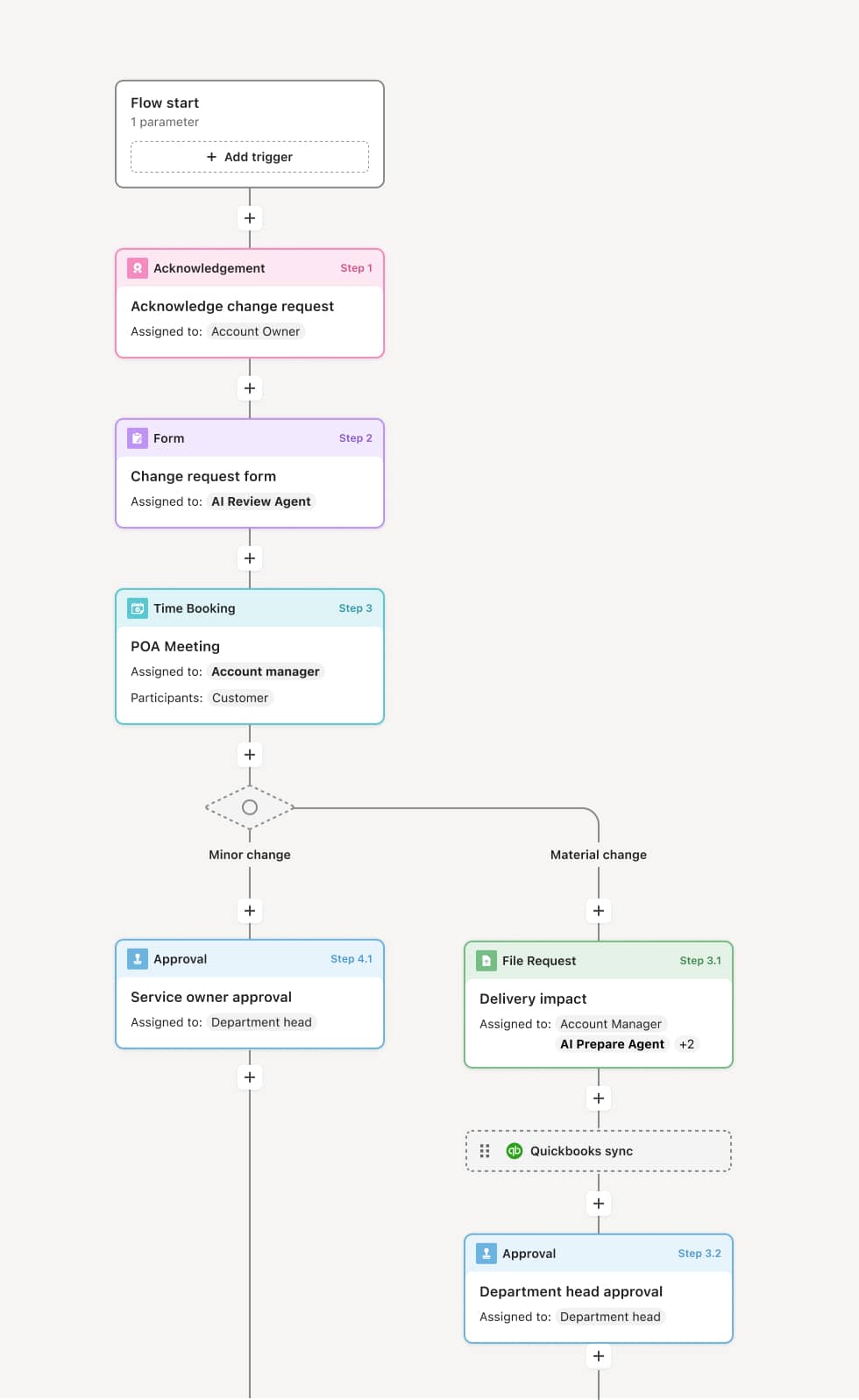
Your version of this process may vary based on roles, systems, data, and approval paths. Moxo’s flow builder can be configured with AI agents, conditional branching, dynamic data references, and sophisticated logic to match how your organization runs this workflow. The steps below illustrate one example.
Model inventory and classification
The process includes maintaining a comprehensive inventory of all models used in the organization. Each model is classified by type, materiality, business function, and risk tier. New models are registered in the inventory before development or implementation. An AI Agent can assist by flagging unregistered models identified through system scans or business unit attestations.
Model development and documentation
Model owners develop or modify models following the organization’s development standards. Development documentation includes the model’s purpose, theoretical basis, data sources, assumptions, limitations, and intended use. The documentation is submitted for validation review.
Independent model validation
The model validation team conducts an independent assessment of the model’s conceptual soundness, data integrity, implementation accuracy, and performance through backtesting and benchmarking. The validation report documents findings, identified limitations, and any conditions for approval. An AI Agent may track validation progress and flag overdue validations.
Governance committee approval
The model’s development documentation and validation report are presented to the model risk governance committee for approval. The committee approves the model for use, approves with conditions (such as enhanced monitoring or usage restrictions), or requires remediation before approval. The approval decision and conditions are documented.
Ongoing monitoring and performance review
Approved models are subject to ongoing monitoring, including periodic performance testing, backtesting against actual outcomes, assumption review, and usage monitoring. When monitoring indicates model degradation or performance outside acceptable thresholds, the model owner is alerted and remediation or revalidation is initiated.
Model revalidation and retirement
Models are revalidated at defined intervals or when triggered by material changes to inputs, market conditions, or business use. Models that are no longer needed or no longer perform adequately are retired from the inventory with documented rationale and transition planning.
This process commonly relies on inputs such as the model inventory, development documentation, validation reports, performance monitoring data, governance committee minutes, and regulatory examination findings. It may be triggered by new model development, the periodic validation schedule, monitoring alerts, or regulatory examination. Connected systems often include model risk management platforms, statistical computing environments, data warehouses for model inputs and outputs, and governance documentation systems.
Key decision points include how each model is classified based on materiality, risk, and business function, whether the validation confirms the model’s conceptual soundness and performance, whether the governance committee approves the model and under what conditions, and whether ongoing monitoring indicates the model requires revalidation, remediation, or retirement.
Model inventory incomplete, leaving models in production without governance oversight. Validation backlogs caused by insufficient validation resources, allowing models to operate beyond their revalidation dates. Validation findings not remediated by model owners, leaving known model limitations unaddressed. Monitoring thresholds not calibrated, missing model degradation until performance failures affect business outcomes. Governance committee reviews perfunctory, approving models without meaningful challenge or condition-setting.
Orchestrates model risk governance across model owners, validation teams, risk management, and governance committees in a single coordinated flow that manages the full model lifecycle.
AI Agents track the model inventory and flag unregistered models, overdue validations, and monitoring threshold breaches.
Manages independent validation within the workflow, routing development documentation to validation teams and tracking findings through remediation.
Coordinates governance committee reviews with complete model packages including documentation, validation reports, and monitoring data compiled within the workflow.
Tracks ongoing monitoring and revalidation schedules so every model is reviewed at the appropriate interval based on its risk classification.
Preserves the complete model governance record including inventory classification, validation reports, approval decisions, monitoring results, and retirement documentation for SR 11-7 compliance and regulatory examination.