Patient accounts manager
Revenue cycle director
Billing supervisor
Finance controller
Compliance officer
Patient financial services lead

This process is used when a patient credit balance is identified — due to insurance payment adjustments, duplicate payments, billing corrections, or charges reversed after the patient has already paid. It applies when the credit must be verified against the account history, confirmed as a true overpayment, approved for refund, and returned to the patient through the appropriate payment method. It is common when billing, patient accounts, finance, and compliance teams must coordinate to verify the credit and process the refund within state-mandated timelines. Ideal for hospitals, physician practices, ambulatory care centers, and any healthcare organization managing patient account credits.
The patient refund process typically involves patient accounts staff who identify and verify credit balances, billing analysts who investigate the cause of the overpayment, finance reviewers who approve refunds based on amount thresholds, compliance officers who ensure regulatory timeline adherence, and accounts payable or treasury staff who issue the refund payment.
Timely refund processing that meets state regulatory deadlines and organizational service standards. Accurate refund amounts because credit balances are verified against the complete account history before approval. Consistent approval controls with refunds routed to the appropriate authority based on amount. Reduced patient complaints by proactively identifying and processing credits rather than waiting for patients to inquire. Complete refund documentation supporting financial reconciliation, audit, and regulatory compliance.
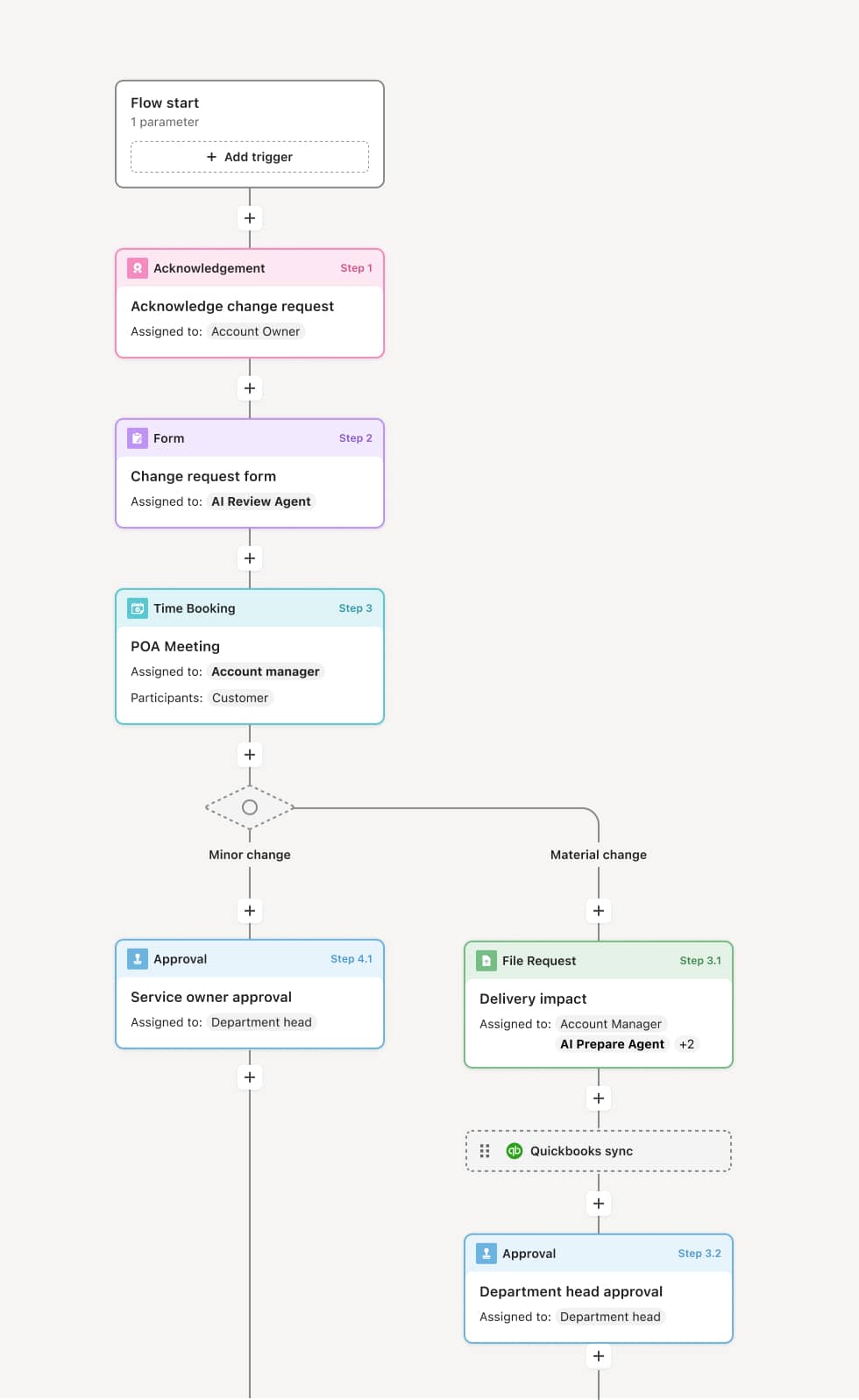
Your version of this process may vary based on roles, systems, data, and approval paths. Moxo’s flow builder can be configured with AI agents, conditional branching, dynamic data references, and sophisticated logic to match how your organization runs this workflow. The steps below illustrate one example.
Credit balance identification
The process begins when a patient credit balance is identified — through a routine credit balance report, a patient inquiry, an insurance payment adjustment, or a billing correction. An AI Agent can assist by scanning credit balance reports and flagging accounts that meet refund criteria based on the credit age and amount.
Overpayment verification
Patient accounts or billing staff investigate the credit to confirm it represents a true overpayment. The investigation includes reviewing the payment history, insurance adjustments, charges, and any pending transactions that might offset the credit. If the credit is not a true overpayment (such as a pending insurance adjustment), the account is noted and the refund is not processed.
Refund approval
Once verified, the refund request is submitted for approval. Refunds within standard limits may be approved by patient accounts staff. Higher-amount refunds are escalated to finance leadership or the controller for authorization. The approver reviews the verification documentation and authorizes the refund.
Refund processing and payment
The approved refund is processed through accounts payable or treasury. The payment method is determined based on the original payment method and patient preference — check, electronic payment, or credit card reversal. The refund is issued and the patient is notified.
Account update and reconciliation
The patient’s account is updated to reflect the refund. The credit balance is resolved, and the refund transaction is recorded in the financial system for reconciliation.
Documentation and compliance record
The complete refund record — including the credit identification, verification, approval, and payment — is preserved for audit, financial reconciliation, and regulatory compliance.
This process commonly relies on inputs such as credit balance reports, patient account detail, payment history, insurance remittance advice, and refund policy references. It may be triggered by a scheduled credit balance review, a patient inquiry, or a billing adjustment event. Connected systems often include patient accounting and billing systems like Epic, Athenahealth, or Meditech, accounts payable systems for payment processing, and financial reporting tools for reconciliation.
Key decision points include whether the credit balance represents a verified true overpayment, whether the refund amount falls within standard approval authority or requires escalation, what payment method is appropriate for issuing the refund, and whether the refund is processed within applicable state regulatory deadlines.
Credit balances not identified promptly, causing refund processing to exceed state-mandated timelines. Overpayment verification incomplete, resulting in refunds issued on accounts that still have pending insurance adjustments. Refund approvals delayed when high-value refunds require multiple sign-offs without clear timelines. Wrong payment method used, creating patient inconvenience or reconciliation issues. Refund records not maintained in a manner that supports audit and demonstrates regulatory compliance.
Orchestrates patient refund processing from credit identification through payment issuance across billing, finance, and patient accounts in a single flow.
Routes refunds based on amount so standard refunds are processed quickly while higher-value refunds reach the appropriate financial authority.
AI Agents scan credit balance reports to proactively identify accounts meeting refund criteria, preventing aging credits from exceeding regulatory deadlines.
Tracks refund processing timelines to ensure every refund is completed within state-mandated and organizational deadlines.
Connects to patient accounting and accounts payable systems like Epic, Meditech, and financial platforms so payment processing and account updates are synchronized.
Preserves the complete refund record including verification, approval, payment confirmation, and account adjustment for audit and regulatory compliance.