Risk manager
Compliance officer
Chief risk officer
Operations director
Project manager
Senior business leader

This process is used when a business decision, transaction, project, or operational change involves a level of risk that exceeds standard operating parameters and requires formal assessment and authorization. It applies when risk factors such as financial exposure, regulatory non-compliance, operational disruption, or reputational impact must be weighed before proceeding. It is common when risk committees, compliance teams, or senior leadership must coordinate to evaluate and approve risk acceptance or mitigation plans. Ideal for financial services, healthcare, energy, technology, and any organization with a formal risk management framework.
The risk approval process typically involves risk owners who identify and document the risk, risk analysts or managers who assess likelihood and impact, compliance officers who evaluate regulatory implications, and senior leaders or risk committees who authorize risk acceptance, require mitigation, or escalate for further review. In some cases, external advisors or auditors may participate in the assessment.
Faster risk disposition by routing assessments to the appropriate authority based on risk type and severity, avoiding blanket escalation. Documented risk acceptance so every approved risk has a clear owner, rationale, and conditions recorded for audit and governance. Consistent risk evaluation through standardized assessment criteria applied across business units and decision types. Reduced operational delays from risk reviews that stall because ownership, authority, or required information is unclear. Stronger governance posture because risk decisions are visible, traceable, and tied to accountable individuals.
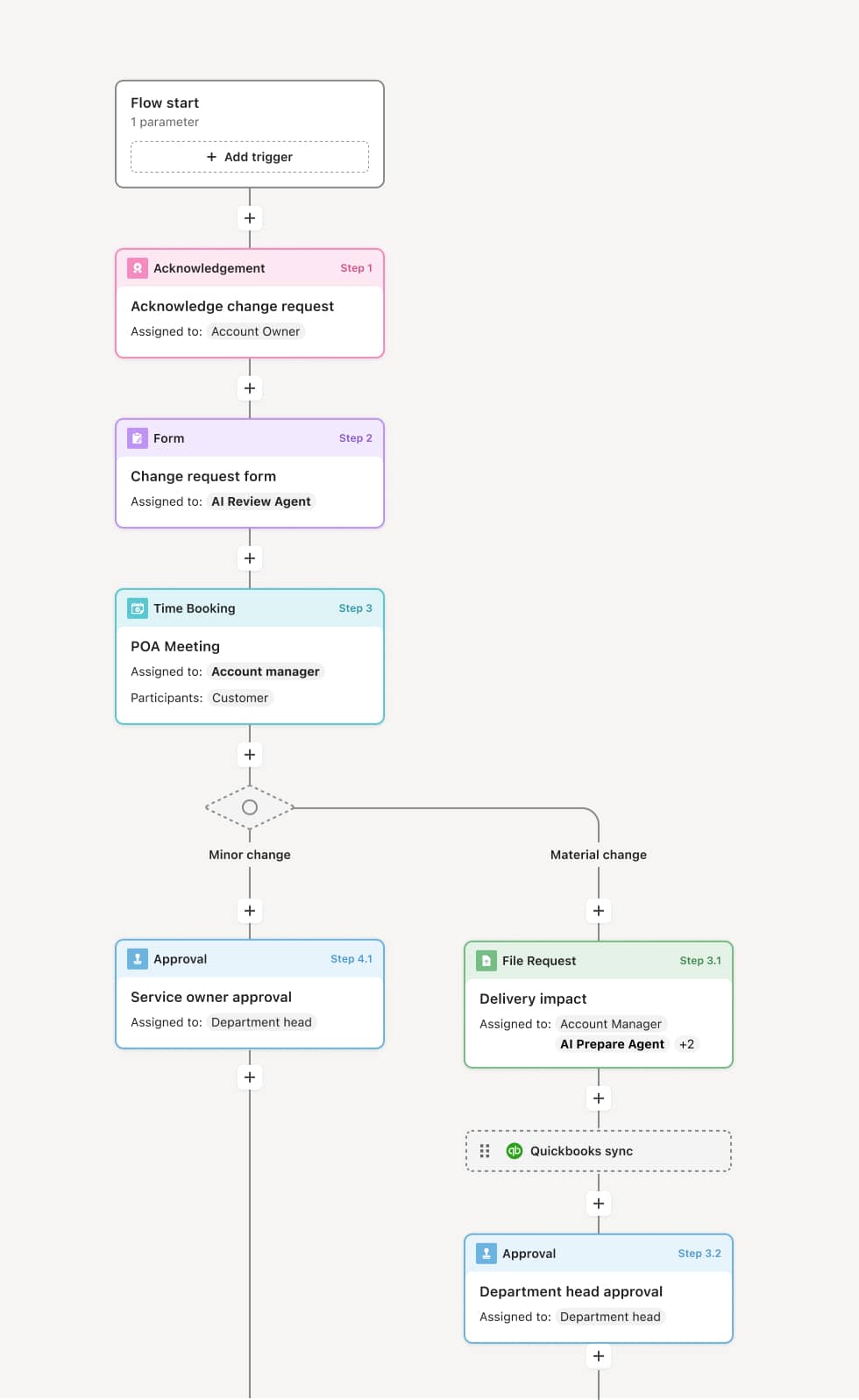
Your version of this process may vary based on roles, systems, data, and approval paths. Moxo’s flow builder can be configured with AI agents, conditional branching, dynamic data references, and sophisticated logic to match how your organization runs this workflow. The steps below illustrate one example.
Risk identification and submission
The process begins when a risk is identified in the course of a business decision, project, transaction, or operational activity. The risk owner submits a risk assessment that includes the nature of the risk, potential impact, likelihood, and any proposed mitigation measures. An AI Agent can assist by pre-populating assessment fields based on the risk category and pulling relevant policy references.
Risk analysis and classification
A risk analyst or manager evaluates the submitted risk against the organization’s risk taxonomy and tolerance thresholds. The risk is classified by severity, category, and affected business area. If the risk falls within pre-approved tolerance levels and existing controls are adequate, it may be approved at this stage. If it exceeds thresholds, it is escalated.
Compliance and regulatory review
For risks with regulatory implications — such as data privacy exposure, financial compliance risk, or operational safety concerns — the submission is routed to a compliance officer for additional assessment. This review may occur in parallel with the risk analysis phase. An AI Agent may flag regulatory references or prior similar risk decisions to provide context.
Approval or escalation decision
The risk is routed to the appropriate approver based on its classification. Moderate risks may be approved by a risk manager with documented conditions. High or critical risks are escalated to senior leadership or a risk committee for collective review. The approver either accepts the risk with documented conditions, requires additional mitigation actions, or rejects the proposal.
Mitigation action tracking
If mitigation is required, specific actions are assigned to responsible parties with deadlines. Progress on mitigation actions is tracked, and the risk approval may remain conditional until mitigation is confirmed.
Closure and governance record
Once the risk is formally accepted or mitigated, the decision is recorded along with the rationale, conditions, responsible parties, and any linked mitigation actions. Stakeholders are notified, and the risk enters the ongoing monitoring cycle.
This process commonly relies on inputs such as risk assessment forms, impact and likelihood scoring, mitigation plans, and supporting documentation such as financial models or regulatory references. It may be triggered by a project initiation, a transaction review, a compliance finding, or a change management request. Connected systems often include GRC platforms like Archer or ServiceNow, ERP systems like SAP or NetSuite for financial data, and project management tools for tracking mitigation actions.
Key decision points include whether the identified risk falls within pre-approved tolerance thresholds, whether regulatory or compliance implications require additional review, whether the risk should be accepted with conditions, mitigated, or rejected, and whether mitigation actions have been adequately completed before conditional approval is finalized.
Incomplete risk descriptions that fail to provide sufficient context for reviewers, resulting in delayed assessments and requests for additional information. Misclassified risk severity that routes risks to the wrong level of authority, either over-burdening senior leadership with routine items or under-escalating critical exposures. Stalled mitigation tracking when required actions lack clear ownership or deadlines, leaving conditional approvals unresolved. Fragmented risk documentation spread across emails and spreadsheets, making it difficult to demonstrate governance compliance during audits.
Orchestrates risk assessment and approval across risk owners, analysts, compliance teams, and senior leadership in a single structured flow.
Routes risks based on severity and category so routine risks are approved efficiently while critical exposures reach the right decision-makers.
AI Agents assist with risk classification by pre-populating assessment fields, surfacing relevant policy thresholds, and flagging prior similar risk decisions.
Tracks mitigation actions within the workflow so conditional approvals include assigned tasks with deadlines and progress visibility.
Connects to GRC and ERP systems like Archer, ServiceNow, and SAP so risk data flows into the process and governance records stay aligned.
Maintains a complete governance record of every risk assessment, reviewer comment, approval decision, and mitigation action for audit and regulatory purposes.