Service operations manager
Customer success director
Escalation manager
Team lead
VP of operations
Service delivery manager

This process is used when a service issue cannot be resolved within the standard workflow due to complexity, severity, time sensitivity, or because it exceeds the authority of the current handler. It applies when SLA deadlines are at risk, when a client has explicitly requested escalation, or when the issue involves cross-functional coordination that requires management intervention. It is common when frontline teams, specialized support groups, and operations leadership must align quickly to prevent further impact. Ideal for managed services, SaaS, telecommunications, financial services, and any organization with tiered service delivery models.
The service escalation process typically involves frontline service agents or account managers who identify and initiate the escalation, escalation managers or team leads who triage and assign the issue, specialized resolution teams who investigate and resolve the root cause, and operations leadership who oversee high-severity escalations and authorize exceptional remediation actions. The affected client or external stakeholder may also participate in confirming resolution.
Faster resolution of complex issues by routing escalations directly to the team or individual with the right authority and expertise. Fewer SLA breaches because at-risk issues are surfaced and acted on before deadlines are missed. Clear escalation ownership so every escalated issue has a named owner at each stage, preventing issues from stalling between teams. Reduced client frustration through proactive communication and structured follow-up during the escalation lifecycle. Actionable escalation data that reveals recurring issue patterns, enabling process improvements and root cause prevention.
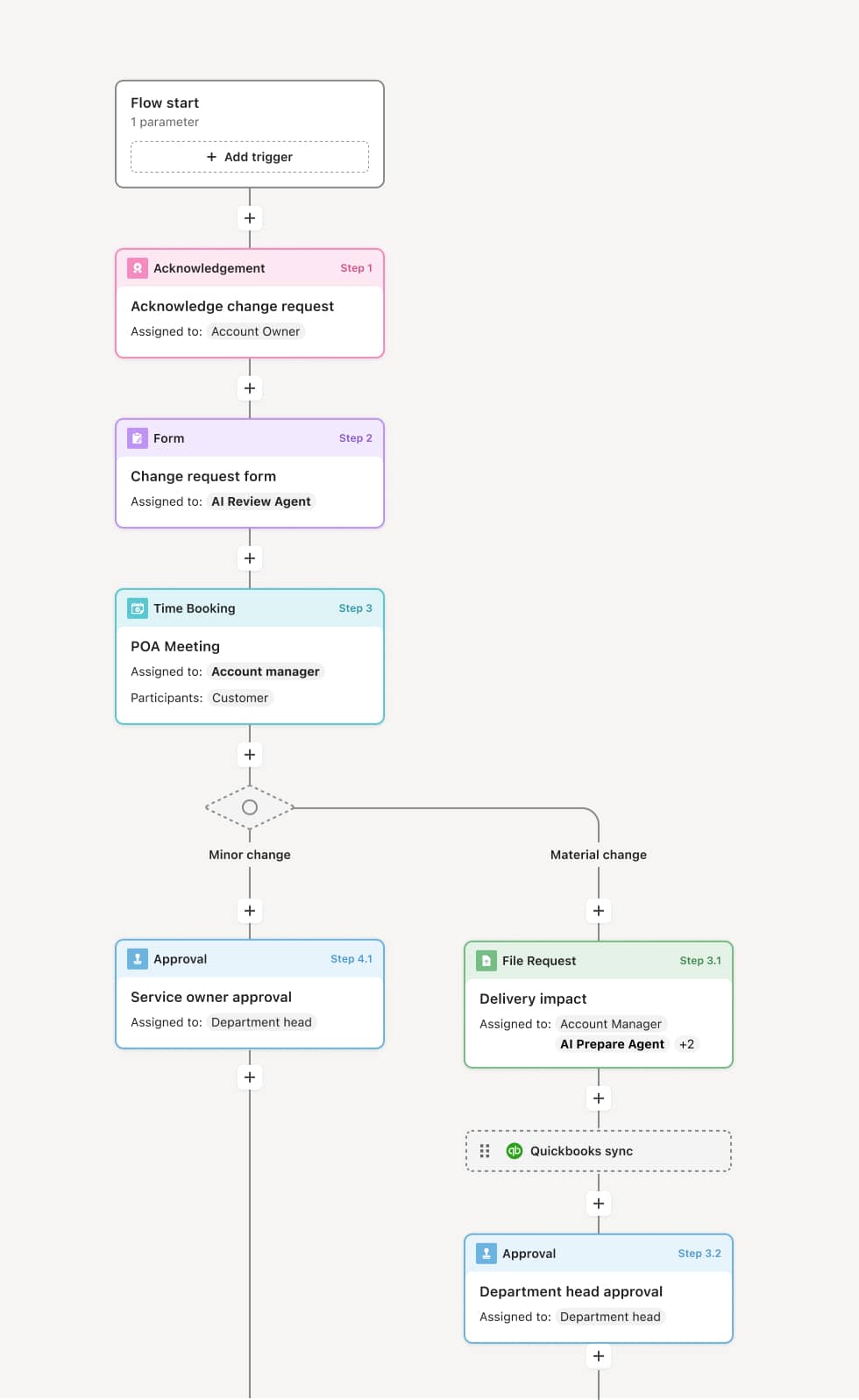
Your version of this process may vary based on roles, systems, data, and approval paths. Moxo’s flow builder can be configured with AI agents, conditional branching, dynamic data references, and sophisticated logic to match how your organization runs this workflow. The steps below illustrate one example.
Issue identification and escalation trigger
The process begins when a frontline agent or service team member determines that an issue cannot be resolved through standard procedures. This may be triggered by an SLA timer approaching its threshold, a client request for escalation, or the agent’s assessment that the issue exceeds their authority or expertise. An AI Agent can assist by evaluating the issue against escalation criteria and flagging it for review when conditions are met.
Escalation triage and classification
The escalation manager or team lead reviews the issue to confirm it warrants escalation and classifies it by severity, impact, and required expertise. The classification determines the resolution path — whether the issue routes to a specialized technical team, a senior account manager, or operations leadership. If the issue does not meet escalation criteria, it is returned to the original handler with guidance.
Assignment and investigation
The escalated issue is assigned to the appropriate resolution team or individual. The assignee receives the full issue context, including prior resolution attempts, client communications, and relevant system data. An AI Agent may prepare a summary of the issue timeline and key details to accelerate onboarding. The resolution team investigates root cause and develops a remediation plan.
Resolution and client communication
Once a resolution is identified, it is implemented and the affected client or stakeholder is notified. If the resolution requires client confirmation or additional input, the process pauses for their response. If the initial resolution is insufficient, the escalation may be elevated further or looped back for additional investigation.
Closure and post-escalation review
Upon confirmed resolution, the escalation is formally closed. The resolution details, timeline, root cause, and any preventive actions are documented. Stakeholders are notified of closure, and the escalation data is available for trend analysis and process improvement.
This process commonly relies on inputs such as the original service ticket or case record, SLA performance data, client communication history, and technical diagnostic information. It may be triggered by an SLA timer, a client escalation request, or a manual flag from a frontline agent. Connected systems often include ITSM or case management platforms like ServiceNow or Zendesk, CRM tools like Salesforce for account context, and monitoring systems for real-time service data.
Key decision points include whether the issue meets the criteria for escalation based on severity, SLA risk, or client impact, which resolution team or authority level the issue should be routed to, whether the proposed resolution adequately addresses the root cause, and whether the client confirms that the issue is resolved to their satisfaction.
Escalations triggered too late, allowing SLA breaches to occur before the issue reaches the right team. Insufficient context passed to the resolution team, forcing them to re-investigate from scratch and adding time to resolution. Unclear escalation ownership when multiple teams are involved and no single owner is accountable for driving the issue to closure. Lack of client communication during the escalation, creating the perception that the issue is being ignored even when progress is being made.
Orchestrates the full escalation lifecycle from trigger through resolution and closure across frontline teams, escalation managers, resolution groups, and clients.
Routes escalations based on severity, SLA status, and issue type so the right team is engaged immediately without manual triage delays.
AI Agents prepare escalation context by summarizing the issue timeline, prior resolution attempts, and relevant account data for the resolution team.
Keeps clients informed within the workflow so escalation status, updates, and resolution details are communicated in context rather than through disconnected emails.
Connects to ITSM and CRM platforms like ServiceNow, Zendesk, and Salesforce so escalation data stays synchronized with case records and account history.
Captures escalation patterns over time by preserving resolution details, root causes, and timelines as part of the operational record for trend analysis and prevention.