SOX compliance manager
Internal audit director
Finance controller
Chief financial officer
External audit liaison
IT compliance lead

This process is used when an organization subject to SOX requirements must review, test, and certify that its internal controls over financial reporting are effective. It applies during quarterly and annual reporting cycles when control owners must attest to the operating effectiveness of their controls, when deficiencies must be evaluated and remediated, and when management certifications must be prepared for SEC filings. It is common when internal audit, finance, IT, and executive officers must coordinate within tight regulatory deadlines. Ideal for publicly traded companies and their subsidiaries across all industries.
The SOX approval process typically involves SOX compliance managers who coordinate the testing and certification schedule, control owners across finance and IT who execute and attest to control activities, internal auditors who test control effectiveness and document findings, finance leadership who review results and assess deficiencies, and executive certifiers (CEO and CFO) who sign off on the adequacy of internal controls for regulatory filings.
On-time SOX certifications by coordinating testing, remediation, and sign-off across all control owners within regulatory filing deadlines. Fewer control deficiencies reaching external audit through structured internal testing and remediation before the external review begins. Clear control ownership so every control has an identified owner accountable for execution, testing, and attestation. Documented evidence trail that satisfies external auditors and regulators with complete records of control testing, results, and remediation. Reduced SOX program overhead by eliminating manual tracking of control status, testing results, and certification deadlines across spreadsheets and emails.
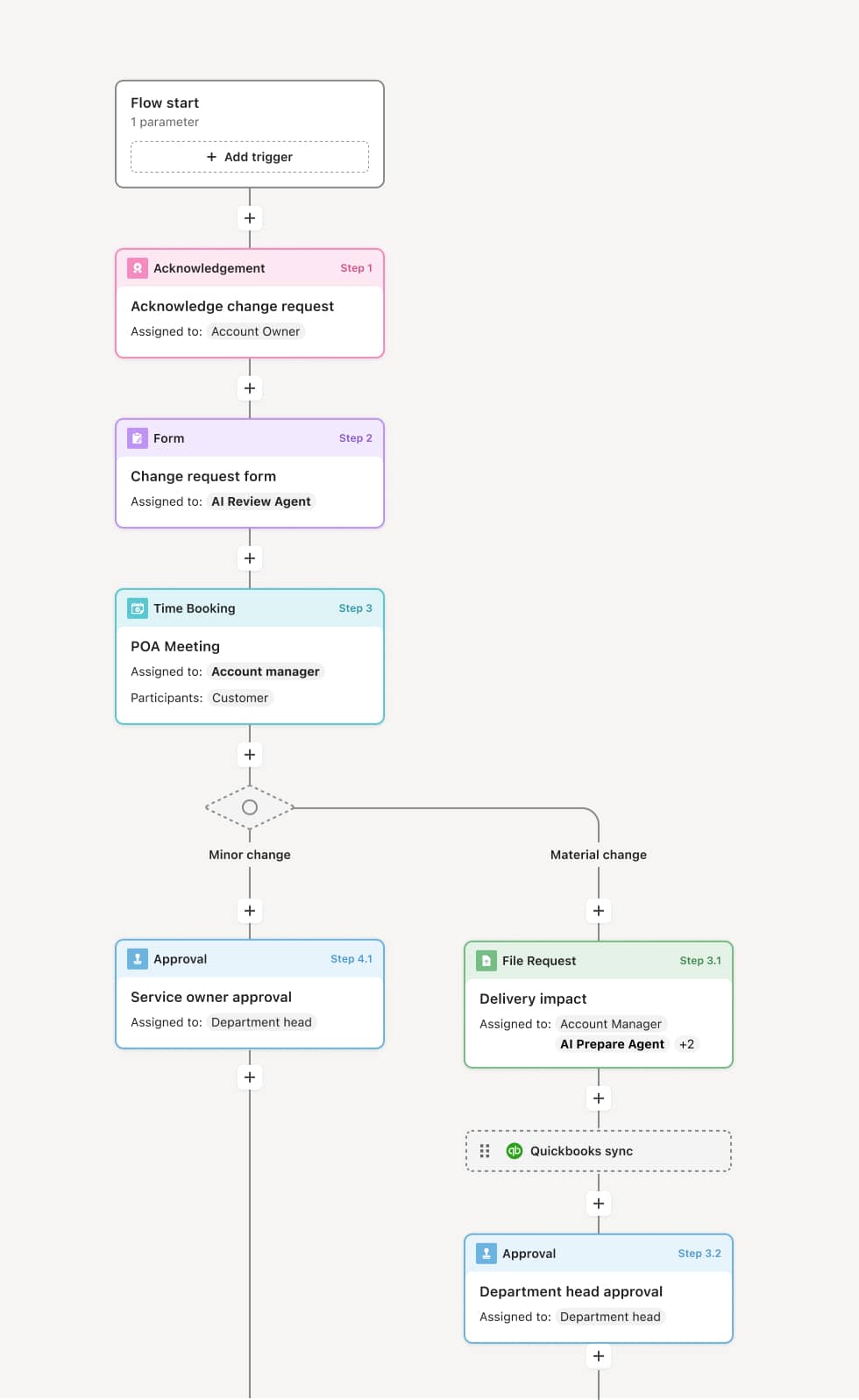
Your version of this process may vary based on roles, systems, data, and approval paths. Moxo’s flow builder can be configured with AI agents, conditional branching, dynamic data references, and sophisticated logic to match how your organization runs this workflow. The steps below illustrate one example.
Control testing initiation
The process begins when the SOX compliance manager initiates the testing cycle for a reporting period. Control owners are notified of their assigned controls, testing requirements, and deadlines. An AI Agent can assist by preparing the testing schedule with control descriptions, prior period results, and required evidence documentation for each owner.
Control execution and evidence collection
Control owners perform or confirm the execution of their assigned controls and submit evidence of operating effectiveness. Evidence may include transaction samples, reconciliation records, system access reviews, or approval documentation. An AI Agent may validate that the submitted evidence matches the expected format and completeness requirements for each control type.
Internal audit testing and evaluation
Internal audit reviews the submitted evidence, conducts independent testing where required, and evaluates whether each control is operating effectively. If a control deficiency is identified, it is classified by severity — deficiency, significant deficiency, or material weakness — and a remediation plan is required.
Deficiency remediation
For identified deficiencies, the control owner develops and implements a remediation plan. The remediation is tracked to completion, and re-testing may be required to confirm effectiveness. If a deficiency is classified as a material weakness, it is escalated to finance leadership and the audit committee.
Management review and certification
Finance leadership reviews the aggregated control testing results, deficiency status, and remediation outcomes. The SOX compliance manager prepares the management assessment for executive review. The CEO and CFO review the assessment and certify the adequacy of internal controls over financial reporting for the SEC filing.
Filing and record preservation
Upon certification, the management assessment and supporting documentation are finalized for the regulatory filing. The complete SOX record — including control testing evidence, deficiency evaluations, remediation records, and executive certifications — is preserved for external audit and regulatory review.
This process commonly relies on inputs such as the control matrix, testing procedures, evidence documentation, prior period findings, and remediation plans. It may be triggered by the quarterly or annual reporting calendar or by an internal audit planning cycle. Connected systems often include GRC platforms like Workiva, AuditBoard, or Archer for control management, ERP systems like SAP or Oracle for financial data, and document management systems for evidence storage.
Key decision points include whether submitted evidence demonstrates that a control is operating effectively, how identified deficiencies are classified by severity, whether remediation plans adequately address the root cause of deficiencies, and whether the aggregated results support an unqualified management certification of internal controls.
Late or incomplete evidence submissions from control owners, compressing the testing timeline and creating last-minute scrambles before filing deadlines. Deficiencies identified late in the cycle without sufficient time for remediation before external audit or certification. Inconsistent deficiency classification across control areas, undermining the reliability of the management assessment. Manual tracking of control status in spreadsheets that fall out of sync, making it difficult to assess overall program readiness. Certification delays when executive reviewers lack a clear, consolidated view of testing results and outstanding issues.
Orchestrates the full SOX cycle across control owners, internal audit, compliance, finance leadership, and executive certifiers in a single coordinated flow.
Routes testing assignments and evidence collection to each control owner with clear deadlines and documentation requirements.
AI Agents validate evidence completeness at submission, flagging missing or insufficient documentation before it reaches internal audit.
Tracks deficiency remediation within the workflow so remediation plans, re-testing, and closure are managed alongside the broader testing cycle.
Connects to GRC and ERP platforms like Workiva, AuditBoard, and SAP so control data, testing results, and financial records stay synchronized.
Preserves the complete compliance record including control evidence, testing results, deficiency evaluations, remediation actions, and executive certifications for external audit and regulatory review.