HR operations manager
Talent acquisition lead
Hiring manager
Compliance officer
People operations director
Background screening coordinator

This process is used when a candidate has received a conditional offer of employment and the organization requires pre-employment background screening before the hire can be finalized. It applies when the screening must include one or more checks such as criminal history, employment verification, education verification, credit history, professional license verification, or drug screening, depending on the role and organizational policy. It is common when HR, the hiring manager, the candidate, and the screening vendor must coordinate to collect consent, initiate screening, review results, and make hiring decisions within the recruitment timeline. Ideal for organizations of all sizes managing pre-employment background screening programs.
The background check process typically involves HR coordinators who manage the screening process and vendor relationship, the candidate who provides consent and personal information, the background screening vendor who conducts the checks and reports results, the hiring manager who reviews results in the context of the role, and compliance staff who ensure FCRA and state law requirements are met.
Verified candidate qualifications through independent confirmation of employment history, education, and professional credentials. Compliant screening process that meets FCRA requirements for disclosure, consent, and adverse action procedures. Informed hiring decisions based on complete screening results reviewed in the context of the specific role. Faster time-to-hire by initiating screening promptly after conditional offer and tracking results against the hiring timeline. Protected organizational risk by identifying disqualifying information before the candidate joins the organization.
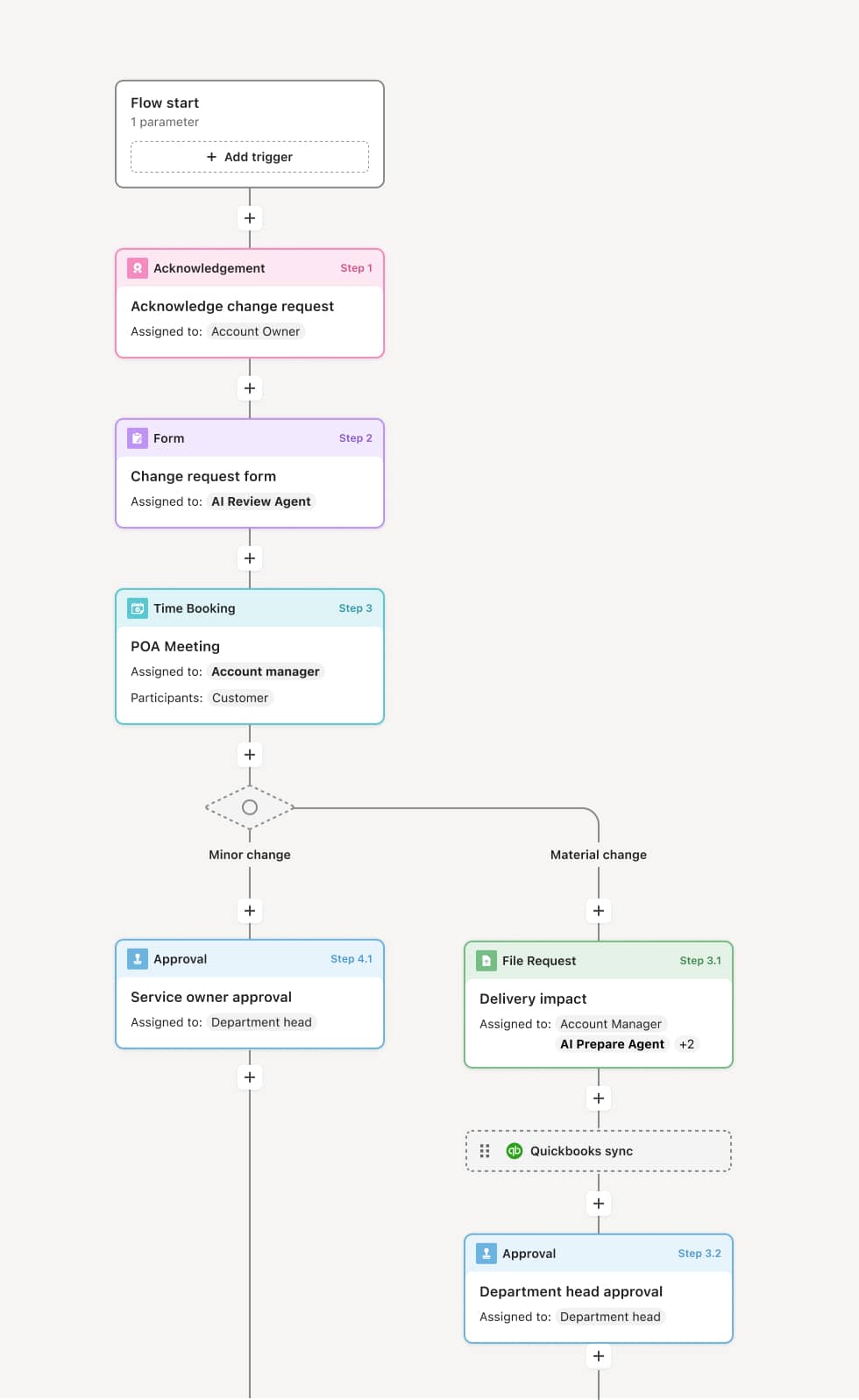
Your version of this process may vary based on roles, systems, data, and approval paths. Moxo’s flow builder can be configured with AI agents, conditional branching, dynamic data references, and sophisticated logic to match how your organization runs this workflow. The steps below illustrate one example.
Conditional offer and screening authorization
The process begins when a candidate receives a conditional offer of employment. HR provides the candidate with the FCRA-required standalone disclosure and obtains written authorization to conduct the background check. The candidate provides personal information required for screening, including full legal name, date of birth, Social Security number, and address history. An AI Agent can assist by verifying that the disclosure and authorization documents are the correct versions and that all required information has been collected.
Screening initiation
HR submits the screening request to the background check vendor, specifying the screening package based on the role and organizational policy. The screening package may include criminal history (county, state, and federal), employment verification, education verification, professional license checks, credit history, motor vehicle records, and drug screening as applicable.
Results monitoring and vendor follow-up
HR monitors the screening progress and follows up with the vendor on any pending checks. If the vendor encounters issues — such as unverifiable employment, court records requiring in-person retrieval, or unresponsive references — the team coordinates to resolve delays.
Results review and hiring decision
When results are received, HR and the hiring manager review the findings in the context of the role. If results are clear, the hire is finalized. If adverse information is identified, the organization evaluates the information against its hiring criteria, considering the nature of the finding, its relevance to the role, and the time elapsed. An AI Agent may flag results that require individual assessment based on the organization’s policy.
Adverse action process (if applicable)
If the organization is considering not hiring the candidate based on screening results, the FCRA pre-adverse action process is followed: the candidate receives a copy of the report, a summary of rights, and an opportunity to dispute the findings before a final decision is made. If the decision stands, a final adverse action notice is sent.
Hire finalization and record retention
If the screening supports the hire, the background check is documented and the onboarding process proceeds. All screening records, consent forms, and adverse action documentation (if applicable) are retained per FCRA and organizational record retention requirements.
This process commonly relies on inputs such as the candidate’s personal information, FCRA disclosure and consent forms, the screening package specification, and the vendor’s screening results. It may be triggered by a conditional offer of employment. Connected systems often include applicant tracking systems (ATS) like Greenhouse, Lever, or Workday Recruiting, background screening vendors like Checkr, Sterling, or HireRight, and HRIS platforms for hire finalization.
Key decision points include which screening components are required based on the role and organizational policy, whether adverse information identified in the screening is relevant to the role and disqualifying under organizational criteria, whether the FCRA pre-adverse action process must be initiated, and whether the candidate’s dispute of findings changes the hiring decision.
FCRA disclosure and consent not obtained before screening begins, creating legal exposure. Screening delays not tracked, extending the time-to-hire and risking candidate drop-off. Adverse information evaluated without considering job-relatedness, leading to inconsistent or legally vulnerable hiring decisions. Pre-adverse action notice not sent before making a final decision, violating FCRA requirements. Screening records not retained per FCRA and state requirements, creating compliance gaps.
Orchestrates the background check process from consent through hire finalization across HR, hiring managers, candidates, and screening vendors in a single workflow.
Engages candidates within the workflow for disclosure, consent, and information collection, ensuring FCRA-compliant documentation is captured before screening begins.
AI Agents verify that required documents and information are collected and that the correct screening package is specified for the role.
Tracks screening progress against the hiring timeline and alerts HR when vendor results are delayed or pending.
Manages the adverse action process within the workflow when applicable, ensuring pre-adverse and final adverse action notices are sent in the correct sequence.
Connects to ATS and HRIS platforms like Greenhouse, Workday, and screening vendors like Checkr and Sterling so screening status and hire decisions flow into the talent and HR systems.
Preserves the complete screening record including consent, results, decision documentation, and adverse action correspondence for FCRA compliance and retention.